

On this page
You weigh out a solid. You have a solution of known molarity. The question asks how many millilitres of that solution will just use the solid up. In a CBSE board paper or a JEE Main numerical, it runs on the same three conversions.
How do you find the volume needed to react completely?
Work in moles, because a balanced equation counts particles, not grams. NCERT's Class 11 chemistry chapter says the coefficients in a balanced equation indicate the molar ratios of the substances taking part (NCERT Class 11 Chemistry, Unit 1). The same chapter defines molarity as the number of moles of solute divided by the volume of solution in litres.
Moles of the solid: n = mass ÷ molar mass.
Moles of the reagent in solution: multiply by the mole ratio from the balanced equation (reagent over solid).
Volume: V in litres = moles of reagent ÷ molarity. Multiply by 1000 for millilitres.
LibreTexts' introductory chemistry text runs the same chain for two solutions: molarity gives moles of the known substance, the balanced equation gives moles of the unknown, and its molarity gives the volume (LibreTexts, Solution Stoichiometry/13%3A_Solutions/13.08%3A_Solution_Stoichiometry)). If step 2 feels shaky, our guide to reading mole ratios straight off a balanced equation covers it, and the all-solids version of this method is in the three-line method for mass-to-mass stoichiometry.
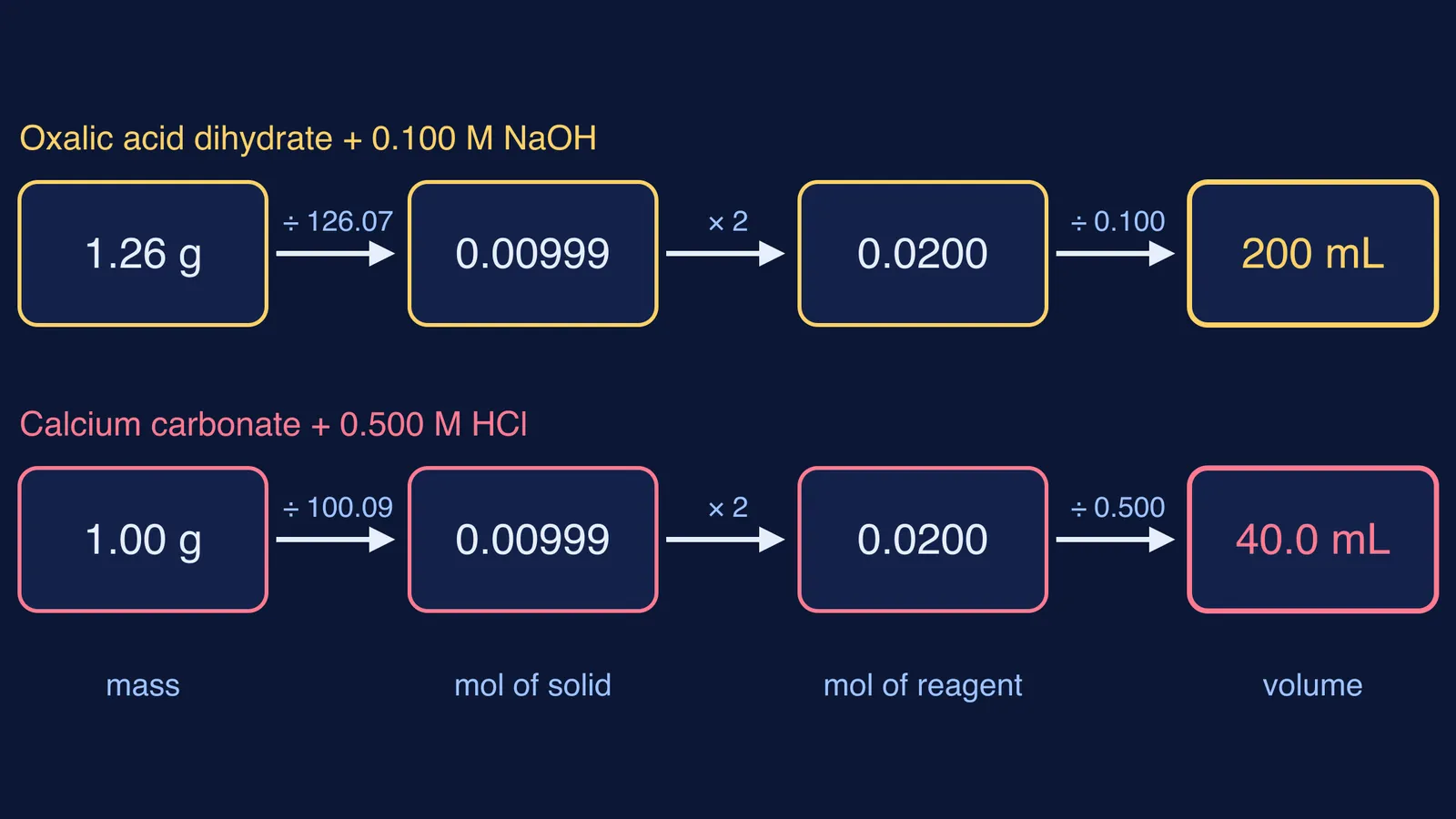
What volume of 0.100 M NaOH reacts with 1.26 g of oxalic acid?
Oxalic acid has two acidic hydrogens, and it typically occurs as the dihydrate, H₂C₂O₄·2H₂O (Wikipedia, Oxalic acid). PubChem lists oxalic acid dihydrate at 126.07 g/mol (PubChem, oxalic acid dihydrate) and anhydrous oxalic acid at 90.03 g/mol (PubChem, oxalic acid). NaOH neutralises both hydrogens, so the balanced equation is H₂C₂O₄ + 2NaOH → Na₂C₂O₄ + 2H₂O: 2 mol NaOH for every 1 mol of oxalic acid. The water of crystallisation simply joins the solvent.
Moles of oxalic acid = 1.26 g ÷ 126.07 g/mol = 0.00999 mol.
Moles of NaOH = 2 × 0.00999 = 0.0200 mol.
Volume = 0.0200 mol ÷ 0.100 mol/L = 0.200 L = 200 mL.
The same reaction is used to find the strength of an NaOH solution in the lab; see how to prepare a standard solution of oxalic acid for the weighing side.
What volume of 0.500 M HCl reacts with 1.00 g of calcium carbonate?
NCERT gives the reaction in its Unit 1 exercises: CaCO₃ + 2HCl → CaCl₂ + CO₂ + H₂O (NCERT Class 11 Chemistry, Unit 1, exercise 1.35). PubChem lists calcium carbonate at 100.09 g/mol (PubChem, calcium carbonate).
Moles of CaCO₃ = 1.00 g ÷ 100.09 g/mol = 0.00999 mol.
Moles of HCl = 2 × 0.00999 = 0.0200 mol.
Volume = 0.0200 mol ÷ 0.500 mol/L = 0.0400 L = 40.0 mL.
Both examples need 0.0200 mol of reagent, yet the volumes differ five times over. That is the molarity at work: the stronger solution delivers the same moles in less liquid.
Now run it backwards. NCERT's exercise 1.35 asks what mass of CaCO₃ reacts completely with 25 mL of 0.75 M HCl. Moles of HCl = 0.025 L × 0.75 mol/L = 0.01875 mol. Halve it for CaCO₃: 0.009375 mol. Multiply by 100.09 g/mol: 0.938 g. Same three steps, opposite direction.
Which mistakes cost marks in these problems?
NCERT files all of this under stoichiometry, the quantitative study of reactants and products (NCERT Class 11 Chemistry, Unit 1). Most lost marks come from bookkeeping, not the idea.
Forgetting the ratio. Skip the 2 in the calcium carbonate example and you get 20.0 mL, half the right answer. Write the ratio as a fraction with units: 2 mol HCl / 1 mol CaCO₃.
Millilitres in the molarity step. Molarity is per litre, so 25 mL must become 0.025 L before you multiply.
The wrong formula for the solid. Hydrates, as with oxalic acid above, change the molar mass.
Rounding too early. Keep one extra digit until the last line, then round to the significant figures in the data.
Where can you practise these steps?
Try one variation yourself: what volume of 0.250 M NaOH reacts completely with 0.630 g of oxalic acid dihydrate? Using PubChem's 126.07 g/mol (PubChem): 0.630 ÷ 126.07 = 0.00500 mol, × 2 = 0.0100 mol NaOH, ÷ 0.250 = 0.0400 L, so 40.0 mL.
If a different reaction trips you up, the Fermi Problem Library has worked problems with a step-by-step solver that explains the reasoning rather than printing an answer, so you can see which of the three conversions went wrong. If the gap is the mole itself, the Fermi Concept Library gives each chemistry concept its own lesson.
Next time you see "react completely", write the three lines before you touch the calculator: moles, ratio, volume.


