

On this page
Questions that show you a stack of cubes and ask for its views look easy, until you draw a side view the wrong way round or count a cube you cannot see. Here is one method that works both ways: solid to views, and views back to solid.
What are the top, front and side views of a solid?
NCERT's Class 7 exemplar lists looking at a shape "from different positions" (the front view, the side view and the top view) as one of the ways to view a solid (NCERT Exemplar, Unit 12). The same unit lists oblique and isometric sketches separately, as the two ways to sketch a solid on a flat surface.
A view is what you see looking straight at the solid from one direction. It has no depth, and a cube hidden behind another never shows up.
How do you draw the three views of a cube stack?
Use a height map. Look down on the stack and write, in each square of the floor plan, how many cubes stand on it.
Top view: draw one square for every floor cell with at least one cube. Keep the front row at the bottom of your drawing.
Front view: for each column running from front to back, find the largest number. Draw a tower of that height, column by column from left to right.
Side view: do the same for each row running from left to right, again taking the largest number. If you are viewing from the right, the front row appears on the left of your drawing.
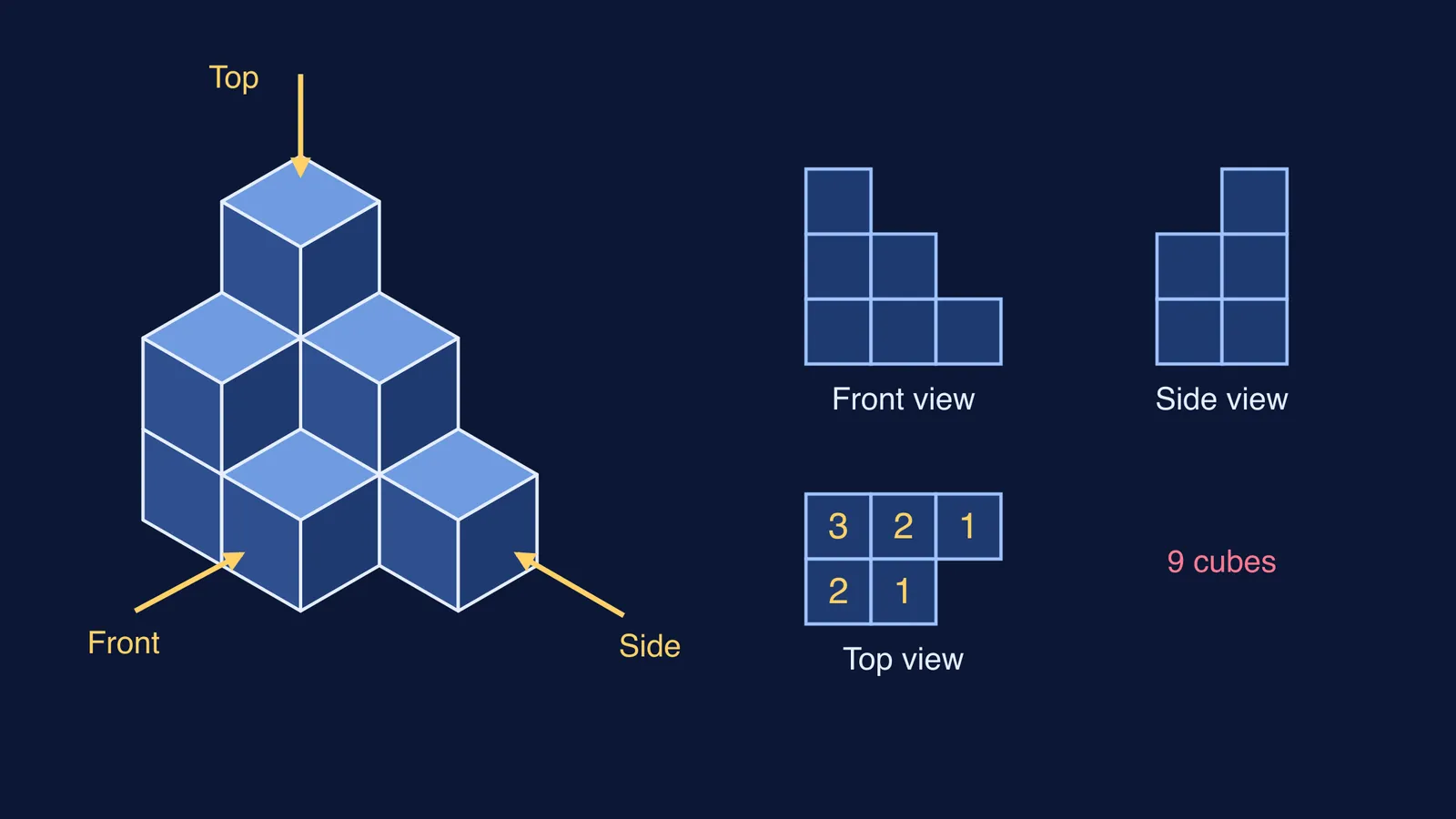
For a worked example, take the stack in the diagram above. The back row has heights 3, 2, 1 from left to right. The front row has 2, 1 and an empty cell. That is 9 cubes.
Front view: the tallest in each column is 3, 2 and 1, so you get a staircase stepping down to the right.
Side view (from the right): the front row's tallest is 2 and the back row's is 3, so a 2-tower sits on the left of a 3-tower.
Top view: five squares, three in the back row and two in the front.
The 2 at the front-left vanishes in the front view, because the 3 behind it is taller.
Can you work out the solid from its views?
Not always uniquely: different stacks can give the same three pictures. For each cell on the top view, the cell's height can be no taller than the smaller of its column's front-view height and its row's side-view height.
Most cubes: fill every cell to that limit. For our views, that gives 2 + 2 + 3 + 2 + 1 = 10 cubes.
Fewest cubes: start every cell at 1 and add only what each front and side tower needs. One 3 in the back-left and a 2 in the front-middle cover every tower, giving 3 + 2 + 1 + 1 + 1 = 8 cubes.
So three views allow anything from 8 to 10 cubes, and our 9-cube stack is one answer. If a question asks "how many cubes?" without saying "maximum" or "minimum", look for another clue, such as an isometric sketch.
What mistakes cost marks in views questions?
Drawing slanted depth lines. A view is flat; slants belong in isometric sketches.
Mirroring the side view. Write "from the right" or "from the left" next to it and check which row sits nearest you.
Counting squares in the front view as cubes. Count from the height map instead.
If nets confuse you as well, our guide to which nets fold into a cube uses the same habit of turning a solid in your head. Counting hidden faces is practised in the painted cube problem, and first-year engineering students meet these views again as formal projections in engineering drawing.
Can you get better at seeing 3-D shapes?
Yes. In a 2013 meta-analysis in Psychological Bulletin, David Uttal and colleagues pooled 217 training studies and, after removing outliers, found an average effect size of 0.47 (Hedges's g) for training compared with control groups (Uttal et al., 2013). The same abstract reports that the gains held up over delays between training and testing, and transferred to spatial tasks that were not trained directly.
A simple plan for one week:
Each day, build a stack of 6 to 10 dice or sugar cubes.
Write its height map and draw all three views without moving your head.
Then look from the front, side and top, and mark what you got wrong.
Swap with a sibling or parent: one draws three views, the other builds a stack that fits.
When you move on to textbook questions, the Fermi Problem Library has worked problems with a step-by-step solver that explains the reasoning rather than printing an answer. If the idea of a projection itself is shaky, the Fermi Concept Library gives each mathematics concept its own lesson.
Build one stack tonight, write its height map, and draw its three views before you look.


