

On this page
Explosions seem chaotic, but in physics, they follow one strict rule: momentum is conserved. When a stationary object breaks apart, it starts with zero momentum, so the vector sum of the flying fragments must cancel out to zero.
Here is how to calculate the velocity of the third fragment after an explosion using vector addition and the principles of classical mechanics.
How does momentum conservation apply to explosions?
An explosion is an internal process where potential energy converts into kinetic energy rapidly. According to the Law of Conservation of Momentum, if the net external force on a closed system is zero, the total momentum remains constant.
For a stationary body, the initial momentum is exactly zero. When it blows up into three fragments, the sum of their individual momenta must also be exactly zero:
p₁ + p₂ + p₃ = 0
Because momentum is mass times velocity (p = m × v), we can expand this equation as:
m₁v₁ + m₂v₂ + m₃v₃ = 0
If you know the mass and velocity of the first two fragments, finding the third is simply a matter of adding their vectors and reversing the direction. The internal forces pushing the pieces apart cancel each other out, ensuring that the centre of mass of the system remains exactly where it was before the explosion.
How do you find the velocity of the third fragment?
To solve a three-fragment explosion problem, you cannot just add the speeds together as scalars. Momentum is a vector quantity, so you must break the motion down into horizontal (x) and vertical (y) components.
Follow this four-step method to solve standard exam problems:
Calculate the known momenta: Find the x and y momentum components for the first two fragments using trigonometry.
Sum the vectors: Add the x components together, and add the y components together to find the total momentum of the first two pieces.
Reverse the sign: The third fragment's momentum must exactly cancel the first two. Set the third piece's x-momentum as p₃x = −(p₁x + p₂x) and its y-momentum as p₃y = −(p₁y + p₂y).
Divide by mass to find velocity: Use the formula v = p / m to find the final velocity components. Then use the Pythagorean theorem to find the total speed and an inverse tangent function to find the exact launch angle.
If you struggle with setting up these vector equations correctly, the Fermi Problem Library breaks physics questions down step by step, showing you the reasoning behind the components before calculating the final answer.
What is the velocity of the third fragment in a worked example?
Let's apply this to a real-world problem from OpenStax *University Physics*: an empty scuba tank weighing 14.4 kg sits motionless before suddenly exploding into three pieces.
Piece 1: 4.5 kg, shoots off horizontally along the x-axis at 105 m/s.
Piece 2: 3.2 kg, shoots off horizontally at 77 m/s, at a 19° angle to the first piece.
What is the mass and velocity of the third piece?
Step 1: Find the mass of the third fragment. Since the total mass of the closed system is conserved, m₃ = 14.4 − (4.5 + 3.2) = 6.7 kg.
Step 2: Find the total momentum of pieces 1 and 2.
x-direction: The first piece travels entirely along the x-axis, so its momentum is 4.5 × 105 = 472.5 kg·m/s. The second piece's x component is 3.2 × 77 × cos(19°) ≈ 233.1 kg·m/s. The total x momentum is 472.5 + 233.1 = 705.6 kg·m/s.
y-direction: The first piece has no y momentum because it travels along the x-axis. The second piece's y component is 3.2 × 77 × sin(19°) ≈ 80.2 kg·m/s.
Step 3: Find the momentum of the third fragment. To keep the total momentum at zero, the third piece must cancel out the movement of the first two pieces.
p₃x = −705.6 kg·m/s
p₃y = −80.2 kg·m/s
Using the Pythagorean theorem, the total magnitude of its momentum is √(705.6² + 80.2²) ≈ 710 kg·m/s.
Step 4: Find the velocity of the third fragment. Divide the total momentum by the mass of the third fragment to find its speed: v₃ = 710 / 6.7 ≈ 106 m/s.
Its direction is tan⁻¹(−80.2 / −705.6) ≈ 6.5° below the negative x-axis.
How to solve the classic perpendicular explosion trick?
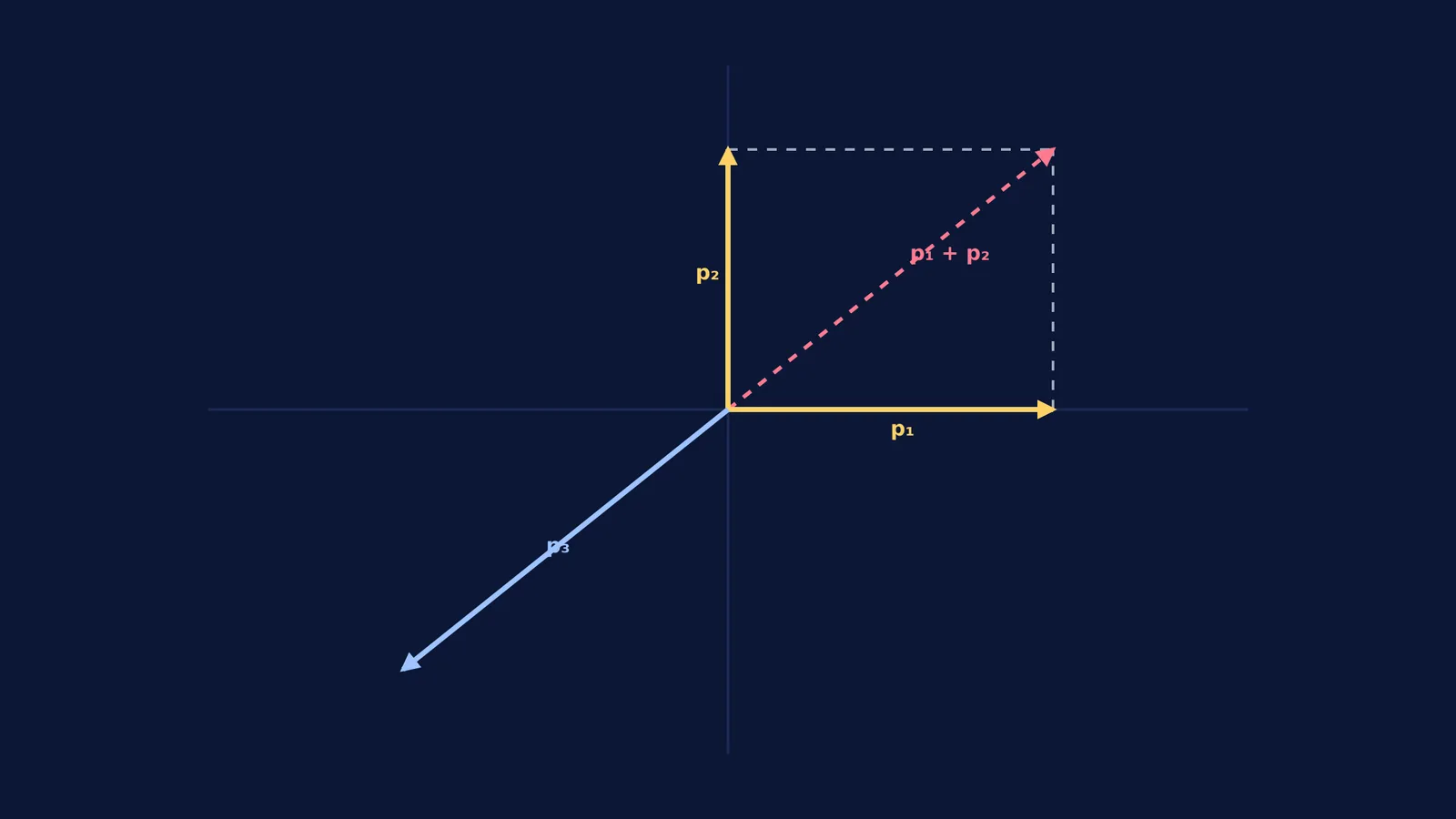
Many entrance exam questions use a specific simplified variation to test your understanding quickly: an object explodes into three pieces, and two identical fragments fly off at 90° to each other with the same speed v.
Because their momentum vectors form a right angle, their combined momentum points at exactly 45° between them, with a magnitude of p√(2). To conserve momentum, the third fragment must fly in the exact opposite direction (225° relative to the first piece) to balance the entire system.
If you are revising for exams and want to review every concept in physics, the Fermi Concept Library provides lessons for each one and its place in the map. You can also review when to use energy conservation instead of Newton's laws or read up on how to solve physics problems step by step.
Why does the kinetic energy increase?
You might notice that the initial kinetic energy was zero because the original object was at rest, but all three fragments end up with positive kinetic energy.
While momentum is strictly conserved during an explosion, kinetic energy is not. The blast converts stored potential energy—such as chemical energy in explosives or high pressure in a scuba tank—into kinetic energy. For interactive examples of how energy and momentum behave during impacts, try testing elastic vs inelastic collisions in a simulation.


