

On this page
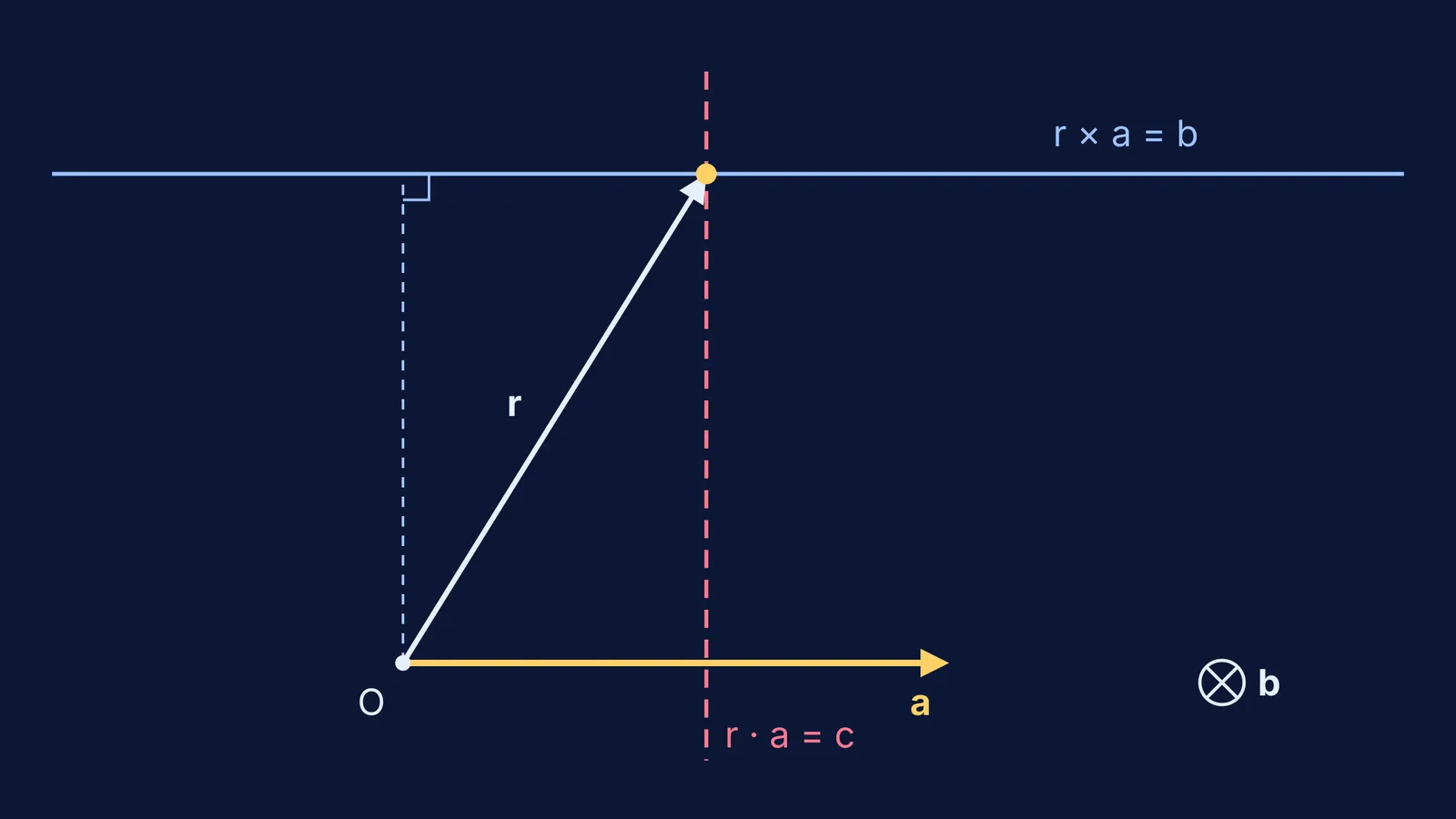
An equation like r × a = b tempts you to "divide by a". You can't. The cross product has no inverse: for a nonzero a, an equation of the form a × x = c has solutions only if a is perpendicular to c, and then it has infinitely many. So questions add a second condition, usually r · a = c, and the pair can be solved in one line.
Why can't you just divide r × a = b by a?
The NCERT Class 12 chapter on vector algebra defines a × b = |a||b| sin θ n̂, where n̂ is a unit vector perpendicular to both a and b. The same chapter notes that the cross product of two nonzero vectors is zero if and only if they are parallel, and that a × b = −b × a.
So if r works, r + 5a also works, because 5a × a is zero. On its own, r × a = b fixes a whole line of answers parallel to a. The second equation, r · a = c, picks one point on that line. It is why you cannot cancel vectors, as in the dot product cancellation trap, and why a zero cross product means parallel vectors.
How do you solve r × a = b and r · a = c step by step?
The tool you need is the vector triple product expansion: a × (b × c) = (a · c)b − (a · b)c.
Dot both sides with a. The left side, (r × a) · a, is zero because r × a is perpendicular to a. Geometric meaning: b must be perpendicular to a (a · b = 0), or no r exists.
Cross both sides with a, from the left. You get a × (r × a) = a × b. Geometric meaning: crossing with a throws away the part of r along a and keeps the part perpendicular to a, scaled by |a|².
Expand the left side. a × (r × a) = (a · a)r − (a · r)a = |a|²r − (a · r)a.
Feed in the dot equation. Replace a · r with c: |a|²r − c a = a × b.
Solve. r = (a × b + c a)/|a|².
Read the answer as a picture. The piece (a × b)/|a|² is the foot of the perpendicular from the origin to the line of solutions. The piece c a/|a|² is the slide along a that the dot equation chooses.
Worked example: a = i + 2j + 2k
Solve r × a = −2i − 5j + 6k and r · a = 5.
Check: a · b = −2 − 10 + 12 = 0, so a solution exists.
|a|² = 1 + 4 + 4 = 9.
a × b = (2·6 − 2·(−5))i + (2·(−2) − 1·6)j + (1·(−5) − 2·(−2))k = 22i − 10j − k.
c a = 5i + 10j + 10k.
r = (27i + 0j + 9k)/9 = 3i + k.
Now plug it back. r · a = 3 + 0 + 2 = 5. r × a = (0·2 − 1·2)i + (1·1 − 3·2)j + (3·2 − 0·1)k = −2i − 5j + 6k. Both equations hold.
What if the equation is r × a = b × a, or the second condition is r · d = c?
Type 1: r × a = b × a. Rearrange: (r − b) × a = 0. A zero cross product means r − b is parallel to a, so r = b + t a. Geometric meaning: the line through the point b, parallel to a. A second condition such as r · d = 0 then gives t = −(b · d)/(a · d).
Type 2: r × a = b with r · d = c. Write the general solution r = (a × b)/|a|² + t a, then dot with d to find t = [c − d · (a × b)/|a|²]/(a · d). Geometric meaning: the plane r · d = c cuts the line in one point, unless a · d = 0 and the line runs parallel to it.
A checklist before you write the final answer
Is a · b = 0? If not, write "no solution" and stop.
Did you cross the same side, in the same order, on both sides?
Did you replace a · r with c before dividing by |a|²?
Does your r satisfy both original equations when you plug it back?
For more practice, the Fermi Problem Library has worked problems with a step-by-step solver that explains the reasoning rather than printing an answer, so you can see where a sign went wrong.
Next, see how dot and cross fit together in Lagrange's identity for the cross and dot product.


