

On this page
If a statistics question hands you numbers that rise in equal steps, skip the long table. Every arithmetic progression (AP) has a one-line variance, and the first term plays no part in it.
What is the variance of numbers in arithmetic progression?
The NCERT Class 11 textbook defines variance as the mean of the squares of the deviations from the mean, σ² = (1/n)Σ(xᵢ − x̄)² (NCERT Mathematics Class 11, Chapter 13, Statistics).
Apply that definition to the n terms a, a + d, a + 2d, ..., a + (n − 1)d and you get:
Variance = d²(n² − 1)/12
Standard deviation = |d| × √((n² − 1)/12)
Only two things matter: the common difference d and the number of terms n. The first term a is missing, and so is the sign of d, because d appears squared.
Why does the first term a not matter?
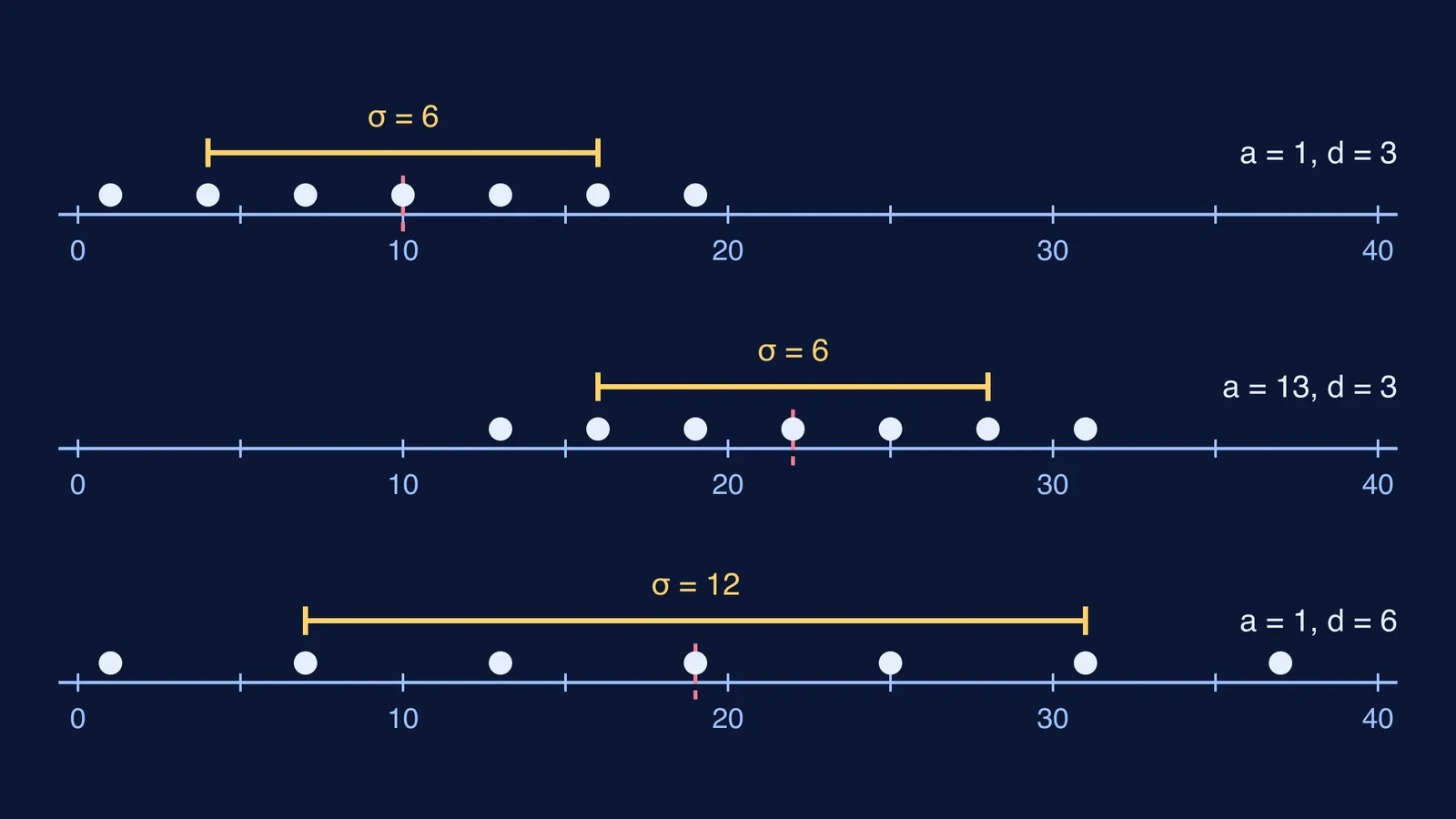
Variance measures how far the numbers sit from their own mean. If you add the same number to every term, the whole set slides along the number line. The mean slides by the same amount, so every gap between a term and the mean stays the same. The AP 1, 4, 7, ..., 19 and the AP 13, 16, 19, ..., 31 have the same spread, as the diagram above shows. You can read more on how adding or multiplying by a constant changes mean and variance.
Multiplying is different. Doubling d doubles every gap, and squaring the gaps makes the variance four times as large. That is why d enters as d².
How do you prove the variance is d²(n² − 1)/12?
Write the k-th term as xₖ = a + (k − 1)d, for k = 1, 2, ..., n.
Find the mean. In an AP it is the average of the first and last terms: x̄ = a + (n − 1)d/2.
Find each deviation: xₖ − x̄ = (k − 1)d − (n − 1)d/2 = d(k − (n + 1)/2). The a has cancelled.
Square and average: σ² = d² × (1/n)Σ(k − (n + 1)/2)². The part after d² is just the variance of 1, 2, ..., n, whose mean is (n + 1)/2.
Find that variance with the shortcut Σk²/n − (mean)². NCERT uses the result that the sum of squares of the first n natural numbers is n(n + 1)(2n + 1)/6 (NCERT Class 11, Chapter 13). So the variance is (n + 1)(2n + 1)/6 − (n + 1)²/4 = (n + 1)[2(2n + 1) − 3(n + 1)]/12 = (n + 1)(n − 1)/12.
Put it back: σ² = d²(n² − 1)/12.
Step 4 is the variance of the first n natural numbers; the AP formula scales it by d².
Does the formula match NCERT's worked examples?
Both checks come from the same chapter (NCERT Class 11, Chapter 13).
Example 8 asks for the variance of 6, 8, 10, ..., 24. NCERT's table gives a sum of squared deviations of 330 for n = 10, so the variance is 33. With the formula: n = 10, d = 2, so 4 × (100 − 1)/12 = 33.
Set B in Section 13.5 is the 31 numbers 15, 16, ..., 45. NCERT gets 2480/31 = 80. With the formula: n = 31, d = 1, so (961 − 1)/12 = 80.
Practice: four quick AP variance problems
Find the variance of 7, 12, 17, 22, 27. Here n = 5 and d = 5, so 25 × 24/12 = 50. Check directly: the deviations from the mean 17 are −10, −5, 0, 5, 10, their squares add to 250, and 250/5 = 50.
Find the variance of the first 50 even natural numbers. That is 2, 4, ..., 100, so n = 50 and d = 2: 4 × 2499/12 = 833.
An AP with common difference 3 has variance 90. How many terms does it have? 9(n² − 1)/12 = 90 gives n² − 1 = 120, so n = 11.
Find the variance of 40, 37, 34, ..., 1. First count the terms: n = (1 − 40)/(−3) + 1 = 14 (see how to count the terms of an AP). Then d² = 9, so the variance is 9 × 195/12 = 146.25. The negative d makes no difference.
If problem 4 went wrong, the slip is usually in n, not the formula. The Fermi Problem Library has worked problems with a step-by-step solver that explains the reasoning, so you can see where your working went a different way. If variance itself feels shaky, the Fermi Concept Library gives each mathematics concept its own lesson and its place in the map.
When can you use this shortcut?
Only when every term appears once and the gaps are equal. With frequencies or uneven gaps, use the full definition. Next time you see equally spaced data, write down n and d first.


