

On this page
Understanding Media is Chapter 6 of NCERT’s Class 7 civics book, Social and Political Life II. Here are its three big ideas, then a check you can run on any advert.
One thing to know first: from 2025-26 NCERT began replacing that book and the Class 7 history and geography books with one integrated textbook, Exploring Society: India and Beyond (The Wire, 28 April 2025). Check with your teacher which book your school follows.
What is media in Class 7 NCERT?
In the textbook, media is the plural of “medium” and means the various ways we communicate in society, from a phone call to the evening news on TV (NCERT, Social and Political Life II, Chapter 6). TV, radio and newspapers reach millions of people, so they are called mass media. Newspapers and magazines are print media; TV and radio are electronic media.
Who pays for the media?
Studios, cameras, satellites and staff are expensive, so most television channels and newspapers are part of big business houses, the chapter explains (NCERT Chapter 6). A photo caption in the same chapter says a TV advert costs ₹1,000 to ₹1,00,000 per 10 seconds, depending on how popular the channel is and the time.
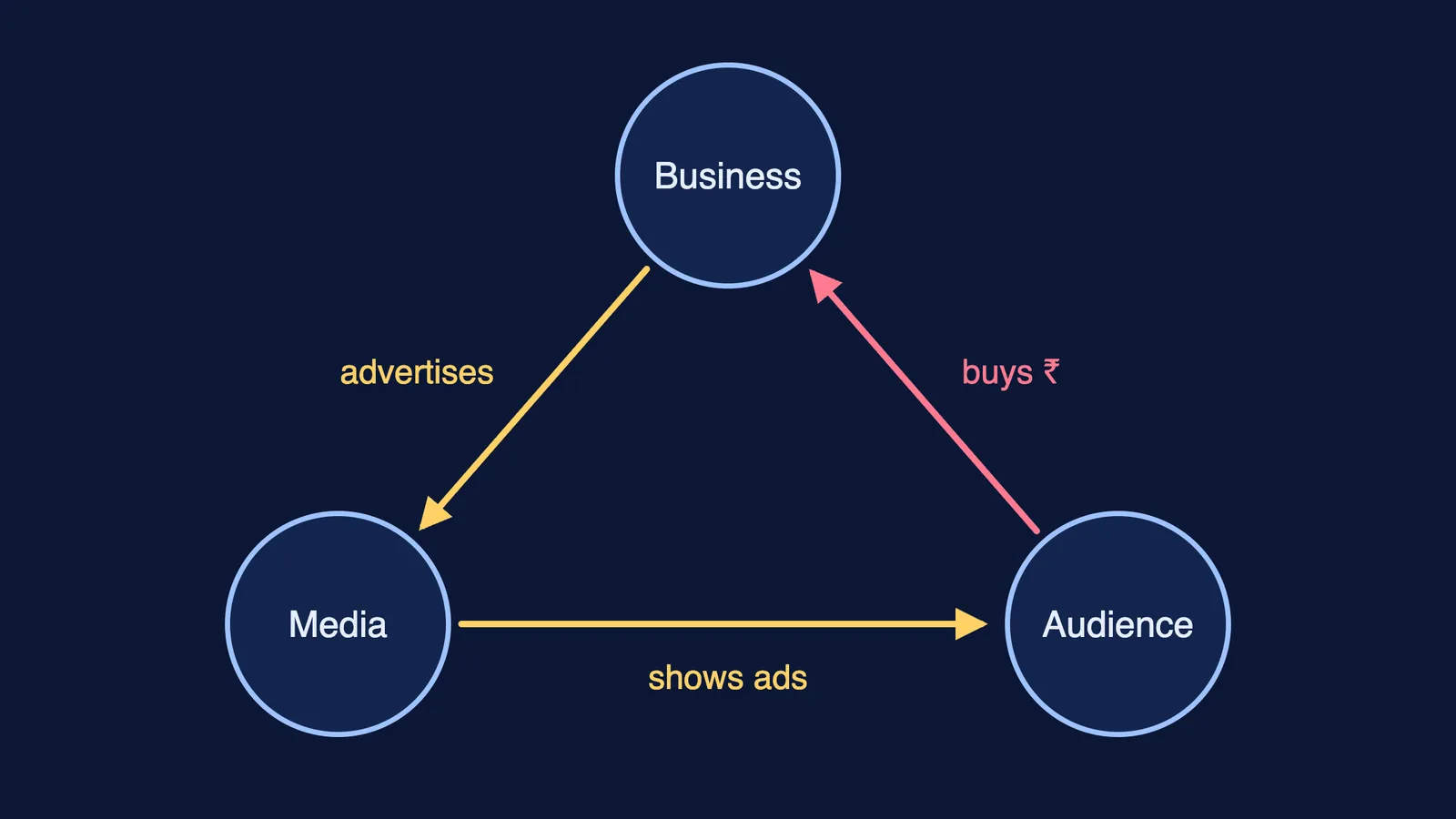
Adverts are one way the media earns. The chapter draws this as a loop, shown at the top of this page:
Big business houses advertise their products in the media, and some own TV, radio or newspapers.
The media promotes those products to readers, viewers and listeners.
People buy what they saw, and money flows back to the businesses.
The catch: a media house that needs advertisers finds it hard to report against them, so NCERT says the media is no longer considered independent, because of its close links to business.
How does the media set the agenda?
Setting the agenda means the media decides which stories to focus on, and so decides what is newsworthy (NCERT Chapter 6). Your school’s annual function is unlikely to make the news. Invite a famous actor as chief guest and it might.
Reporting on pesticides in cola drinks helped people. But a well-known journalist, the chapter says, wrote that in the week Fashion Week filled the front pages, slum demolitions in Mumbai were not even noticed.
Three more terms:
Balanced report: discusses all points of view and leaves readers to make up their minds.
Censorship: the government stopping a news item, film scenes or song lyrics from reaching the public; the book calls the Emergency of 1975–1977 the worst such period.
Local media: community radio, or Khabar Lahriya, a fortnightly paper run by Dalit women in Chitrakoot district, Uttar Pradesh.
How do adverts persuade, and who checks them?
Adverts are repeated in the hope that you will buy what is advertised, the chapter notes. Two bodies that check whether ads in India are fair are ASCI and the CCPA.
The Advertising Standards Council of India (ASCI) runs a code that requires ads to be legal, decent, honest and truthful (ASCI Annual Complaints Report 2024-25). In 2024-25 ASCI scrutinised 7,199 ads, and 98% of them needed some change. ASCI reported that 56% of ads were found misleading, and digital ads made up 94.4% of those it processed.
The government’s Central Consumer Protection Authority issued guidelines in 2022 (PIB, 10 June 2022). For ads aimed at children, they forbid exaggerating a product so that children form unrealistic expectations, and making health or nutrition claims that a recognised body has not scientifically backed. A misleading ad can cost the maker, advertiser or endorser up to ₹10 lakh, and up to ₹50 lakh for a repeat.
Worked example: a five-step advert check
Take an invented ad. A cartoon cricketer says: “Drink PowerMalt and grow taller, smarter, stronger!”
Who paid? The company that makes PowerMalt.
What feeling is it selling? Winning, being liked, a parent’s worry about growth.
What exactly is claimed? “Taller” and “smarter”. Has a recognised body backed these claims? If not, the 2022 guidelines say an ad aimed at children should not make them.
What is missing? Sugar, price, and taller compared with what.
Commercial or social? NCERT separates selling ads from social advertisements, which carry a larger message for society, such as safety at railway level crossings.
If percentages in ad claims trip you up, the Fermi Concept Library has a lesson for every concept in mathematics.
How can parents help with this chapter?
Watch one ad break together and ask the five questions aloud. Compare two newspapers on one story, the chapter’s own class project. Later topics build on this: the six consumer rights and COPRA in Class 10, why democracy matters in Class 9, and how to spot fake AI study tips on reels.
Tonight, take one advert you saw today and run all five steps on it.


