

On this page
The atomic radius table in your NCERT Class 11 chemistry textbook, Unit 3 gives chlorine as 99 pm. A van der Waals table such as the one on Wikipedia gives 175 pm. Neither is wrong: they are different radii. Below: how each is measured, why van der Waals is largest, and how to pick the right one in a board or JEE question.
What are covalent, metallic and van der Waals radii?
NCERT explains that the electron cloud "does not have a sharp boundary", so chemists estimate an atom's size from the distance between atoms. Change which distance you measure and you get a different radius.
Covalent radius is half the distance between two atoms joined by a single covalent bond (NCERT, Unit 3).
Metallic radius is half the distance between the metal cores in a metallic crystal (NCERT, Unit 3).
Van der Waals radius is half the distance between two atoms that are not bonded but are brought together by intermolecular forces (LibreTexts, Atomic Radius).
Ionic radius, for ions rather than neutral atoms, is estimated from the distances between cations and anions in ionic crystals (NCERT, Unit 3).
How is each radius measured?
Each halves a distance between two nuclei. What changes is which pair you measure.
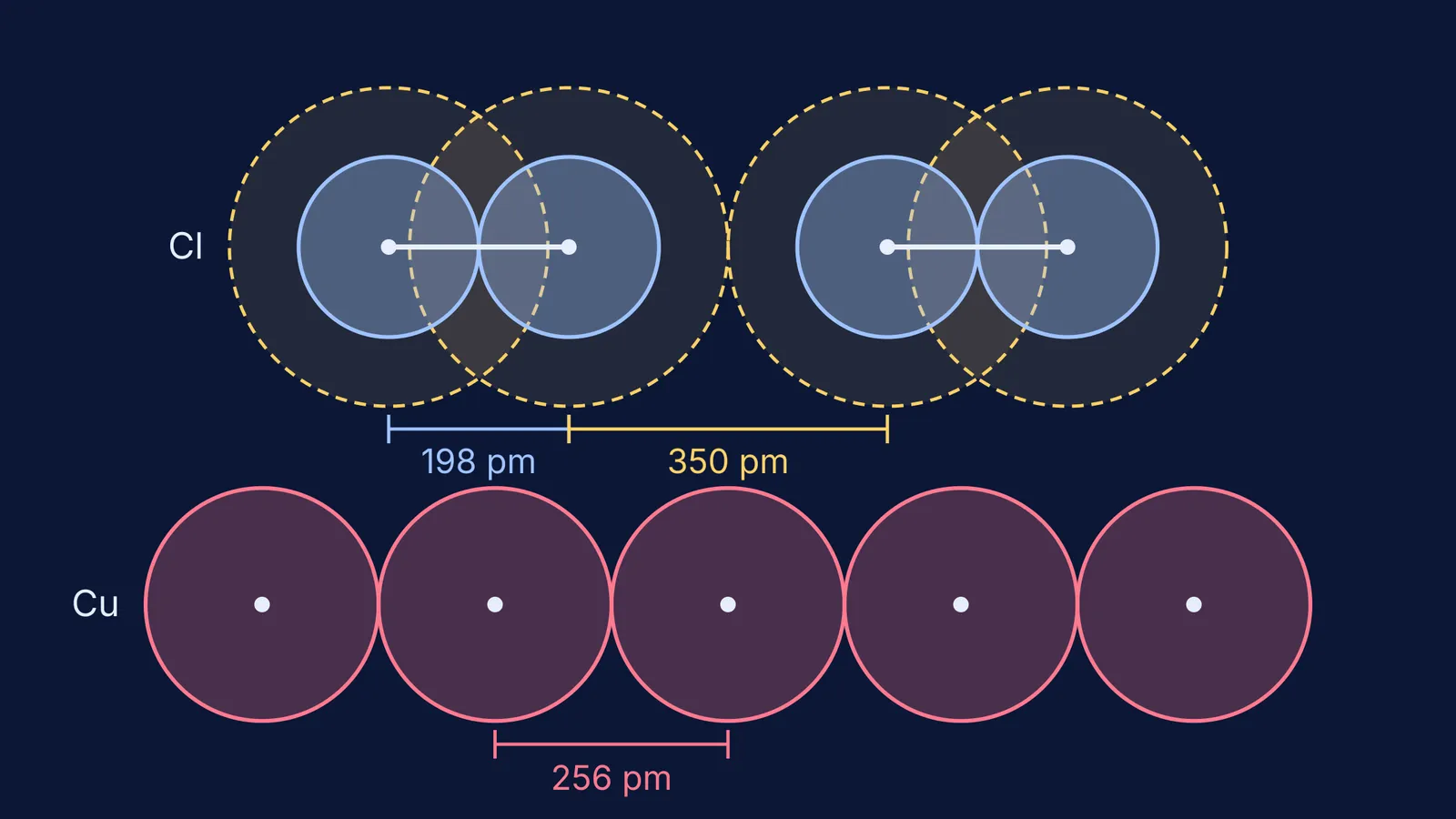
Covalent: measure a bond length. NCERT gives the bond distance in Cl2 as 198 pm, so chlorine's covalent radius is 99 pm.
Metallic: measure the spacing in the solid metal. Adjacent copper atoms in solid copper are 256 pm apart, so copper's metallic radius is 128 pm (NCERT).
Van der Waals: find how close atoms from different molecules get. Methods include crystal spacings, the van der Waals constant b, polarizability and molar refractivity, and they give similar but not identical values (van der Waals radius overview). A widely cited set comes from A. Bondi's 1964 paper van der Waals Volumes and Radii; the Bondi table on that overview page lists chlorine at 1.75 Å, or 175 pm.
Why is van der Waals radius the largest?
Because no electrons are shared. In a covalent bond, two atoms share an electron pair, so their electron clouds overlap and their nuclei sit close together. Atoms in separate molecules are held only by weak attractions, and repulsion between their filled electron clouds stops them much farther apart.
A worked example with the chlorine figures from NCERT and the Bondi table:
Two bonded chlorine atoms in one Cl2 molecule: 2 × 99 = 198 pm apart.
Two chlorine atoms from neighbouring molecules at van der Waals contact: 2 × 175 = 350 pm apart.
The same atom looks 175 ÷ 99, about 1.8 times, bigger when measured the van der Waals way.
Metallic radius is also a bonded radius: atoms in a metal share their outer electrons across the crystal. Our post on why metals bend and ionic crystals shatter explains that electron sea.
Which radius should you use when comparing elements?
Compare like with like. NCERT uses "atomic radius" to mean the covalent radius for non-metals and the metallic radius for metals. It also says noble gas radii "should be compared not with the covalent radii but with the van der Waals radii of other elements".
Ask three questions before comparing two sizes:
Is it a neutral atom or an ion? Ions need ionic radii. NCERT gives fluorine as 64 pm but the fluoride ion as 136 pm, and sodium as 186 pm but Na+ as 95 pm.
How does the element exist? Non-metal in a molecule: covalent. Metal: metallic. Monatomic noble gas: van der Waals.
Are both numbers the same type? If not, swap one before reading a trend.
Worked example: why does argon look so much bigger than chlorine? NCERT's 99 pm for chlorine is a covalent radius. Argon is monatomic, so tables give its van der Waals radius, 188 pm in the table of van der Waals radii on Wikipedia. Comparing 99 with 188 mixes two definitions. Like for like, chlorine's van der Waals radius is 175 pm in the same table, so the gap shrinks from 89 pm to 13 pm. Most of the jump comes from switching definitions.
How do you practise this before an exam?
In rough work, label each radius with its type, for example Cl (cov) 99 pm or Ar (vdW) 188 pm. Then take three size-order questions from your NCERT exercises and name the radius type of each value before answering.
If the definitions still blur together, the Fermi Concept Library gives each chemistry concept its own lesson and its place in the map. For size-order questions you get wrong, the Fermi Problem Library has worked problems with a step-by-step solver that explains the reasoning rather than printing an answer.
Once the types are clear, the trends follow. Read how metallic character changes across a period and down a group, then see why bond length is the starting point for covalent radius in the relation between bond order and bond length.


