

On this page
It is a classic in physics and maths problem sets: two runners, cyclists or particles start from the same point on a circular track, so when do they meet? Many students reach for distance formulas and then get stuck on the circle. One idea fixes it: track the angle between the two runners, not where each one is.
What is relative angular speed?
Angular speed ω is the rate at which the angle θ changes as a particle moves along its circular path, measured in radians per second (OpenStax University Physics, Section 10.1). That same section gives the link to ordinary speed, v = rω, and notes that 360° equals 2π radians. So one full lap is an angle of 2π.
Relative motion in a straight line works by combining velocities: how fast A moves relative to B is A's velocity minus B's (OpenStax University Physics, Section 4.5). On a circle, angles do the same job. From B's point of view, B is still and A goes round at the relative angular speed.
Same direction: ωrel = ωA − ωB
Opposite directions: ωrel = ωA + ωB
When do two particles moving on a circular track meet?
They meet each time the angular gap between them reaches 2π.
Same direction: t = 2π / (ωA − ωB). The faster runner gains one full lap.
Opposite directions: t = 2π / (ωA + ωB). Together they cover one lap.
Since ω = v/r and the lap length is L = 2πr, both formulas turn into distances: t = L / (vA − vB) for the same direction and t = L / (vA + vB) for opposite directions. If the question gives rpm or lap times, work in angles. If it gives m/s and a track length, work in distances.
Worked example: a 400 m track
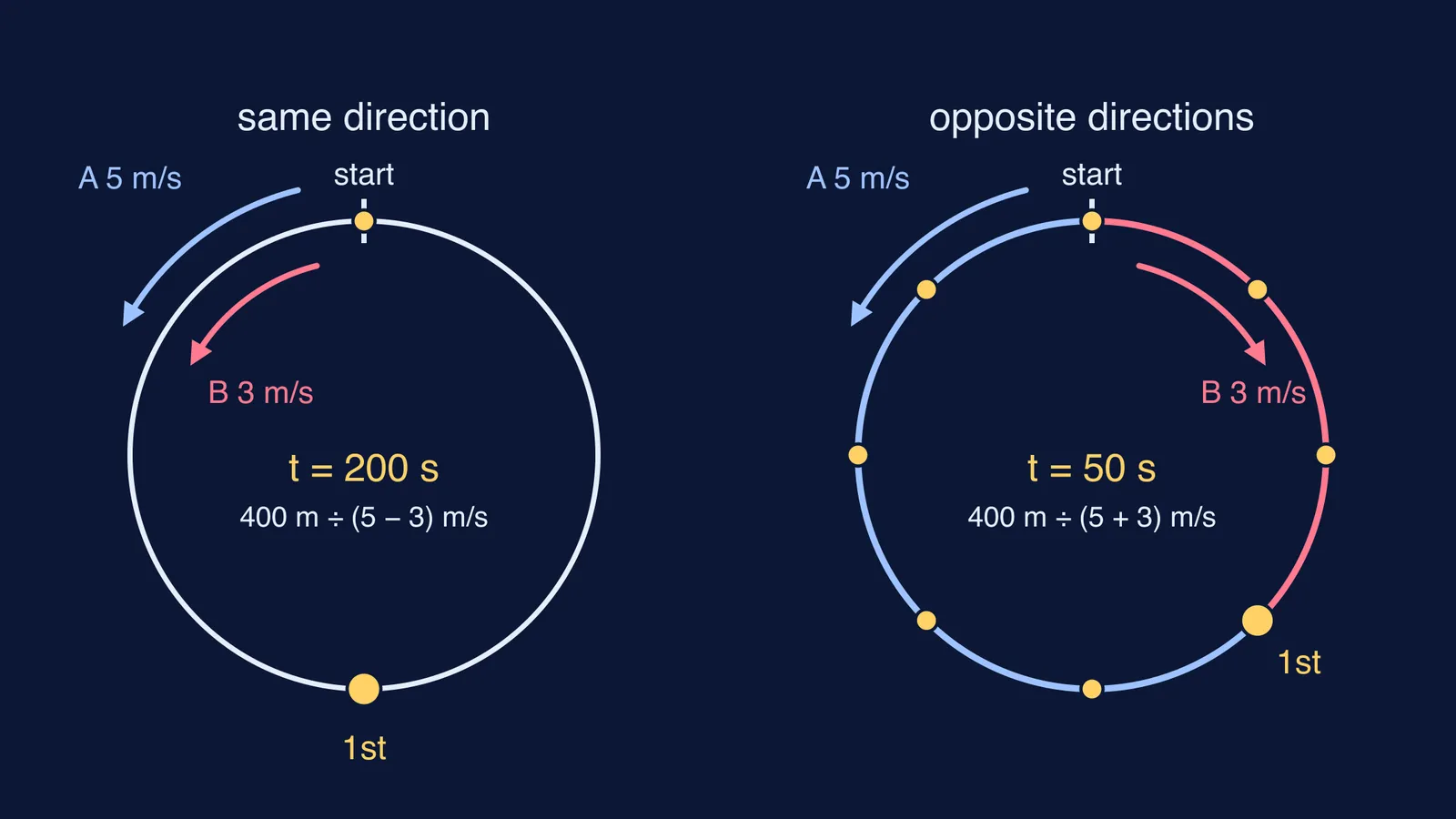
Runner A runs at 5 m/s and runner B at 3 m/s. They start together on a 400 m track.
Angular speeds. The radius is r = 400/2π m, so ωA = 5/r = π/40 rad/s and ωB = 3/r = 3π/200 rad/s.
Same direction. ωrel = π/40 − 3π/200 = π/100 rad/s, so t = 2π ÷ (π/100) = 200 s. Check it with distances: 400 ÷ (5 − 3) = 200 s. By then A has run 1000 m (2.5 laps) and B 600 m (1.5 laps), so they meet halfway round, directly across from the start.
Opposite directions. ωrel = π/40 + 3π/200 = π/25 rad/s, so t = 2π ÷ (π/25) = 50 s. A has run 250 m and B 150 m, which add up to one lap.
Both back at the start together. A's lap takes 80 s and B's takes 400/3 s. The first time that is a whole number of laps for both is 400 s, when A has done 5 laps and B 3.
How many different points do they meet at?
For runners who start together, write the speeds as a ratio a : b in lowest terms. Here that is 5 : 3. Running the same way, they meet at a − b = 2 different points. Running opposite ways, they meet at a + b = 8 different points, spaced evenly around the track. Each pattern repeats every 400 s, when both runners are back at the start (200 s × 2 and 50 s × 8).
The minute and hour hands of a clock are the same-direction case with fixed speeds. Our guide to the angular speed of clock hands works through it. For the straight-line version, see solving chase and catch-up problems.
Where else does this idea appear in physics?
The same rule works for planets. NASA lists Venus's sidereal orbital period as 224.701 days, Earth's as 365.256 days, and Venus's synodic period (the time between repeats of the same Venus–Earth alignment) as 583.92 days (NASA Venus Fact Sheet). Both planets orbit the same way, so subtract the angular speeds: 1 ÷ (1/224.701 − 1/365.256) gives one meeting every 583.9 days, which matches NASA's value.
What mistakes cost marks here?
Mixing rad/s with m/s in the same subtraction. Convert first.
Subtracting when the runners move in opposite directions.
Forgetting the head start. If B starts ahead of the faster runner A by an angle θ0, the first meeting comes at θ0 / ωrel. After that, they meet every 2π / ωrel.
Confusing "first meeting anywhere" with "first meeting at the start". The second one needs the LCM of the lap times.
If your answer keeps coming out wrong, the Fermi Problem Library has worked problems with a step-by-step solver that explains the reasoning rather than printing an answer. To brush up on angular velocity itself, look it up in the Fermi Concept Library, where each concept has its own lesson.


