

On this page
It is one of the most common heights and distances problems in Class 10 mathematics: two poles of equal height stand on opposite sides of a road. You are given the width of the road and the angles of elevation from a point between the poles. How do you find the height of the poles and where the observation point is?
If you are preparing for your board exams, you will almost certainly face a variation of this question. It tests your ability to read a word problem, draw an accurate right-angled triangle diagram, and solve two simultaneous equations using basic trigonometric ratios.
What is the two poles on opposite sides of a road problem?
The standard version of this problem, found in the NCERT Class 10 mathematics textbook, asks you to find the height of two equal poles on an 80-metre wide road, given angles of elevation of 60° and 30° from a point between them.
Because the poles have the same height, the observation point cannot be exactly in the middle of the road. The pole that looks taller (producing the 60° angle of elevation) must be physically closer to the point than the pole that looks shorter (producing the 30° angle). As you walk closer to a tall object, you have to tilt your head further back to see the top, which increases the angle of elevation.
If you find it hard to picture the problem, Fermi's AI tutor can draw the figure, run the simulation, and check your understanding as it goes. For more on how angles change with distance, the Heights and distances visualised: watch the angle of elevation grow tool is a helpful guide.
How do you set up the two right triangles?
Every heights and distances problem becomes easier when you draw a clear diagram before writing any equations.
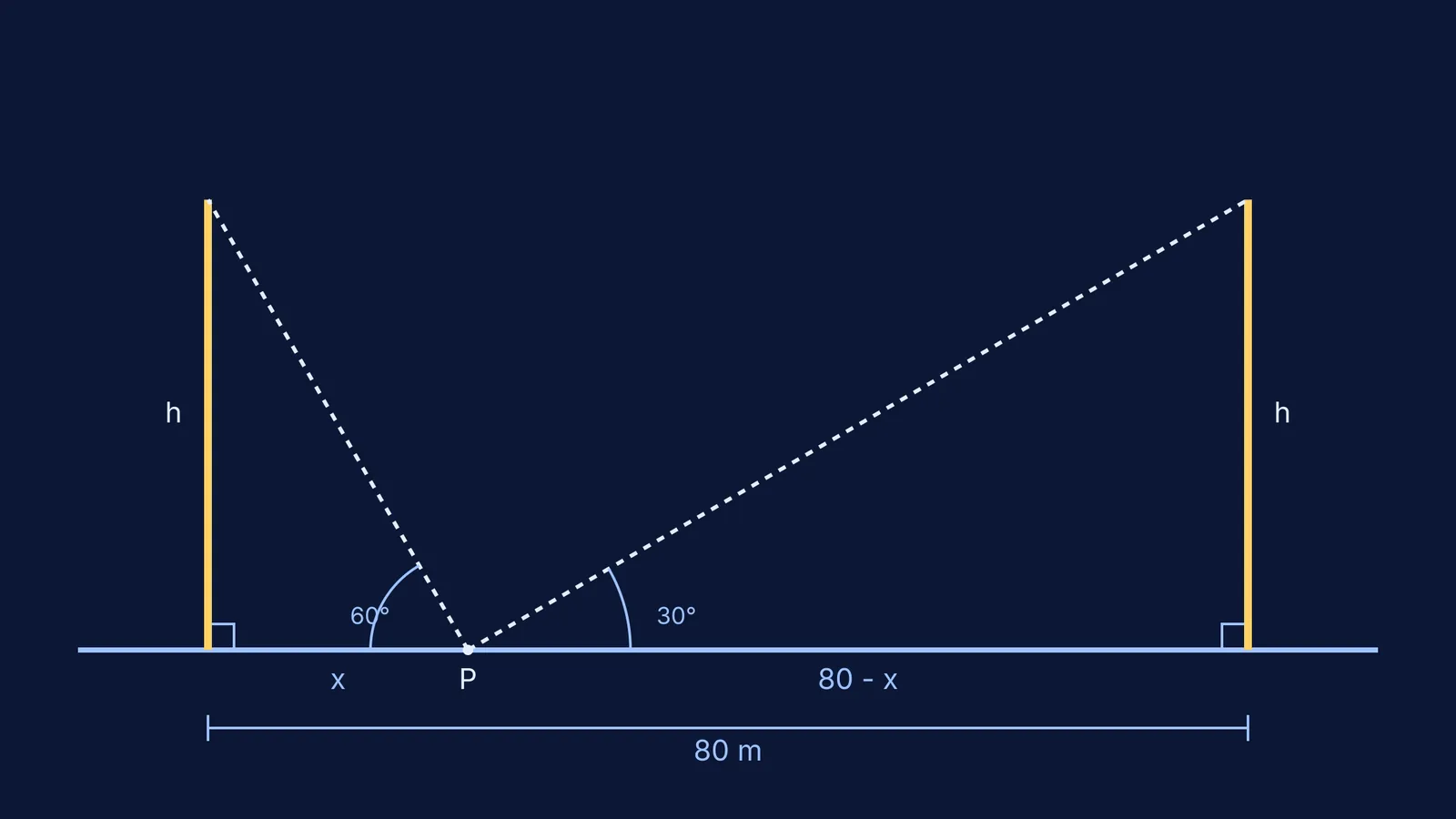
Let the height of each pole be *h*. Let the width of the road be 80 m. Let the point on the road be *P*.
If *P* is at a distance *x* from the first pole, its distance from the second pole must be 80 − *x*. This ensures that the two distances add up to the total width of the road.
This setup gives you two right-angled triangles that share the same unknown height *h*. In trigonometry, when two triangles share a side, you can write an equation for that side in both triangles and solve them together. The Ratio of Areas of Triangles with Same Height: The Base Rule post explains why shared heights are so useful in geometry.
What is the step-by-step solution?
We use the tangent ratio (tan θ = opposite / adjacent) for both triangles, because we are dealing with the height (opposite) and the distance on the ground (adjacent).
In the first triangle (with the 60° angle of elevation): tan 60° = *h* / *x* Because the standard value of tan 60° is √3, this equation becomes √3 = *h* / *x*. Rearranging this gives our first equation: *h* = *x*√3
In the second triangle (with the 30° angle of elevation): tan 30° = *h* / (80 − *x*) Because the standard value of tan 30° is 1 / √3, this equation becomes 1 / √3 = *h* / (80 − *x*). Rearranging this gives our second equation: *h* = (80 − *x*) / √3
Now, we can equate the two expressions for the height *h*: *x*√3 = (80 − *x*) / √3
Multiply both sides of the equation by √3 to remove the fraction: 3*x* = 80 − *x*
Add *x* to both sides: 4*x* = 80
Divide by 4: *x* = 20 m.
So, the observation point is 20 m from the first pole and 60 m (which is 80 − 20) from the second pole.
To find the height of the poles, substitute *x* = 20 back into the first equation: *h* = 20√3 m. If you need a decimal answer, the NCERT Class 10 mathematics textbook uses the approximation √3 ≈ 1.732 to get a height of approximately 34.64 m.
Is there a shortcut for competitive exams?
If you are taking a multiple-choice exam like the JEE or state CETs, you do not need to write out the full derivation. You can use a ratio shortcut to save time.
Because both poles have the same height, the distances from the point to the poles are proportional to the cotangents of the angles of elevation.
Distance 1 / Distance 2 = cot 60° / cot 30° We know that cot 60° = 1/√3 and cot 30° = √3. Therefore, the ratio is (1/√3) / √3 = 1/3.
This means the 80 m road is divided into four equal parts (1 part + 3 parts). The distances are: First distance = (1/4) × 80 = 20 m. Second distance = (3/4) × 80 = 60 m.
You can find the distances in your head in ten seconds, and then multiply the shorter distance by √3 to get the height of the poles. If you get stuck applying shortcuts like this, the Fermi Problem Library has worked problems with a step-by-step solver that explains the reasoning rather than printing an answer.


