

On this page
Geometry problems often ask you to find the area of a triangle without giving you enough information to use standard formulas. You might not know the height, or you might only know how a line divides the base. In these cases, you can use a simple shortcut: comparing the triangles to each other.
If two triangles have the same height, you do not need the height to compare their areas. The mathematics simplifies.
What is the ratio of areas of triangles with the same height?
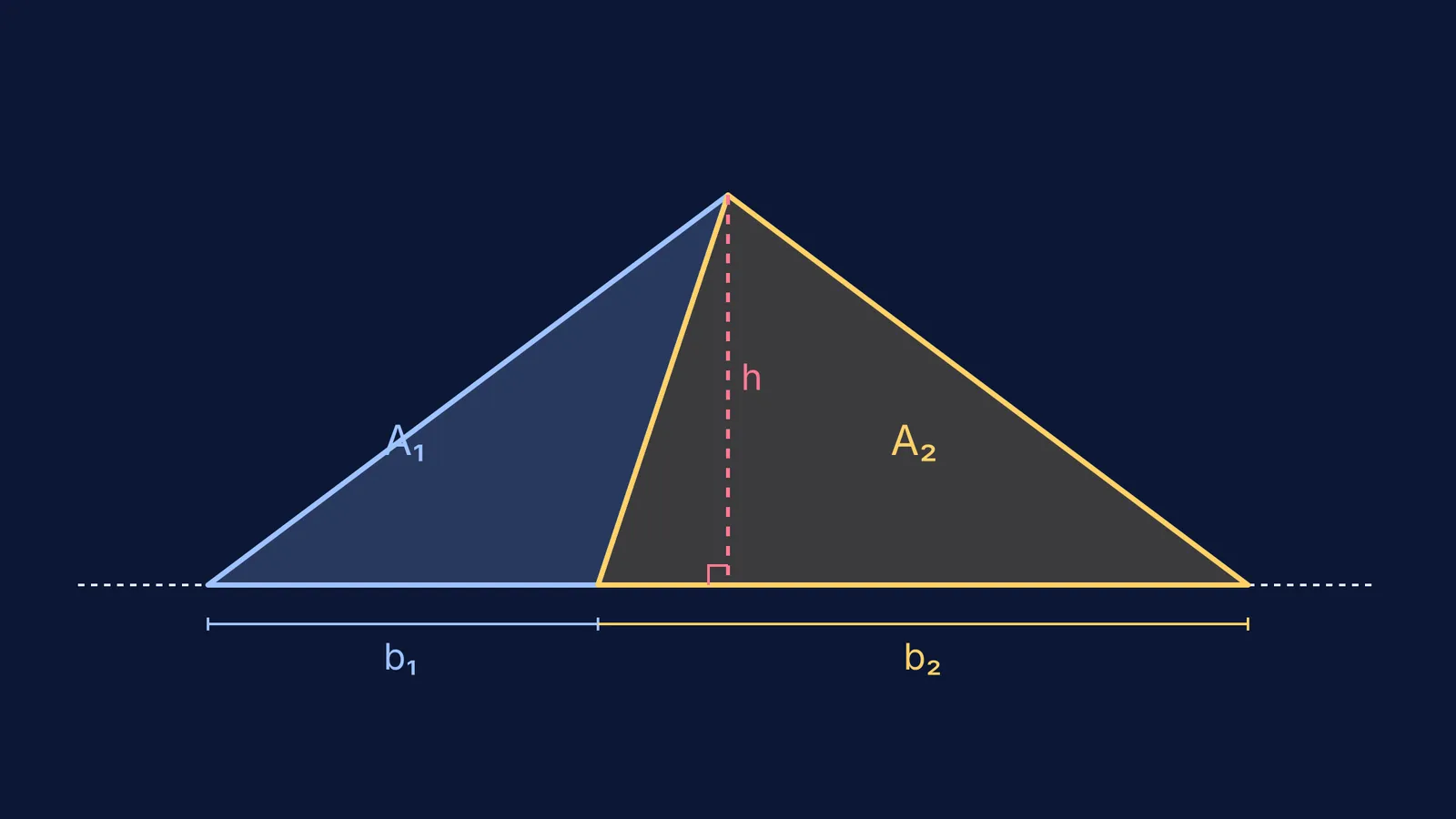
The rule is straightforward: when two triangles share the same height, the ratio of their areas is exactly equal to the ratio of their bases.
We can see why by looking at the standard area formula. The area of a triangle is half its base multiplied by its height. If we have two triangles with bases b₁ and b₂, and they share the same height h, their areas are (1/2) · b₁ · h and (1/2) · b₂ · h. When we divide the first area by the second, the fraction 1/2 and the height h cancel out completely. We are left with just the ratio b₁ / b₂.
This is not a new trick. It is one of the oldest formal proofs in mathematics. As Euclid's *Elements* Book VI Proposition 1 states: "Triangles and parallelograms which are under the same height are to one another as their bases." This single sentence is the foundation for solving many geometry problems.
You can read more about different ways to calculate area in our guide to the Area of a triangle using determinants, and the collinearity test.
How do triangles between the same parallels work?
Sometimes, geometry problems hide the fact that triangles have the same height. They do this by placing the triangles between the same parallel lines.
Parallel lines are, by definition, always the same distance apart. If two triangles have their bases lying on one line, and their top vertices lying on the opposite parallel line, the perpendicular distance from the top vertex to the base line is identical for both. Therefore, they have the same height.
Because their heights are identical, the rule applies: their areas depend entirely on their bases. If you have two triangles between the same parallels, and their bases are the same length, their areas are exactly equal, even if one triangle leans far to the side and looks completely different from the other.
This concept is closely related to scaling. If you are revising how shapes scale when all dimensions change, see our post on Similar triangles in Class 10: the basic proportionality theorem.
Does a median divide a triangle into equal areas?
Yes. A median is a line segment drawn from a vertex to the exact midpoint of the opposite side.
Drawing a median splits the main triangle into two smaller triangles. Because the line hits the midpoint, the two smaller triangles have identical base lengths. Because they both share the original top vertex and their bases lie on the same straight line, they share the exact same height.
Since their bases are equal and their heights are equal, their areas must be equal. The ratio of their bases is 1:1, so the ratio of their areas is 1:1.
How do you use the base ratio in an area problem?
Let us look at how this saves time in an exam.
Imagine a large triangle ABC with a total area of 60 square centimetres. A point D lies on the base BC such that it divides the base in a ratio of 2:1. You are asked to find the area of the two smaller triangles, ABD and ADC.
You do not know the lengths of the sides, and you do not know the height. If you tried to use Heron's formula in Class 9: area of a triangle from its sides, you would be stuck.
However, because both smaller triangles share the vertex A, they have the same height. Therefore, the ratio of their areas is equal to the ratio of their bases.
The bases are in a 2:1 ratio.
The total area is 60 square centimetres.
The total is split into 3 equal parts (2 parts + 1 part).
Each part is 60 / 3 = 20 square centimetres.
The larger triangle (ABD) takes 2 parts, so its area is 40 square centimetres. The smaller triangle (ADC) takes 1 part, so its area is 20 square centimetres.
By trusting the ratios, you turn a geometry problem into a basic calculation. If you want to practise working through geometry problems, the Fermi Problem Library has worked problems with a step-by-step solver that explains the reasoning rather than printing an answer.


