

On this page
Release two pendulums of different lengths from the same side at the same moment. Within a few swings they are out of step, and a little later they line up again. Exam questions ask when, and so does anyone watching a pendulum wave made from pendulums of different lengths. It is a whole-number problem dressed as physics.
Why do two pendulums of different lengths drift out of step?
A pendulum's period is the time for one full oscillation: out, back, and out again to where it started. For a simple pendulum swinging through a small angle, the period is T = 2π√(L/g), where L is the length and g is the acceleration due to gravity (OpenStax University Physics, section 15.4). The same source says the period does not depend on the bob's mass and is nearly independent of amplitude for angles below about 15°.
So the longer pendulum has the longer period, and the shorter one gets a little further ahead on every swing. They are in step again only at an instant that ends a complete oscillation for both. Galileo's observation that small swings take nearly the same time, told in our post on pendulum isochronism, is what makes this instant predictable.
When will two pendulums swing in phase again?
Work with the ratio of the periods, not the periods themselves. Because T = 2π√(L/g) (OpenStax), the period ratio is T₁/T₂ = √(L₁/L₂), and g cancels.
Write the ratio T(short) : T(long) = √(L short / L long).
Reduce it to the smallest whole numbers, p : q.
In that time the shorter pendulum makes q oscillations and the longer makes p, so the answer is t = q × T(short) = p × T(long).
Only now put in g to turn the answer into seconds.
Why is this the least time? If the short pendulum makes a swings while the long one makes b, then a × T(short) = b × T(long), so a : b = q : p. Since p : q is already in lowest terms, the smallest whole numbers that fit are q and p themselves. This is the same reasoning as bells ringing together again, solved with LCM.
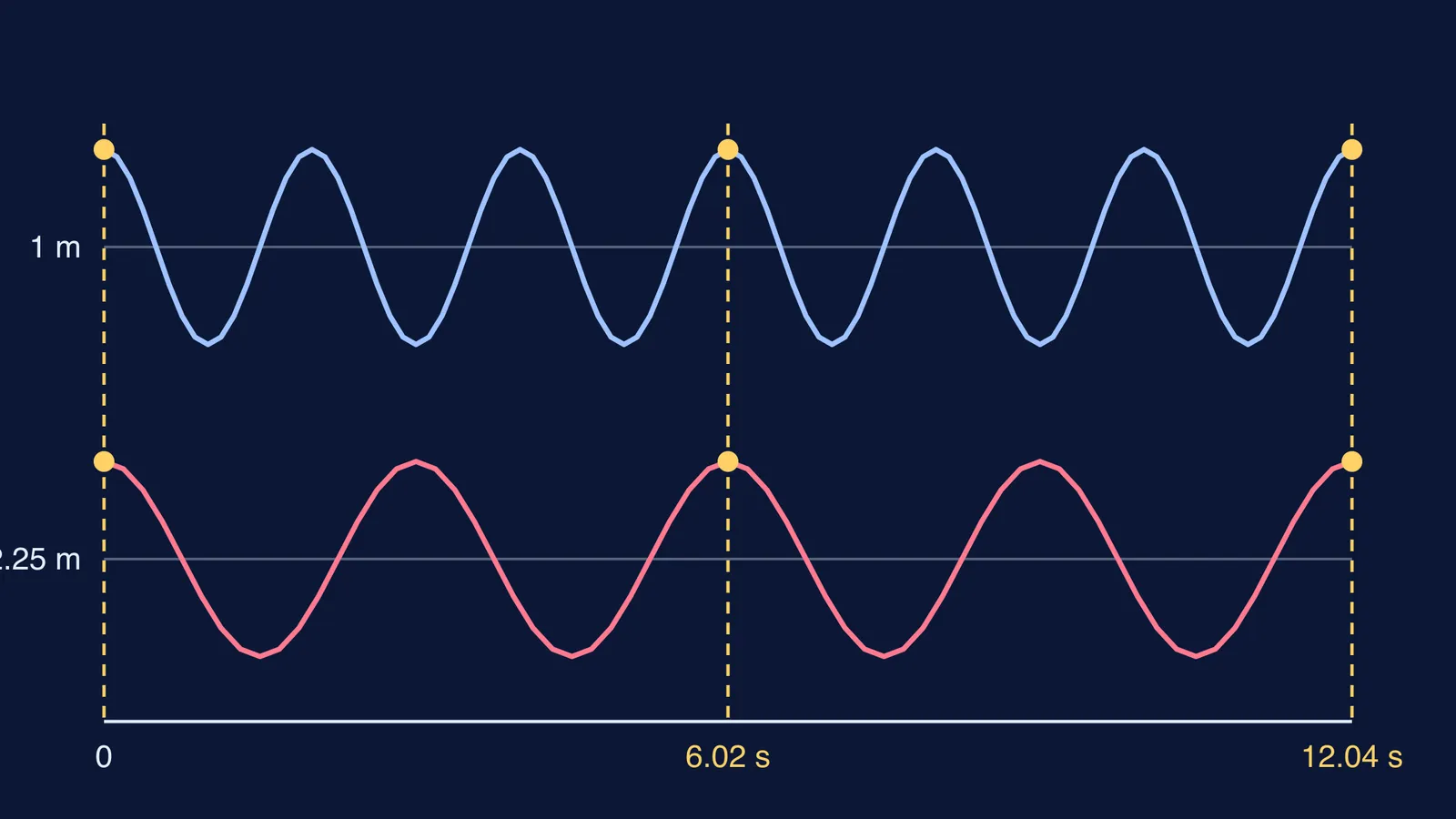
Worked example: 1 m and 2.25 m
Ratio: √(1/2.25) = 1/1.5, which is 2 : 3.
So the 1 m pendulum makes 3 oscillations while the 2.25 m pendulum makes 2.
Take g = 9.8 m/s² (the standard value is 9.80665 m/s², per NIST) in T = 2π√(L/g) (OpenStax). Then T(short) = 2π√(1/9.8) ≈ 2.007 s and T(long) = 1.5 × 2.007 ≈ 3.011 s.
Answer: t = 3 × 2.007 ≈ 6.02 s. Check: 2 × 3.011 ≈ 6.02 s.
The diagram at the top of this page plots both swings over 12 seconds. The peaks line up at 0 s, 6.02 s and 12.04 s, and nowhere in between.
Worked example: the classic 1.44 m and 1 m question
A common textbook version: pendulums of lengths 1.44 m and 1 m start swinging together. After how many oscillations are they together again?
Ratio: √(1/1.44) = 1/1.2, which is 5 : 6.
The 1 m pendulum makes 6 oscillations while the 1.44 m pendulum makes 5.
With g = 9.8 m/s² (NIST gives the standard value) and T = 2π√(L/g) (OpenStax), T(short) ≈ 2.007 s, so t = 6 × 2.007 ≈ 12.04 s.
A shortcut works only when the two counts differ by exactly one: the short pendulum gains one oscillation, so t = T(short) × T(long) / (T(long) − T(short)) = 2.007 × 2.408 / 0.401 ≈ 12.0 s. For counts like 5 and 3, use the ratio instead.
What trips students up in these questions?
Forgetting that T = 2π√(L/g) holds for small swings only (OpenStax).
Using the length ratio instead of its square root. Lengths of 1.44 : 1 give periods of 1.2 : 1.
Giving the counts the wrong way round. The shorter pendulum is faster, so it makes more oscillations.
Mixing up oscillations and one-way swings. A swing from one side to the other is half a period, so check which one the question counts.
Expecting an exact answer when the ratio is irrational. Lengths of 1 m and 2 m give a period ratio of √2, so the pendulums come close to lining up but never exactly.
If the count keeps coming out backwards, the method is the problem, not the physics. The Fermi Problem Library has worked problems with a step-by-step solver that explains the reasoning rather than printing an answer, so you can see which step slipped. If it helps to watch the drift and the realignment, the Fermi Simulation Lab has interactive simulations for ideas that are easier to see than to read.
Next time, try 0.81 m and 1 m before you look anything up. The ratio is 9 : 10, so you should find that the shorter pendulum makes 10 oscillations.


