

On this page
Why can't we use standard acceleration formulas?
When two astronomical bodies or small masses in deep space are released from rest, mutual gravitation pulls them together. A common reflex in introductory physics is to apply kinematic formulas such as v² = u² + 2as. That approach fails because gravitational attraction varies with distance. According to Newton's law of universal gravitation, the attractive force between masses m₁ and m₂ separated by centre-to-centre distance r is F = G m₁ m₂ / r², where G is the Newtonian constant of gravitation, evaluated by CODATA as 6.67430 × 10⁻¹¹ m³ kg⁻¹ s⁻².
As separation r decreases, both accelerations a₁ = F/m₁ and a₂ = F/m₂ grow continuously. Integrating acceleration over time to find velocity requires solving a non-linear differential equation for d²r/dt². Fortunately, when acceleration depends on position rather than time, we bypass time entirely using conserved quantities, as shown in our guide on when to use energy conservation instead of Newton's laws.
How do momentum and energy conservation determine individual speeds?
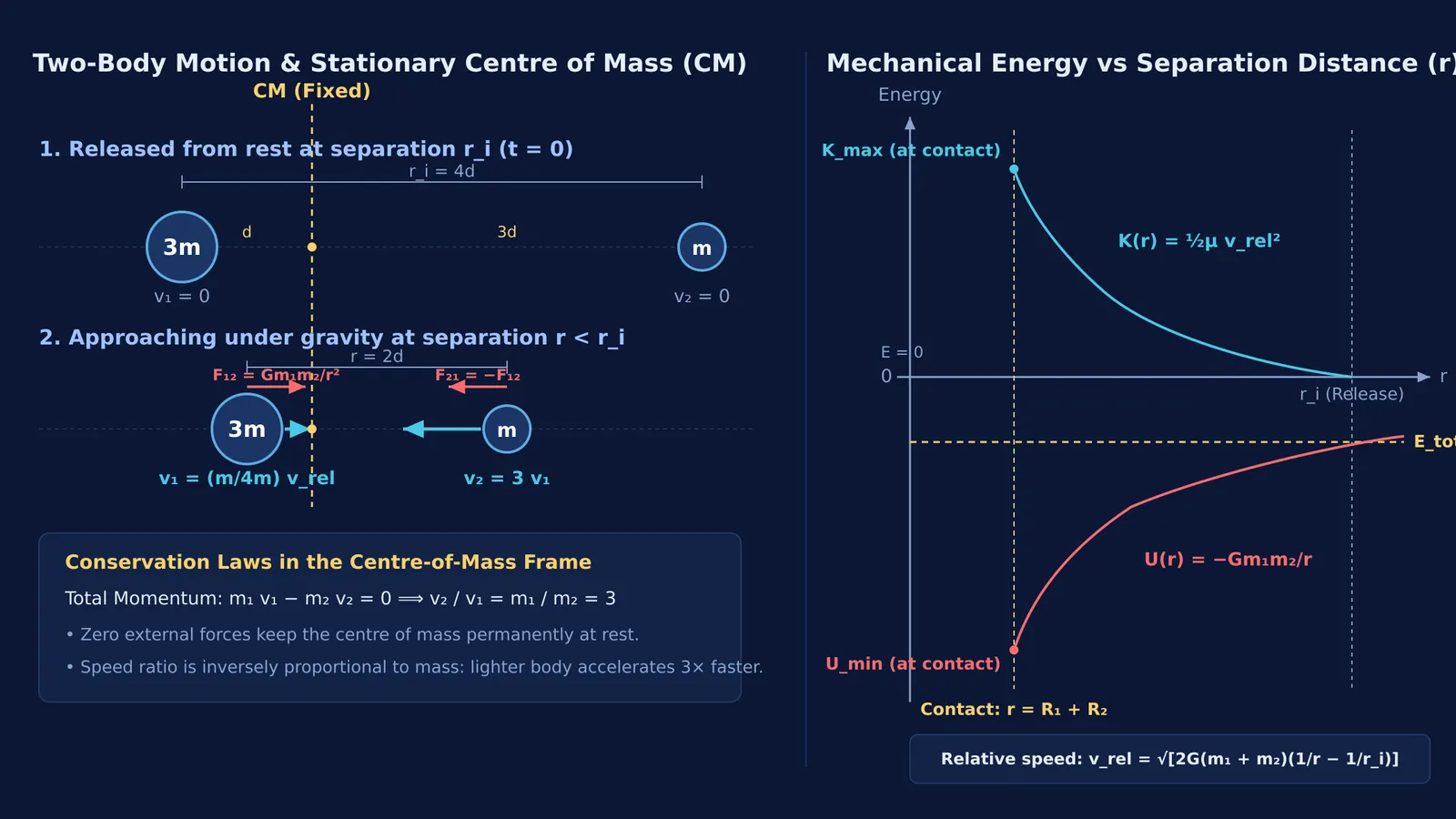
Because the two masses form an isolated system free from external forces, two fundamental conservation laws hold throughout the motion.
First, by Newton's third law, the gravitational pull of m₁ on m₂ is equal in magnitude and opposite in direction to the pull of m₂ on m₁. With zero net external force acting on the two-body system, total linear momentum is strictly conserved, as detailed in OpenStax University Physics Volume 1. Since both bodies are released from rest, the initial momentum is zero. At any subsequent separation r, taking their inward speeds towards each other as v₁ and v₂:
m₁ v₁ − m₂ v₂ = 0
This yields the direct momentum relationship:
v₂ = (m₁ / m₂) v₁
The lighter mass always moves faster than the heavier mass in exact inverse proportion to their masses. This principle ensures that the system's centre of mass remains completely stationary in space, a property discussed in our article on why centre of mass velocity is unchanged by internal forces.
Second, gravity is a conservative central force, meaning the total mechanical energy of the system remains constant. At an initial separation r_initial (which we denote r_i), the initial kinetic energy is zero, and the system possesses only gravitational potential energy. According to OpenStax University Physics principles, the potential energy of two masses separated by distance r is U(r) = −G m₁ m₂ / r, defining zero potential energy at infinite separation.
Equating mechanical energy at initial separation r_i and current separation r:
(1/2) m₁ v₁² + (1/2) m₂ v₂² = G m₁ m₂ (1/r − 1/r_i)
Substituting v₂ = (m₁ / m₂) v₁ gives (1/2) m₁ v₁² [1 + m₁/m₂] = G m₁ m₂ (1/r − 1/r_i). Solving for v₁, and applying symmetry for v₂:
v₁ = m₂ √[ 2 G (1/r − 1/r_i) / (m₁ + m₂) ]
v₂ = m₁ √[ 2 G (1/r − 1/r_i) / (m₁ + m₂) ]
When setting up simultaneous conservation equations for multi-body problems, keeping track of indices and reference frames is where exam mistakes often occur. The Fermi Problem Library provides worked problems with a step-by-step solver that explains the reasoning rather than printing an answer.
How does the reduced mass simplify relative velocity?
Often in competitive exams like JEE Advanced, questions ask for the relative speed of approach, v_rel = v₁ + v₂, rather than individual speeds. We can compute v_rel by adding v₁ and v₂ directly:
v_rel = v₁ + v₂ = (m₁ + m₂) √[ 2 G (1/r − 1/r_i) / (m₁ + m₂) ] = √[ 2 G (m₁ + m₂) (1/r − 1/r_i) ]
An even faster perspective uses the centre-of-mass reference frame and the reduced mass μ = (m₁ m₂) / (m₁ + m₂). In this frame, the internal kinetic energy of the two-body system is simply (1/2) μ v_rel². Setting (1/2) μ v_rel² equal to the potential energy change ΔU immediately produces the identical relative velocity in a single algebraic line.
The Fermi Concept Library maps every concept in physics and mathematics, each with its own lesson and its place in the map, showing how two-body mechanics connects to orbital trajectories.
What is the speed when two spherical bodies collide?
Consider two spherical asteroids released from rest at centre-to-centre distance r_i = 10,000 m. Asteroid 1 has mass m₁ = 2.0 × 10¹⁵ kg and radius R₁ = 500 m. Asteroid 2 has mass m₂ = 6.0 × 10¹⁵ kg and radius R₂ = 700 m. Using the CODATA value G = 6.6743 × 10⁻¹¹ m³ kg⁻¹ s⁻² verified by NIST, we can determine their collision speeds:
Contact separation: The surfaces touch when centres are separated by r = R₁ + R₂ = 500 m + 700 m = 1,200 m.
Geometric factor: 1/r − 1/r_i = 1/1,200 − 1/10,000 ≈ 7.3333 × 10⁻⁴ m⁻¹.
Relative speed: With total mass M = 8.0 × 10¹⁵ kg, v_rel = √[2 × (6.6743 × 10⁻¹¹) × (8.0 × 10¹⁵) × (7.3333 × 10⁻⁴)] ≈ 27.98 m/s.
Individual speeds: v₁ = (m₂ / M) v_rel = (6.0 / 8.0) × 27.98 m/s ≈ 20.99 m/s, and v₂ = (m₁ / M) v_rel = (2.0 / 8.0) × 27.98 m/s ≈ 7.00 m/s (or 6.996 m/s).
Checking momentum gives m₁ v₁ = m₂ v₂ ≈ 4.20 × 10¹⁶ kg m/s. Total kinetic energy equals the 5.87 × 10¹⁷ J of gravitational potential energy released, confirming the principles in OpenStax gravitation.


