

On this page
Spin one disc fast, lower a second disc onto it along the same axle, and the two soon turn together as one. The problem tests two ideas at once: what is conserved, and what is not.
Why is angular momentum conserved when two discs touch?
While the faces slip, friction pulls the fast disc back and drags the slow disc forward. These two friction torques are equal and opposite, so they cancel for the pair. Gravity and the push from the axle give no torque about the shared axis, as long as the bearings are frictionless.
The law of conservation of angular momentum says a system's angular momentum is conserved if no net external torque acts on it (OpenStax University Physics, section 11.3). So total angular momentum before contact equals total angular momentum after:
I₁ω₁ + I₂ω₂ = (I₁ + I₂)ω
The common angular velocity is ω = (I₁ω₁ + I₂ω₂)/(I₁ + I₂). It is a weighted average of the two starting speeds, with the moments of inertia as weights. Signs matter: if the discs spin in opposite senses, one of the ω values is negative.
A version of this problem appears in NCERT Exemplar Class 11 Physics, in the chapter on systems of particles and rotational motion (question with solution).
How much kinetic energy is lost when two rotating discs are brought into contact?
The kinetic energy of a rotating rigid body is K = ½Iω² (OpenStax University Physics, section 10.4). Subtract K after from K before and the algebra gives one line:
ΔK = I₁I₂(ω₁ − ω₂)² / [2(I₁ + I₂)]
This loss can never be negative. It is zero only when ω₁ = ω₂, that is, when there was no slipping to begin with. The energy goes into heat, and a little sound, at the rubbing faces.
The formula matches the energy lost when two blocks stick together in a perfectly inelastic collision, with masses swapped for moments of inertia and velocities for angular velocities. Coupled discs are a rotational perfectly inelastic collision.
In the OpenStax coupled-flywheel example, a flywheel spinning at 600 rev/min is dropped onto a stationary flywheel with three times its moment of inertia; the pair ends at 150 rev/min, and three quarters of the initial kinetic energy is lost to the coupling (OpenStax University Physics, section 11.3).
Worked example: same direction or opposite directions?
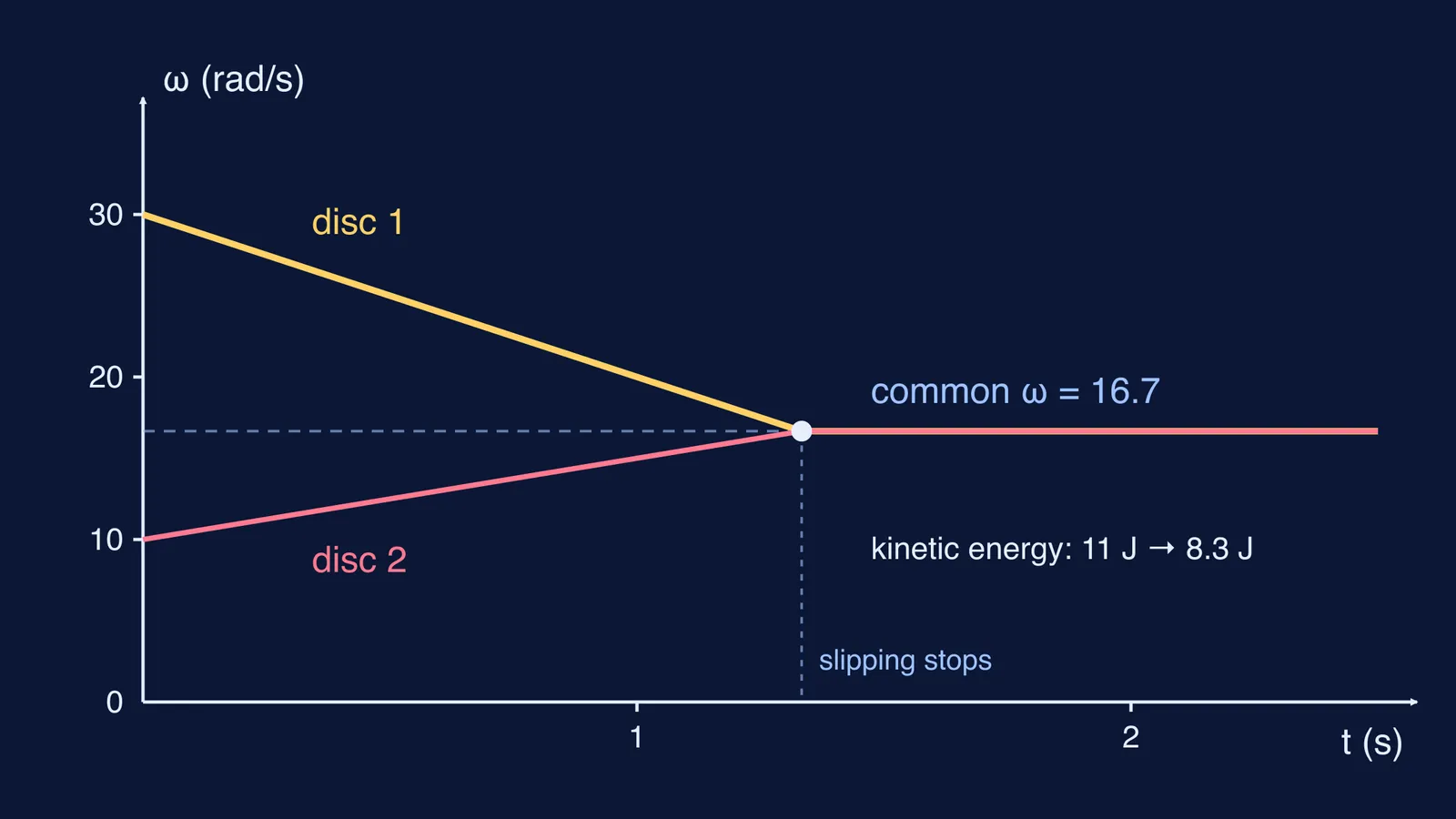
Take two uniform discs of radius 0.2 m, with masses 1 kg and 2 kg. A uniform disc about its central axis has I = ½MR² (OpenStax University Physics, section 10.4), so I₁ = 0.02 kg m² and I₂ = 0.04 kg m². Disc 1 spins at 30 rad/s.
Case A: disc 2 spins at 10 rad/s in the same direction.
Angular momentum: 0.02 × 30 + 0.04 × 10 = 1.0 kg m²/s.
Common ω = 1.0 / 0.06 ≈ 16.7 rad/s.
Initial K = ½(0.02)(30²) + ½(0.04)(10²) = 9 + 2 = 11 J.
Final K = ½(0.06)(16.7)² ≈ 8.33 J.
Loss ≈ 2.67 J, about a quarter of the start. Check with the formula: (0.0008 / 0.12)(20)² ≈ 2.67 J.
Case B: disc 2 spins at 10 rad/s the other way, so ω₂ = −10 rad/s.
Angular momentum: 0.6 − 0.4 = 0.2 kg m²/s.
Common ω = 0.2 / 0.06 ≈ 3.33 rad/s, in disc 1's direction.
Initial K is still 11 J, because K depends on ω².
Final K = ½(0.06)(3.33)² ≈ 0.33 J.
Loss ≈ 10.67 J, about 97% of the start. The formula agrees: (0.0008 / 0.12)(40)² ≈ 10.67 J.
The loss depends on the relative angular velocity, so opposing spins waste far more.
What mistakes cost marks on this problem?
Conserving kinetic energy. It is not conserved while the faces slip.
Dropping the minus sign for a disc spinning the other way. Pick one sense as positive before you write anything.
Thinking the friction coefficient matters for the final ω. Friction decides how long slipping lasts, not where it ends.
Ignoring external torque. If the bearing has friction or a motor drives one disc, the pair's angular momentum is not conserved.
Adding moments of inertia about different axes. I₁ + I₂ works here only because both discs share one axis.
How should you practise it?
Derive ΔK yourself once from K = ½Iω² before and after.
Check limits: identical discs spinning equally in opposite senses should end at ω = 0 with all energy lost.
Solve a cousin, such as a bullet embedding itself in a rotating disc, and spot the shared steps.
If a sign or a step trips you up, the Fermi Problem Library has worked problems with a step-by-step solver that explains the reasoning rather than printing an answer. For ideas that are easier to see than to read, such as two speeds converging, the Fermi Simulation Lab has interactive simulations.
Next time two discs meet, write one line for angular momentum and one for energy.


