

On this page
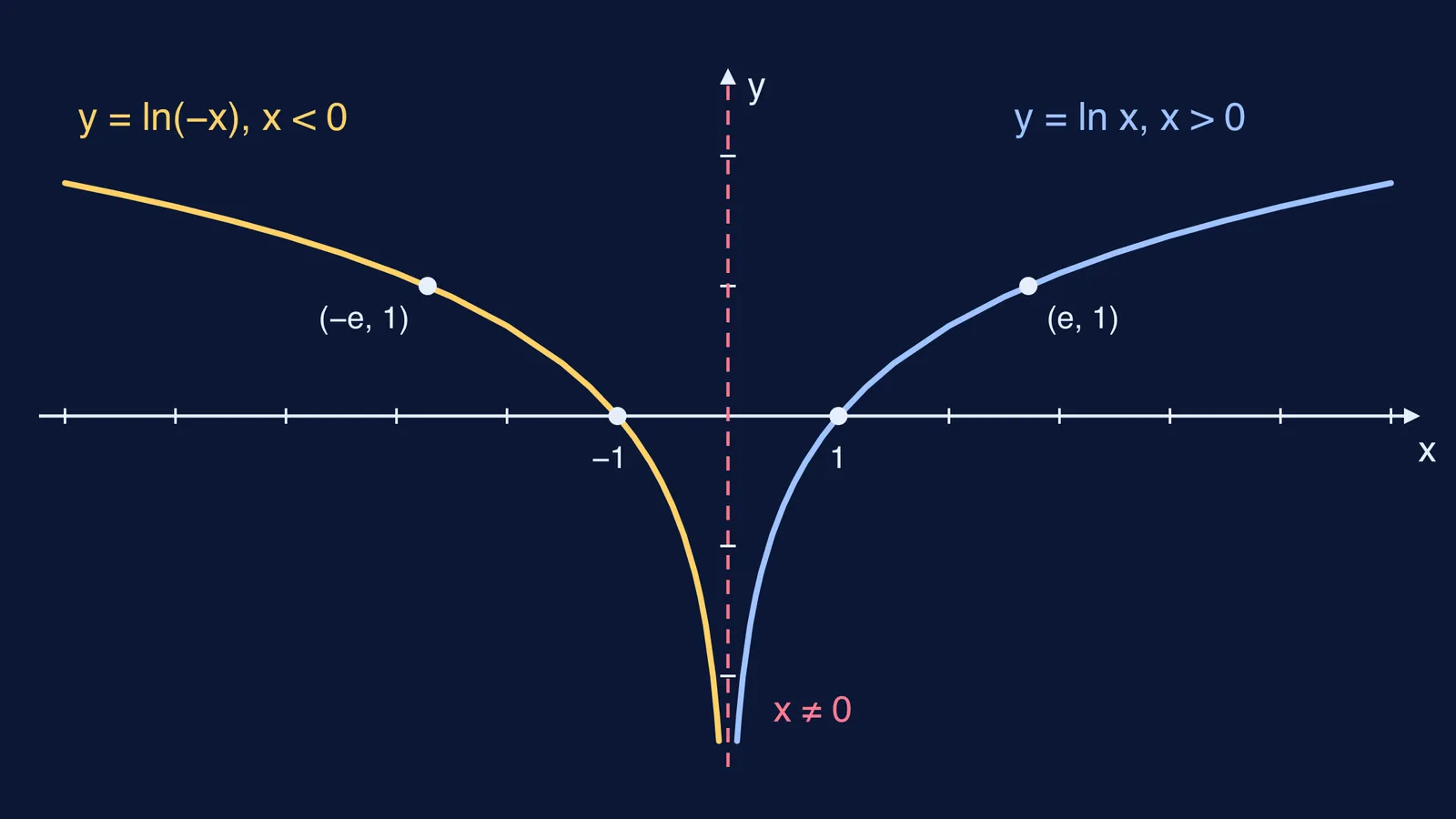
Picture two copies of the ordinary log curve placed back to back, with the y-axis running between them like a mirror. On the right is the familiar y = ln x. On the left is its mirror image, y = ln(−x). The two branches never meet, because the function does not exist at x = 0.
How does the ln|x| curve look?
Start with the plain log. The domain of y = log_b(x) is (0, ∞), its range is all real numbers, it has a vertical asymptote at x = 0, and it crosses the x-axis at (1, 0), as set out in OpenStax Precalculus 2e, section 4.4 on graphs of logarithmic functions. So ln x on its own lives only to the right of the y-axis.
Now split ln|x| into two cases:
For x > 0, |x| = x, so y = ln x.
For x < 0, |x| = −x, so y = ln(−x).
The same OpenStax section states that f(x) = log_b(−x) reflects the parent graph about the y-axis and has domain (−∞, 0). Together they give one branch in each half of the plane, each rising slowly away from the y-axis and plunging downward towards it. To draw it by hand, plot (±1, 0), since ln 1 = 0, and (±e, 1), since ln e = 1.
Why is the domain of ln|x| all x except 0?
The natural log only accepts positive inputs. |x| is positive for every real x except one: at x = 0 it equals 0, and ln 0 is not defined. So the domain of ln|x| is all real x with x ≠ 0, which you can also write as (−∞, 0) ∪ (0, ∞). The range is still all real numbers, and each branch on its own already covers every value of y.
As x approaches 0 from either side, |x| shrinks towards 0 and ln|x| falls without bound, so the y-axis is a vertical asymptote for both branches, not a single missing point.
Why is the ln|x| graph symmetric about the y-axis?
For every x in the domain, ln|−x| = ln|x|. OpenStax Precalculus 2e, section 1.5 defines an even function as one where f(x) = f(−x) for every input, and states that the graph of an even function is symmetric about the y-axis. If you want to see that reflection on single points first, our post on reflecting a point in the x-axis, y-axis and origin walks through it.
One consequence catches students out: ln|x| is not one-one. The equation ln|x| = 1 has two answers, x = e and x = −e, one on each branch. Also, do not confuse ln|x| with |ln x|.
Where does ln|x| show up in calculus?
Most Class 12 and JEE students meet ln|x| through one formula: the integral of 1/x is ln|x| + C, as given in OpenStax Calculus Volume 1, section 5.6. The graph shows why the modulus is needed. 1/x is defined for negative x too, so its antiderivative must cover both sides.
On the right branch, the derivative of ln x is 1/x for x > 0, as stated in OpenStax Calculus Volume 1, section 3.9. On the left branch, the chain rule gives the derivative of ln(−x) as (1/(−x)) × (−1) = 1/x. Same formula on both sides. You can check it against the picture: at x = −1 the slope is −1, and the left branch is indeed falling as you move right. Our explainer on why the integral of 1/x is ln|x|, and when you can drop the modulus takes this further.
How do you sketch ln|x − a| in four steps?
The same shape moves around the plane. Here is a plan for y = ln|x − 2|:
Find the forbidden x. Set the inside of the modulus to zero: x − 2 = 0, so x ≠ 2. Draw a dashed vertical asymptote at x = 2.
Find the x-intercepts. Set |x − 2| = 1, giving x = 1 and x = 3.
Mark the height-1 points. Set |x − 2| = e, giving x = 2 + e and x = 2 − e, both at y = 1.
Draw two branches, mirror images in the line x = 2, each diving towards −∞ along the asymptote and rising slowly outwards.
Now test yourself: solve ln|x| < 0. You need 0 < |x| < 1, so the answer is −1 < x < 1 with x ≠ 0. Forget the domain and you write −1 < x < 1 and lose the mark.
If the rules for log inputs still feel shaky, the Fermi Concept Library covers every concept in mathematics, each with its own lesson and its place in the map. When you want to practise, the Fermi Problem Library has worked problems with a step-by-step solver that explains the reasoning rather than printing an answer.
Next, read why a log base must be positive and not 1, and why x > 0.


