

On this page
If you spot a shelled reptile in the wild or at a zoo, you might wonder if you are looking at a turtle or a tortoise. While the two words are often used interchangeably in everyday language, biologists draw a clear line based on where the animals live and how their bodies have adapted.
Biologically, all tortoises are a type of turtle, but not all turtles are tortoises. Both belong to the scientific order Testudines, but they have evolved distinct physical shapes and habits to survive in completely different environments.
What is the main difference between a turtle and a tortoise?
The primary difference lies in their habitat. Turtles are mostly aquatic or semi-aquatic, meaning they spend the majority of their lives in water such as oceans, ponds, and lakes [[1]](https://animals.sandiegozoo.org/animals/turtle-and-tortoise). They typically only leave the water to lay eggs or bask in the sun. Tortoises, on the other hand, are strictly land-dwellers that live in hot, dry habitats like deserts, grasslands, and forests, using burrows to escape the extreme heat.
Because of these distinct habitats, their physical anatomy is built for different purposes:
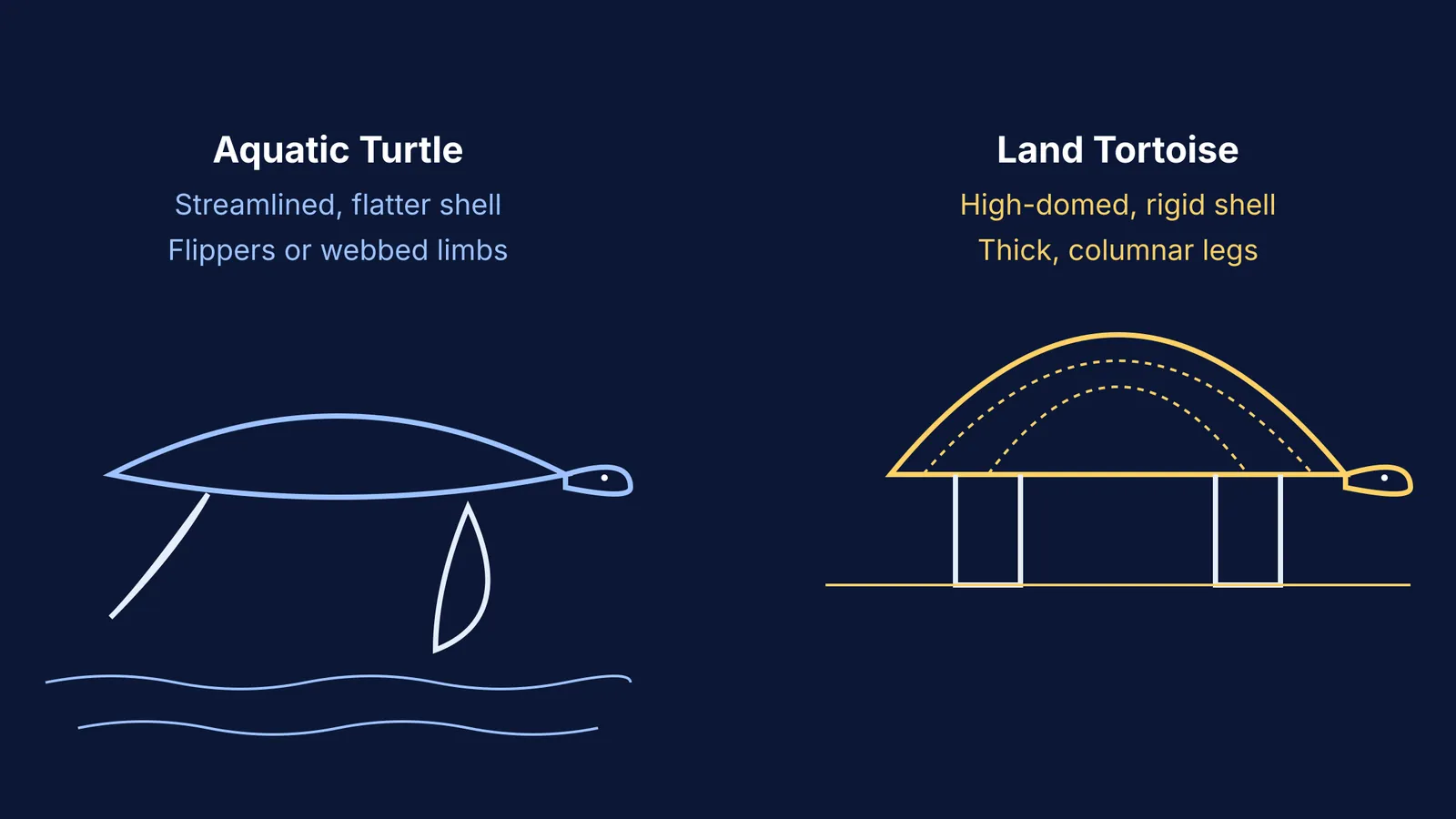
Turtles: Designed for swimming, aquatic turtles have a flatter, streamlined shell. They possess webbed feet for freshwater swimming, while sea turtles have long feet that form paddle-like flippers [[1]](https://animals.sandiegozoo.org/animals/turtle-and-tortoise).
Tortoises: Designed for walking on land, tortoises have heavy, high-domed shells. Their legs are round, thick, and stumpy—often described as looking like miniature elephant legs.
Both animals have a shell made of 59 to 61 bones attached to the spine and rib cage, with the top part called the carapace and the bottom called the plastron [[1]](https://animals.sandiegozoo.org/animals/turtle-and-tortoise). This divergence in shape is an excellent example of branching descent and fitness in Darwin's theory, where species with a common ancestor adapt physically to master their specific ecological niches.
How does shell shape affect their survival?
The shape of the shell is a biomechanical trade-off.
For turtles, a low-profile, flatter shell makes them highly efficient swimmers, capable of escaping marine predators and chasing down fish. Some species, like leatherbacks, even have flexible, leathery shells for deep diving [[1]](https://animals.sandiegozoo.org/animals/turtle-and-tortoise). However, if a flat-shelled turtle is flipped upside down on land, it must actively push itself back over.
For tortoises, the domed shell acts as a natural arch, providing immense strength against the bite of a terrestrial predator. Despite their bulky look, tortoise shells contain tiny air chambers to make them lighter than they appear [[1]](https://animals.sandiegozoo.org/animals/turtle-and-tortoise). Interestingly, this dome shape also acts as a geometric stability device. If a highly domed tortoise is knocked onto its back, its natural curvature and high centre of gravity cause it to easily roll right-side up with minimal effort [[2]](https://doi.org/10.1098/rspb.2007.1188).
When studying evolution and adaptation in biology, seeing how physical forces shape living things is a powerful way to master the material. The Fermi Concept Library contains every concept in physics, chemistry, biology, mathematics and computing, each with its own lesson and its place in the map.
What do turtles and tortoises eat?
Their diets reflect what is available in their respective habitats:
Diet of a turtle: Most aquatic turtles are omnivores. Their diet includes a mix of algae, aquatic plants, small fish, snails, worms, and insects. Some species are specialists; for example, leatherback sea turtles eat almost exclusively jellyfish [[1]](https://animals.sandiegozoo.org/animals/turtle-and-tortoise).
Diet of a tortoise: Tortoises are primarily herbivores. Their digestive systems are adapted for terrestrial plant matter, meaning they eat low-growing shrubs, grasses, leafy greens, flowers, fruits, and cactus [[1]](https://animals.sandiegozoo.org/animals/turtle-and-tortoise). At the San Diego Zoo, they are known to be attracted to red foods like tomatoes.
Neither animal has teeth. Instead, their mouths have a hard, sharpened edge that they use to bite with, functioning much like a bird's beak [[1]](https://animals.sandiegozoo.org/animals/turtle-and-tortoise).
How long do they live?
Both animals are known for their longevity, but land tortoises generally outlive their aquatic cousins.
While aquatic turtles typically live for about 70 years, tortoises are famous for extreme lifespans. Land tortoises can routinely live well over 100 years, with some documented individuals living up to 150 years or more [[1]](https://animals.sandiegozoo.org/animals/turtle-and-tortoise).
How can you tell them apart?
If you are looking at an animal and need to identify it quickly, use this simple three-point checklist:
Look at the feet: Are they webbed or shaped like long flippers? That is a turtle. Are they thick, stumpy, and columnar with distinct claws? That is a tortoise.
Look at the shell profile: Is the shell relatively flat and streamlined like a smooth stone? That is a turtle. Does it look like a large, rigid, rounded dome? That is a tortoise.
Look at the immediate habitat: Is the animal swimming rapidly or resting immediately near deep water? That is a turtle. Is it walking slowly in a dry, terrestrial environment? That is a tortoise.
By understanding these structural differences, you are not just memorising animal facts—you are observing how evolution physically shapes animal and plant cells and entire organisms over millions of years to ensure their survival in a demanding world.


