

On this page
A minus sign inside a trig function is one of the easiest places to lose a mark in Class 11 trigonometry. The good news: two facts and one counting rule handle most negative-angle questions you will meet, from a one-line value to a long identity.
What are sin(−x) and cos(−x)?
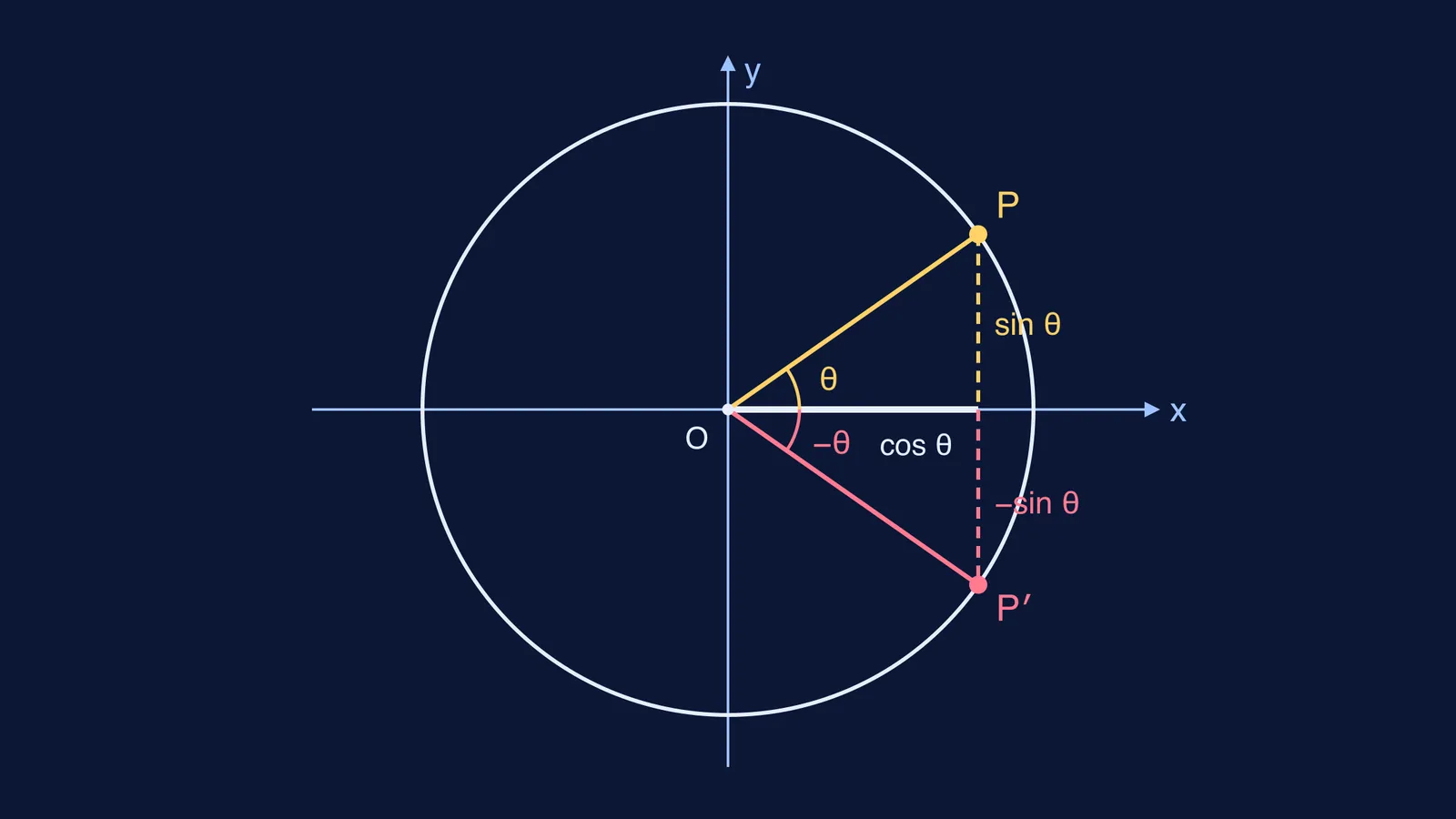
On the unit circle, the cosine of an angle is the x-coordinate of its point and the sine is the y-coordinate, as OpenStax's unit circle chapter defines them.
Turning by −θ means turning the same amount clockwise. The new point is the mirror image of the old one across the x-axis: x stays the same and y flips sign. So:
sin(−x) = −sin x
cos(−x) = cos x
So sin(−π/6) = −1/2, cos(−π/3) = 1/2, and sin(−π/2) = −1 while sin(π/2) = 1, the same pair OpenStax's Precalculus uses to show the symmetry.
Which trig functions are even and which are odd?
An even function satisfies f(−x) = f(x), and an odd function satisfies f(−x) = −f(x), in the words of OpenStax's Algebra and Trigonometry.
The same OpenStax section sorts the six functions:
Even: cos(−θ) = cosθ and sec(−θ) = secθ
Odd: sin(−θ) = −sinθ, tan(−θ) = −tanθ, csc(−θ) = −cscθ, cot(−θ) = −cotθ
You do not need to memorise six lines. Tangent is sine over cosine, so tan(−θ) = −sinθ / cosθ = −tanθ, the derivation OpenStax's Precalculus gives. A reciprocal keeps its parent's behaviour, so cosecant follows sine, secant follows cosine and cotangent follows tangent.
The graphs show it too: an even function's graph is symmetric about the y-axis and an odd function's graph is symmetric about the origin, per the same Precalculus section. Our explainer on how odd and even functions show up as symmetry goes further with the pictures.
How do you simplify cos(−θ) sin(−θ)?
Work factor by factor:
cos(−θ) = cosθ, because cosine is even.
sin(−θ) = −sinθ, because sine is odd.
Multiply: cosθ × (−sinθ) = −sinθ cosθ.
If the question wants a single function, use sin 2θ = 2 sinθ cosθ from OpenStax's double-angle formulas, so the answer is −½ sin 2θ.
The counting rule: in a product, every odd function with a negative angle contributes one minus sign; even functions contribute none. Count the odd factors: an odd count leaves the answer negative, an even count makes it positive. In cos(−θ) sin(−θ) there is one odd factor, so the result is negative.
Five more to try:
tan(−θ) cot(−θ) = (−tanθ)(−cotθ) = 1. Two odd factors, so the signs cancel.
sec(−θ) sin(−θ) = secθ × (−sinθ) = −tanθ. One odd factor.
sin²(−θ) + cos²(−θ) = sin²θ + cos²θ = 1. Squaring removes the sign, and the Pythagorean identity in OpenStax's unit circle chapter finishes it.
cos(x − π/2) = cos(π/2 − x) = sin x. Cosine is even, so you may flip the inside, and then the cofunction identity sinθ = cos(π/2 − θ) from OpenStax's sum and difference chapter applies.
sin(x − π/2) = −sin(π/2 − x) = −cos x. Sine is odd, so flipping the inside costs a minus sign.
What mistakes cost marks here?
Writing cos(−θ) = −cosθ. Cosine never takes the minus sign out.
Treating sin(π − θ) or cos(2π − θ) as negative-angle questions. Those are allied angles; our guide to allied angles in Class 11 trigonometry covers them.
Keeping a minus sign after squaring. [sin(−θ)]² is sin²θ, not −sin²θ.
Not checking the quadrant. For a small positive θ, −θ sits in the fourth quadrant, where only cosine and secant are positive. That matches the even-odd list, and our post on the ASTC rule for signs of trig functions shows the quadrant check in full.
If a question keeps going wrong at the same step, the Fermi Problem Library has worked problems with a step-by-step solver that explains the reasoning rather than printing an answer. If the gap is the idea itself, the Fermi Concept Library gives each mathematics concept its own lesson and its place in the map.
Try the five examples above without looking, then check each one with θ = 30 degrees.


