

On this page
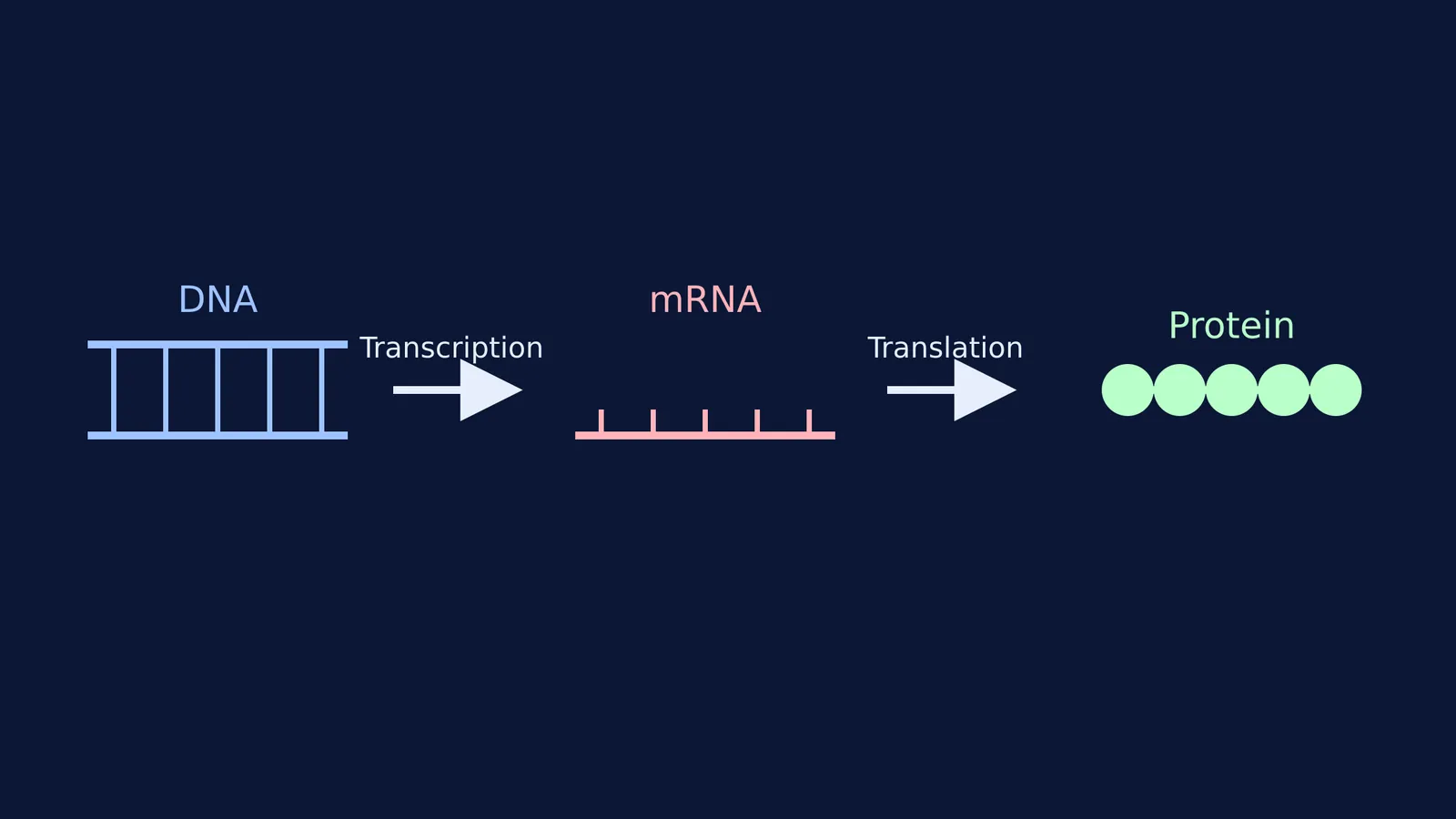
If you are preparing for NEET-UG or your biology board exams, understanding the flow of genetic information—from DNA to RNA to protein—is a crucial foundation. This two-step process, which biologist Francis Crick called the Central Dogma, starts with transcription and finishes with translation. Getting the exact locations, templates, and enzymes mixed up is a common mistake that costs marks in multiple-choice questions. Here is a clear breakdown of how the two stages compare side by side.
What is the difference between transcription and translation?
Transcription is the first step of gene expression. In this phase, a cell copies a specific sequence of DNA into a newly formed molecule of messenger RNA (mRNA). Because a cell's DNA is safely stored and protected within the nucleus of eukaryotic cells, transcription must happen there. The cell uses a dedicated enzyme called RNA polymerase to pry the DNA strands apart and build this complementary RNA strand.
Translation is the second step. The newly synthesised mRNA travels out of the nucleus to a ribosome, where its sequence of nucleotides is read to build a polypeptide chain (a protein). Small molecules called transfer RNA (tRNA) act as adaptors. They bring the correct amino acids to the ribosome, matching them exactly to the mRNA instructions. If you are struggling to picture how these tiny molecular machines interact, you can review the mechanism step by step in the Fermi Concept Library to see exactly how RNA polymerase and ribosomes coordinate their work.
Transcription vs translation difference table
While they are both essential parts of gene expression, the two processes have completely distinct roles, locations, and molecular components. Here is a structured point-by-point comparison to help you revise:
Definition: Transcription copies a target DNA segment into RNA. Translation synthesises a specific protein from an mRNA template.
Location: Transcription occurs inside the nucleus (in eukaryotes). Translation happens on ribosomes, which are either floating in the cytoplasm or attached to the rough endoplasmic reticulum.
Template used: Transcription reads the antisense (template) strand of the DNA double helix. Translation reads the single-stranded mRNA molecule.
Main enzyme: Transcription is driven by RNA polymerase. Translation is driven by the ribosome (a massive complex of ribosomal RNA and proteins) along with peptidyl transferase.
Building blocks: Transcription links ribonucleotides (adenine, uracil, cytosine, and guanine) together. Translation links amino acids together via peptide bonds.
Final product: Transcription produces a functional RNA molecule (such as mRNA, tRNA, or rRNA). Translation produces a polypeptide chain that subsequently folds into a functional 3D protein.
Where does each process happen?
In eukaryotic cells, such as human or plant cells, transcription and translation are strictly physically separated by the nuclear envelope. Transcription must take place in the nucleus because that is where the master DNA code resides. The resulting mRNA is then modified (through a process called splicing) and exported out of the nucleus through nuclear pores.
Translation takes place entirely in the cytoplasm, where the ribosomes are located. This physical separation is actually an evolutionary advantage, as it gives eukaryotic cells a chance to edit the mRNA before it is translated.
However, in prokaryotic cells (like bacteria), there is no nucleus. Because there is no nuclear membrane to separate the two processes, transcription and translation can happen at the exact same time on the same mRNA strand. A bacterial ribosome can begin translating an mRNA molecule while RNA polymerase is still transcribing its trailing end.
Which enzymes and molecules do the heavy lifting?
The molecular machinery behind these processes is highly specialised. During transcription, RNA polymerase does almost all the work. It unzips a localized portion of the DNA double helix, exposing the template strand, and then matches incoming RNA nucleotides to the DNA template.
Translation requires a much larger team. The ribosome is the main factory, but it relies on aminoacyl-tRNA synthetases—special enzymes that ensure each tRNA is chemically linked to the correct amino acid.
What are the start and end signals?
Both processes need specific molecular signals to know exactly where to begin reading the code and where to stop.
Transcription signals: RNA polymerase knows where a gene starts by binding to a specific promoter region on the DNA. It continues copying along the DNA strand until it reaches a terminator sequence, which triggers the enzyme to release the newly synthesised RNA molecule.
Translation signals: The ribosome does not read promoters or terminators. Instead, it scans the mRNA until it finds a start codon (which is almost always the three-letter sequence AUG). It then continues adding amino acids until it reads one of three stop codons (UAA, UAG, or UGA), which signals the ribosome to release the finished polypeptide.
A simple linguistic framework can help you remember the difference. Transcription keeps the information in the same chemical language of nucleotides (just like transcribing an audio speech into text). Translation changes the language entirely, moving from the language of nucleotides into the language of amino acids.


