

On this page
The process of building a protein from messenger RNA (mRNA) is called translation. But how does the cell's machinery, the ribosome, know exactly where to start and where to finish reading the code? The answer lies in specific nucleotide triplets known as start and stop codons.
What is a start codon?
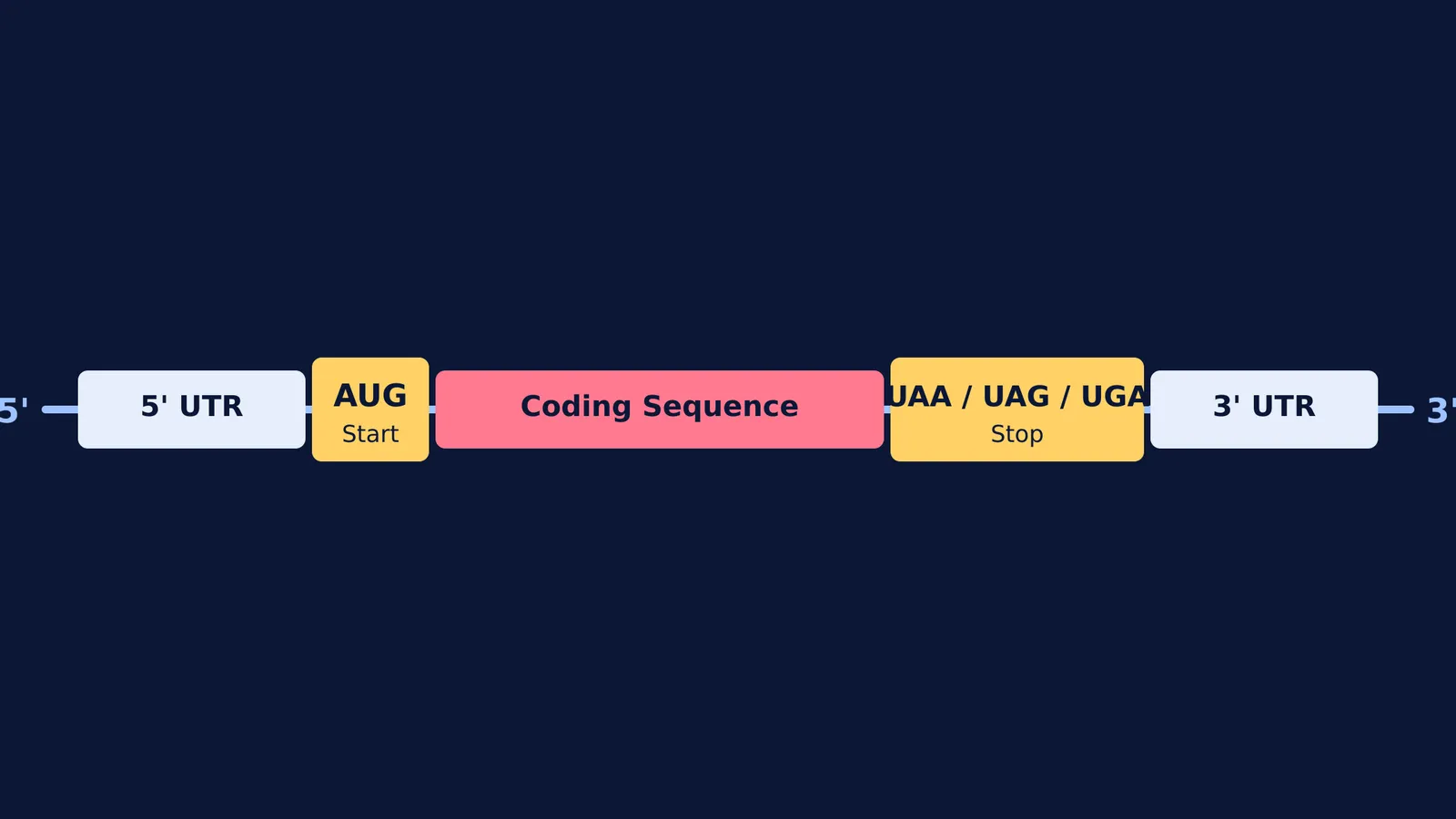
The start codon is the first codon of a messenger RNA (mRNA) transcript translated by a ribosome. In the standard genetic code, the start codon is always AUG (Wikipedia). This specific sequence of three nucleotides—adenine, uracil, and guanine—serves a double role in the cell.
First, it establishes the reading frame for the ribosome. Because nucleotides are read in sets of three, the exact location of the AUG codon dictates how every subsequent triplet is grouped. A shift of even one letter would change the entire sequence of amino acids that follows, often rendering the resulting protein completely non-functional. Second, the start codon codes for the amino acid methionine in eukaryotes and archaea. This means that when a ribosome begins assembling a new polypeptide chain, the very first building block it lays down is methionine, although this initial amino acid is frequently removed during later stages of protein processing. In bacteria, the start codon codes for a modified version called N-formylmethionine.
If you are exploring molecular biology and need to visualise how these genetic mechanisms fit into the larger picture of cell function, the Fermi Concept Library contains every concept in physics, chemistry, biology, mathematics and computing, each with its own lesson and its place in the map.
What are the three stop codons?
While the start codon begins the assembly of a protein, a different set of signals is required to safely end it. In molecular biology, a stop codon—or termination codon—is a nucleotide triplet within mRNA that signals the termination of the translation process of the current protein (Wikipedia).
Unlike the vast majority of codons in the genetic code, stop codons do not correspond to the addition of an amino acid to the growing polypeptide chain. Instead, a stop codon alone is sufficient to initiate termination. When the ribosome reaches one of these sequences, it does not find a matching transfer RNA (tRNA) carrying an amino acid. Instead, it binds to specific proteins known as release factors. These release factors cause the ribosomal subunits to disassociate from the mRNA, freeing the newly built amino acid chain into the cell so it can fold into its final three-dimensional shape.
In the standard genetic code, there are exactly three stop codons:
UAA (historically named the "ochre" mutation)
UAG (known as the "amber" mutation)
UGA (known as the "opal" mutation)
The colourful names for these codons originated from the geneticists who discovered them. For example, the amber mutation was named by its discoverers after their friend Harris Bernstein, whose surname translates to "amber" in German. These fundamental discoveries about how information flows from DNA to proteins built on the work of pioneering scientists like Sydney Brenner, who caught messenger RNA in a 1960 experiment.
What are the untranslated regions (UTRs)?
An mRNA molecule is not perfectly bookended by the start and stop codons; the transcript extends beyond the protein-coding sequence on both sides. In molecular genetics, an untranslated region (UTR) refers to either of the two sections on each side of a coding sequence on a strand of mRNA (Wikipedia).
These flanking sequences are crucial for the proper regulation and execution of translation. The cell uses them to control exactly when and how much of a protein is produced:
The 5' UTR: If it is found on the 5' side, upstream from the coding sequence, it is called the 5' UTR or leader sequence. Within this region is a specific sequence recognised by the ribosome, which allows it to bind securely to the mRNA and initiate translation at the correct AUG codon. Without this binding site, the ribosome would struggle to attach to the mRNA strand.
The 3' UTR: If it is found on the 3' side, immediately following the translation stop codon, it is called the 3' UTR or trailer sequence. The 3' UTR plays a critical role in translation termination as well as post-transcriptional modification. It contains signals that help add the poly-A tail to the mRNA, protecting the molecule from rapid degradation in the cytoplasm.
Historically, these long stretches of RNA were sometimes dismissed as useless filler, but it is now known that they are heavily involved in the regulatory aspects of gene expression. They determine how stable the mRNA molecule is, where it travels within the cell, and how many times it can be translated before it is finally dismantled. They also interact with other cellular processes, such as the capping, tailing and splicing steps that prepare raw RNA transcripts for their journey to the ribosome.


