

On this page
A flag on a roof, a tower on a building, a statue on a pedestal, a tree on a hill: four questions that are really one. You stand at one point on level ground, look up twice, and get two angles of elevation. Both lines of sight end on the same vertical line, so the two right triangles you draw share the same horizontal base.
This pattern appears in NCERT's Class 10 chapter Some Applications of Trigonometry, as worked Example 4 (a flagstaff on a 10 m building) and as Exercise 9.1 questions 7 and 8 (a transmission tower on a 20 m building, and a 1.6 m statue on a pedestal).
How do you solve a flagstaff on tower problem?
Use this four-step method.
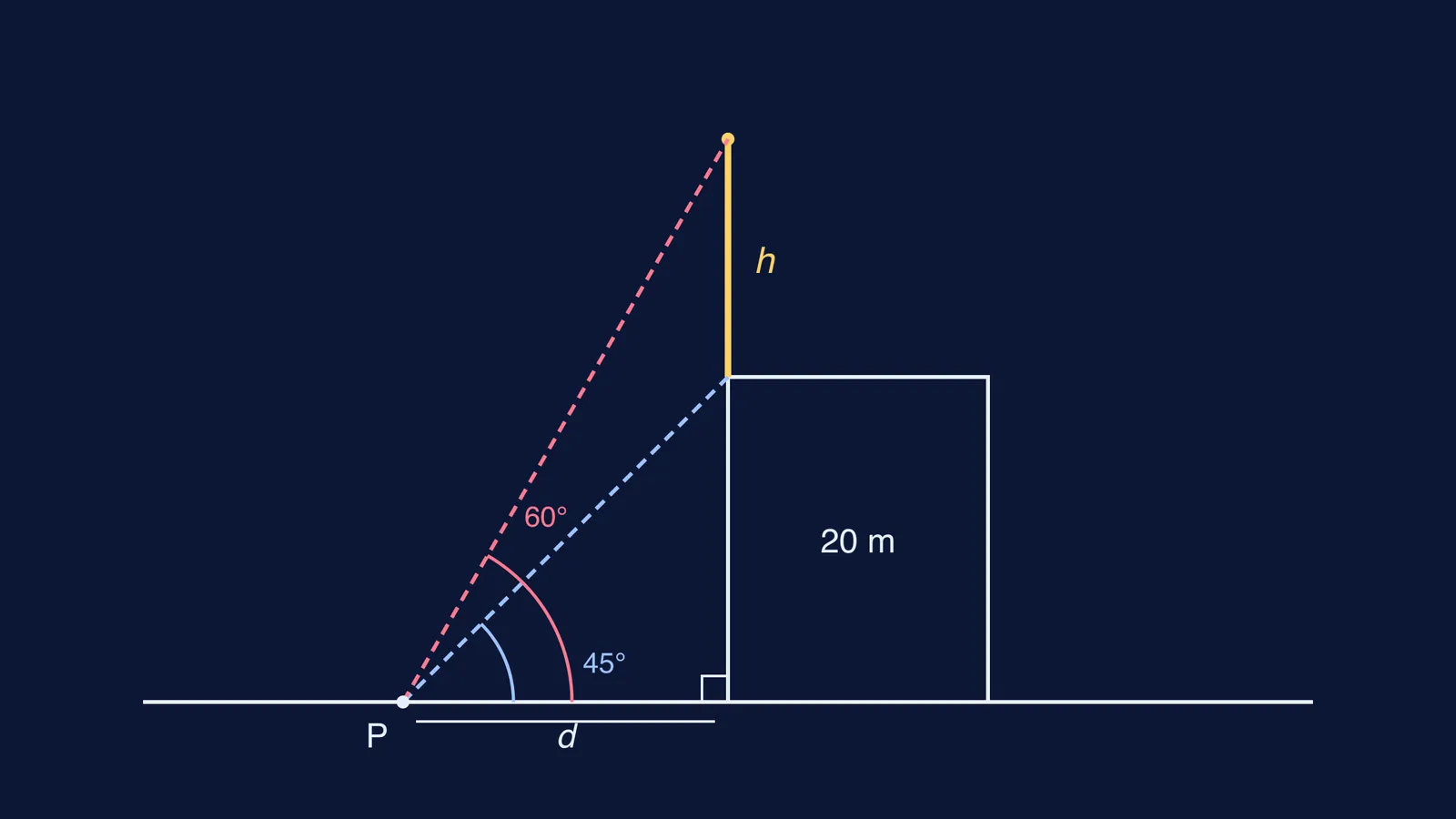
Draw one vertical line for the building and the flagstaff together, with the foot of the building on the ground. Mark the observer P on the ground and join P to the top of the building and to the top of the flagstaff.
Name the shared base d, the distance from P to the foot of the building. It links the two triangles.
Use tan for both triangles, because tan is the ratio of the vertical side to the horizontal side: tan(lower angle) = building / d, and tan(upper angle) = (building + flagstaff) / d.
Solve the equation with only one unknown first, then put d into the other one. If both equations have two unknowns, write d from the lower triangle and substitute it into the upper one.
Worked example: a tower on a 20 m building
Here is Exercise 9.1 question 7 from the NCERT chapter: from a point on the ground, the angles of elevation of the bottom and the top of a transmission tower fixed on top of a 20 m high building are 45° and 60°. Find the height of the tower.
Lower triangle: tan 45° = 20 / d. Since tan 45° = 1, d = 20 m.
Upper triangle: tan 60° = (20 + h) / d, so √3 = (20 + h) / 20, which gives 20 + h = 20√3.
Subtract: h = 20√3 − 20 = 20(√3 − 1) m.
With √3 ≈ 1.732, the tower is about 14.64 m tall.
Notice what you never needed: the height of the tower in the first triangle. The bottom angle gives you the base; the top angle gives you the total height. The tower is the difference.
What if the tree is on a hill?
A tree on a hill is the same figure with the labels swapped: the hill plays the building and the tree plays the flagstaff. Often the question gives you the tree and asks for the hill, so you use the second formula.
Suppose a 15 m tree stands on top of a hillock. From a point on the level ground, the angle of elevation of the foot of the tree is 45° and of its top is 60°. Let the hill be H and the base d.
tan 45° = H / d, so d = H.
tan 60° = (H + 15) / d = (H + 15) / H, so √3 H = H + 15.
H(√3 − 1) = 15, so H = 15 / (√3 − 1) = 7.5(√3 + 1) m, about 20.49 m.
Which mistakes cost marks in heights and distances?
Using sin or cos. You know neither line of sight, so only tan (or cot) links the height to the base.
Writing tan(upper angle) = flagstaff / d. The upper triangle's vertical side is the building plus the flagstaff, measured from the ground.
Rounding √3 too early. Keep surds until the last line, then round once.
If you mix up elevation and depression in the first place, our guide to angle of elevation and angle of depression confusion sorts that out. For the wider chapter, see heights and distances for Class 10, and for the sister pattern where the base changes and the height stays fixed, read two angles of elevation from a moving observer.
How should you practise this pattern?
Try Exercise 9.1 question 8 in the NCERT chapter with the formula above: a 1.6 m statue on a pedestal, seen at 60° (top of statue) and 45° (top of pedestal). You should get a pedestal of 0.8(√3 + 1) m, about 2.19 m. Then redo NCERT's Example 4 without looking.
When your answer is wrong but you cannot see why, the Fermi Problem Library has worked problems with a step-by-step solver that explains the reasoning rather than printing an answer, so you can find the exact line where your triangle went wrong.


