

On this page
What is the difference between a thorn, a spine, and a prickle?
Everyday speech treats "thorn", "spine", and "prickle" as interchangeable labels for sharp plant projections. In botany, however, these structures represent three distinct organs with different developmental origins and internal tissues. Confusing them obscures how plants build their bodies and adapt to environmental stresses.
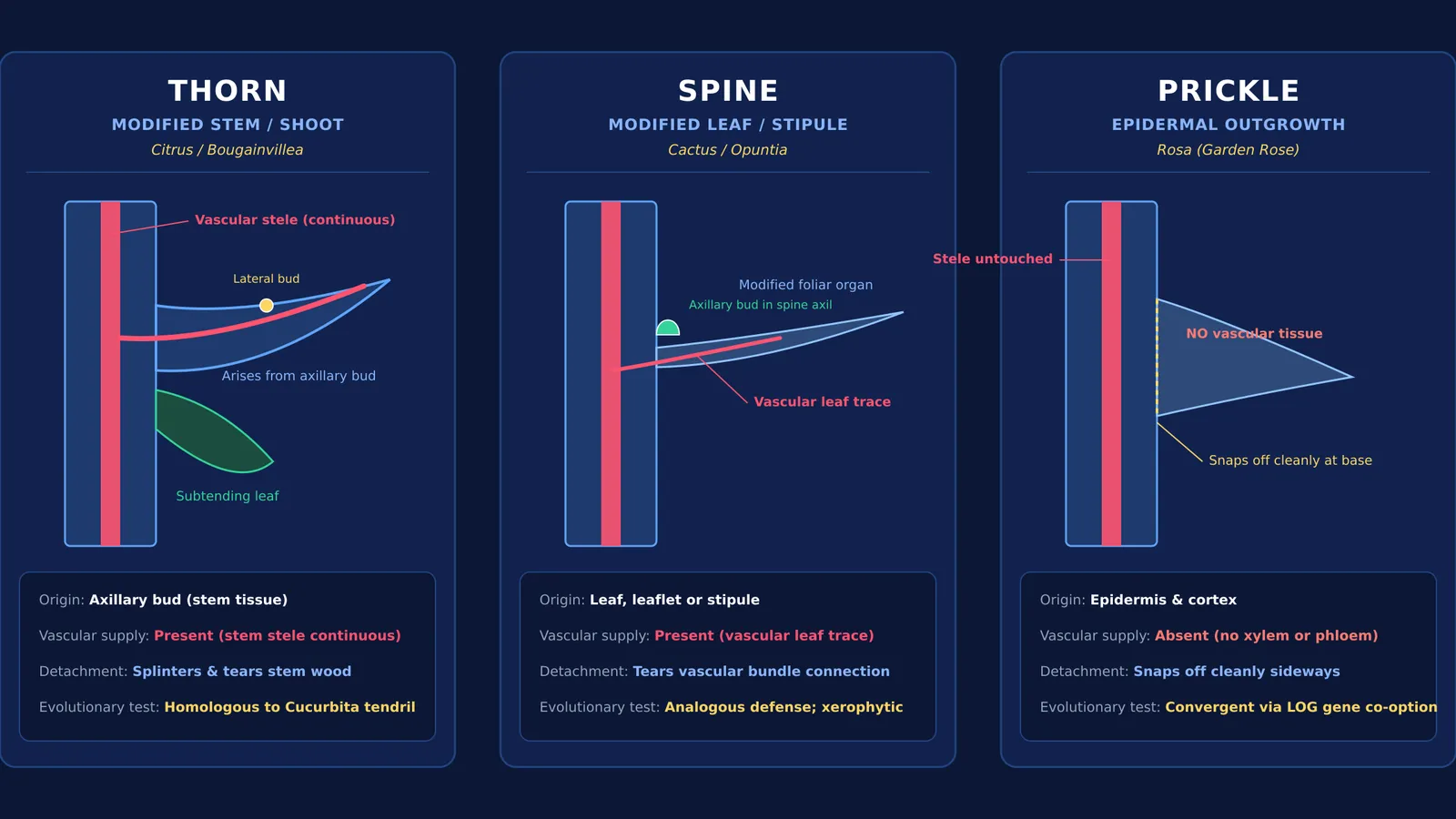
The anatomical differences depend on which plant part modified and whether vascular tissue enters the structure:
Thorns are modified shoots or stems derived from axillary buds. Because a thorn is a modified branch, it contains a central vascular core of xylem and phloem continuous with the stem stele. Thorns can sometimes bear leaves or secondary branches.
Spines are modified leaves, leaflets, or stipules. As foliar organs, spines contain vascular bundles called leaf traces. They originate at nodes, often subtending an axillary bud or flanking a petiole base.
Prickles are superficial emergences derived solely from the epidermis and outer cortex. They contain no vascular tissue and arise irregularly across stems and petioles without fixed nodal positions.
These structural definitions form the core of the NCERT Biology syllabus and explain how vegetative shoots diversify into stem modifications and their specialized functions.
Why are Bougainvillea, cactus, and rose classified differently?
Three common plants illustrate these anatomical rules in action.
In *Bougainvillea*, the woody, curved spikes in leaf axils are true thorns. Because each thorn arises from an axillary bud, it occupies the position of a lateral shoot. It develops secondary xylem continuous with the main stem cylinder, so tearing it strips the stem wood.
In cacti like *Opuntia*, the flattened green pads are modified stems (phylloclades), while the sharp needles clustered in areoles are true spines. In desert conditions, leaves reduced to hardened spines to prevent transpirational water loss while deterring herbivores. Each spine receives a vascular leaf trace from the stem.
In garden roses (*Rosa*), the curved hooks along the cane are prickles. Derived solely from epidermal and cortical layers, they contain no vascular tissue. Gardeners can snap them cleanly sideways without tearing the inner wood.
In an August 2024 study in *Science*, Satterlee and colleagues showed that prickles evolved convergently across at least 28 plant lineages over 400 million years by co-opting cytokinin-activating *LOG* genes. This mechanical spinescence has ancient roots: Charles-Dominique and co-authors found in *PNAS* that African spiny plants diversified roughly 15 million years ago alongside browsing bovids.
To connect structural plant adaptations to ecological demands, the Fermi Concept Library covers every concept in physics, chemistry, biology, mathematics and computing, each with its own lesson and its place in the map.
How can you identify an unknown plant spike in three steps?
When examining an unknown plant spike, use this three-step diagnostic test:
Test for vascular continuity. Push the projection sideways with your thumb. If it snaps off cleanly leaving a smooth surface scar, it is an unvascularized prickle. If it splinters or tears stringy strips of wood from the stem, it contains vascular tissue and is a thorn or spine.
Locate the node and leaf axil. Check where the structure attaches. If it emerges in the axil above a leaf, it is an axillary bud modification: a thorn. If it sits at a node in place of a leaf or as paired stipules, it is a spine. If it is scattered randomly along internodes, it is a prickle.
Inspect for secondary organs. Examine the shaft under a hand lens. If it bears tiny buds, leaves, or flowers, it is an axial stem: a thorn. Leaves and prickles never bear lateral buds.
These developmental differences mirror the distinct tissue layers established by apical and lateral meristems.
Why do exams confuse homologous and analogous plant organs?
Competitive examinations regularly test thorns, spines, and prickles to evaluate understanding of homology versus analogy:
Homologous organs share a common anatomical origin and developmental plan, even when divergent evolution adapts them for different functions.
Analogous organs perform similar functions and look superficially alike, but convergent evolution derived them from different tissue origins.
Two classical comparisons illustrate the distinction:
Homology in action: The thorn of *Bougainvillea* and the tendril of *Cucurbita* (pumpkin). Both originate from the axillary bud of the stem. One protects the plant while the other climbs, making them homologous stem modifications.
Analogy in action: The thorn of *Bougainvillea* (modified stem), the spine of *Opuntia* (modified leaf), and the prickle of *Rosa* (epidermal outgrowth). All three deter herbivores, but because they develop from separate tissue layers, they are analogous organs.
Understanding these evolutionary pathways helps when analyzing other botanical patterns, such as placentation types in flowers.
For students solving complex multi-step biology questions, the Fermi Problem Library provides worked problems with a step-by-step solver that explains the reasoning rather than printing an answer.


