

On this page
Every Class 10 student meets the thermite reaction in one short paragraph of the NCERT chapter Metals and Non-metals. It brings together three ideas: the reactivity series, redox and exothermic reactions. Understand it once and you can handle most versions of the question.
What is the thermite reaction in Class 10?
In NCERT Class 10 Science, Chapter 3, Section 3.4.4, highly reactive metals such as aluminium are used as reducing agents because they can displace metals of lower reactivity from their compounds. The textbook calls these displacement reactions "highly exothermic" and says "the amount of heat evolved is so large that the metals are produced in the molten state." It then says that "the reaction of iron(III) oxide (Fe2O3) with aluminium is used to join railway tracks or cracked machine parts. This reaction is known as the thermit reaction."
Here is the balanced equation, written as NCERT gives it:
Fe₂O₃(s) + 2Al(s) → 2Fe(l) + Al₂O₃(s) + Heat
Look at the (l) after iron. The iron comes out as a liquid, and that is the whole point of the reaction.
Why is the thermite reaction a displacement reaction?
Aluminium sits above iron in the reactivity series. A more reactive metal takes the place of a less reactive one in a compound. Because the compound is an oxide, not a salt solution, it is easy to miss that this is displacement. If the two types still blur together, read our explainer on the difference between displacement and double displacement reactions. If you keep forgetting the order of the metals, try this easy way to remember the reactivity series.
The thermite reaction is also a redox reaction:
Aluminium is oxidised. It gains oxygen, and its oxidation state goes from 0 to +3 in Al₂O₃.
Iron(III) oxide is reduced. It loses oxygen, and iron goes from +3 to 0.
Aluminium is the reducing agent, and Fe₂O₃ is the oxidising agent.
Electron count: two Al atoms lose six electrons between them, and the two Fe³⁺ ions gain those six.
NCERT gives a similar example in the same section, 3MnO₂(s) + 4Al(s) → 3Mn(l) + 2Al₂O₃(s) + Heat, and asks which substances are oxidised and which are reduced.
How much heat does the thermite reaction release?
This calculation is beyond Class 10, but it shows what "highly exothermic" means in numbers.
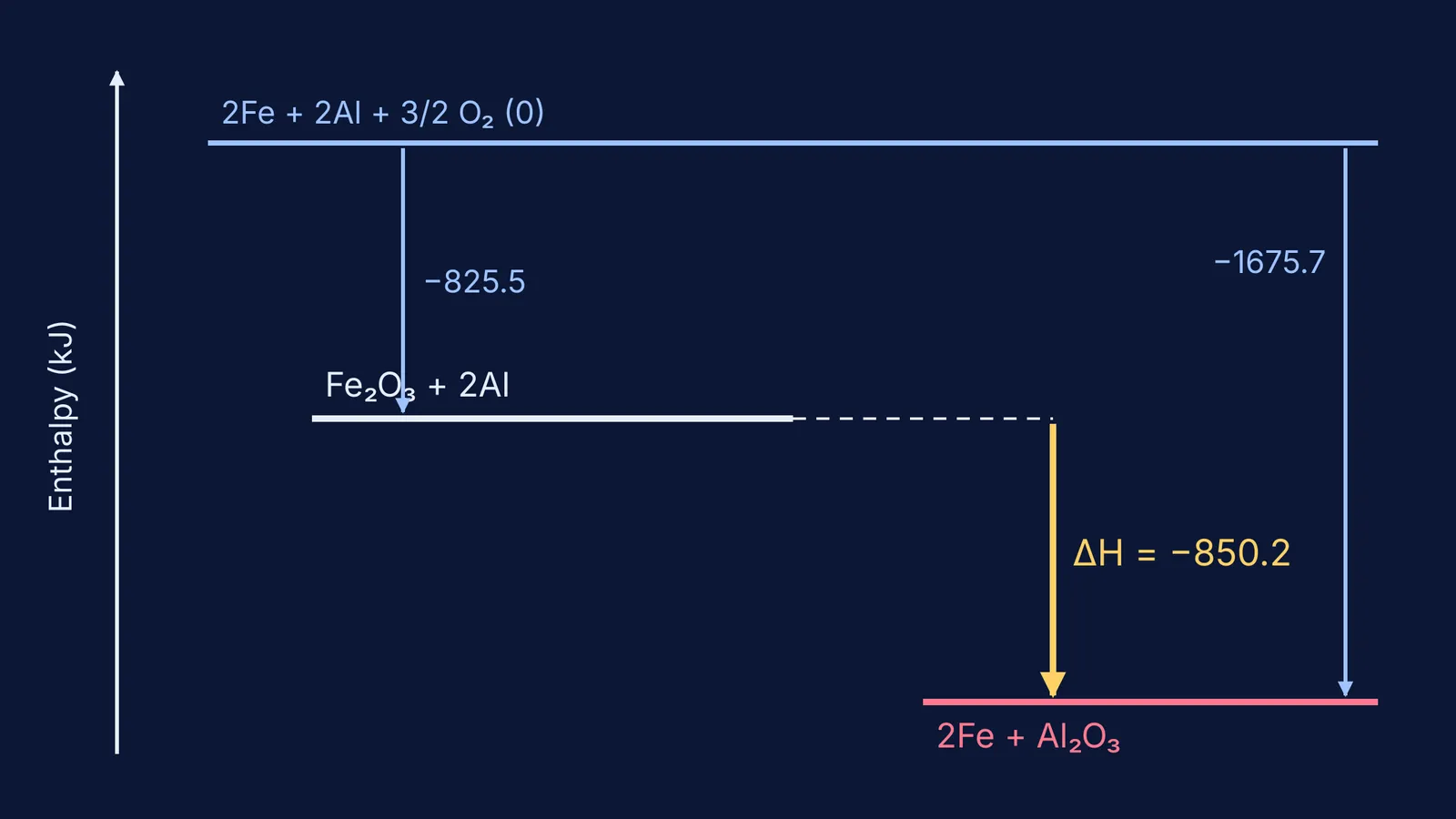
The NIST Chemistry WebBook lists the standard enthalpy of formation of aluminium oxide (corundum) as −1675.7 kJ/mol. For iron(III) oxide (haematite), the NIST entry gives −825.50 kJ/mol. Elements such as Fe and Al are zero by definition.
ΔH = (sum for products) − (sum for reactants).
Products: −1675.7 + 2(0) = −1675.7 kJ.
Reactants: −825.5 + 2(0) = −825.5 kJ.
ΔH = −1675.7 − (−825.5) = −850.2 kJ per mole of Fe₂O₃.
This is the standard value at 25°C, with all products solid. The NIST figures show that forming Al₂O₃ releases about twice as much energy as forming Fe₂O₃. When the oxygen moves from iron to aluminium, about 850 kJ is left over as heat. In energy terms, that is why aluminium wins.
How is thermite used to join railway tracks?
Rails are welded end to end so that trains run over continuous track instead of jointed sections. A description of Indian rail practice by Rajeev Shrivastava on the rail-enthusiast site IRFCA sets out the steps. The rail ends are preheated to about 1000°C, usually with LPG-and-oxygen torches. The thermit portion then reacts in a crucible above the gap for about 20 seconds (20 ± 3 s for the 25 mm and 50 mm gaps). For the 52 kg rail section with a 25 mm gap, the portion weighs 10.8 kg. The mixture also contains ferro-manganese and mild steel particles, so the molten metal poured into the mould is steel rather than pure iron. For the history behind the process, read about Hans Goldschmidt and the thermite process for welding rails.
How do you write a thermite answer in the board exam?
Use this five-line plan for a 3-mark answer:
Define it: "The thermite reaction is the displacement of iron from iron(III) oxide by aluminium."
Write the balanced equation with state symbols and "+ Heat".
Give the reason: aluminium is more reactive than iron.
Label the redox: Al is oxidised, Fe₂O₃ is reduced, and Al is the reducing agent.
Give the use: joining railway tracks or cracked machine parts.
Mistakes that cost marks:
Writing Fe(s) instead of Fe(l).
Leaving it unbalanced: Fe₂O₃ + Al → Fe + Al₂O₃.
Calling it a combination or decomposition reaction.
Saying iron displaces aluminium.
If you keep losing marks on balancing or on picking the oxidising agent, the Fermi Problem Library has worked problems with a step-by-step solver that explains the reasoning rather than printing an answer. For the ideas underneath, the Fermi Concept Library covers every concept in chemistry, each with its own lesson.


