

On this page
Tardigrades, also called water bears, are tiny animals 0.1 to 1.5 mm long that have survived a trip into open space (ScienceDaily, reporting the 2008 Current Biology study). Their trick is not toughness while active. It is the ability to dry out, shut down almost all of life's chemistry, and start again when water returns.
What is the tardigrade tun state?
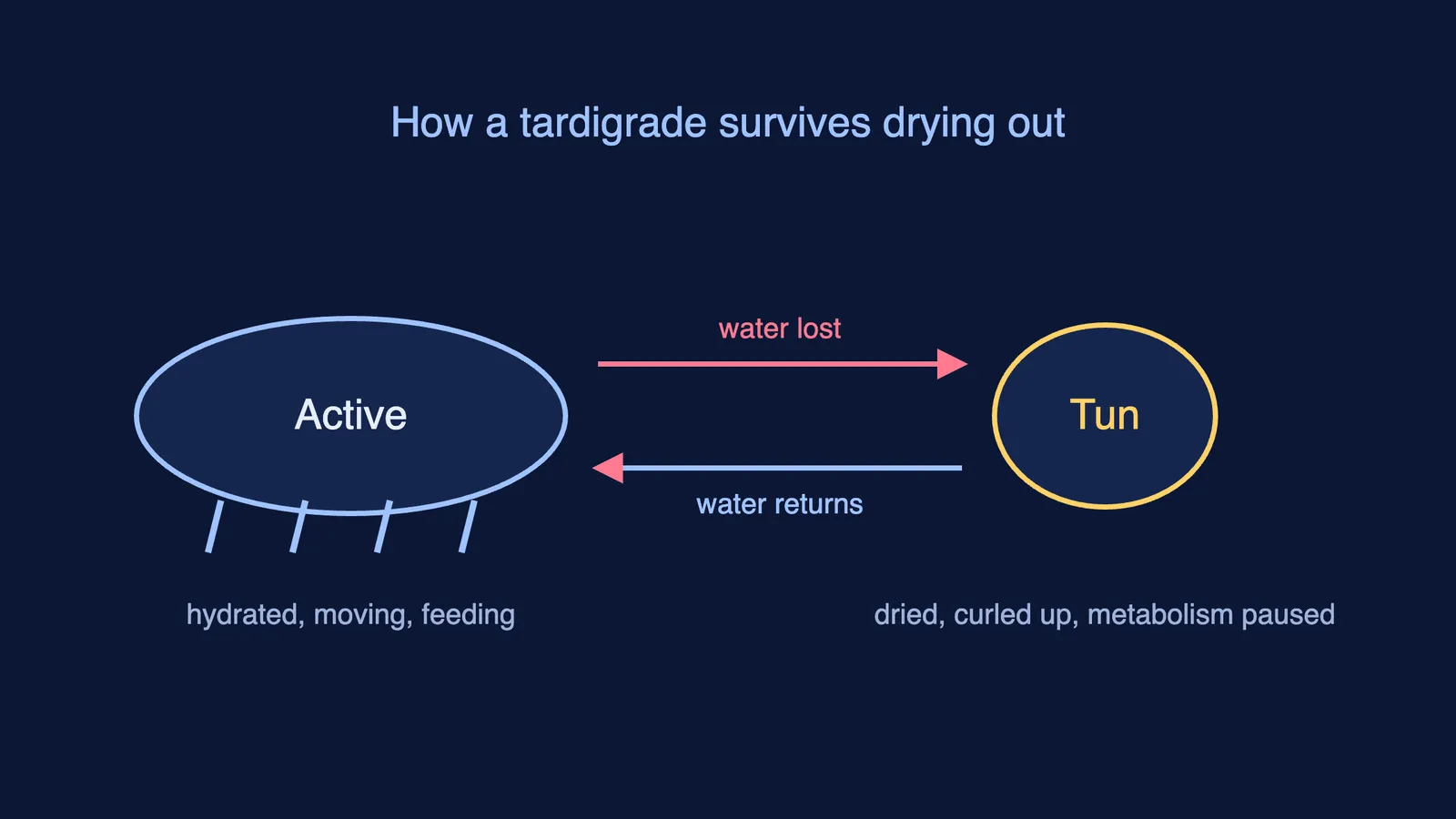
The tun is the contracted, shrivelled form a tardigrade takes when it dries out (Hibshman, Clegg and Goldstein, Frontiers in Physiology, 2020). Desiccated tardigrades keep only 2–3% of the water they had when active, the same review reports. Surviving this way is called anhydrobiosis, which means "life without water". With so little water, metabolism drops sharply, so there is very little chemistry left to go wrong.
Freezing is another way into this shut-down state, called cryptobiosis. Two tardigrades of the Antarctic species Acutuncus antarcticus revived after 30.5 years in a moss sample collected in 1983 and stored at −20 °C, and one of them went on to reproduce (Tsujimoto, Imura and Kanda, Cryobiology, 2016). The revived animals took a long time to recover, which the authors read as a sign that they had damage to repair. For a kitchen example of what freezing and drying do to unprotected tissue, see what causes freezer burn on food.
How do tardigrades survive drying out?
For a long time the main suspect was trehalose, a sugar that helps several organisms survive drying. But a 2017 study led by Thomas Boothby found trehalose at low levels, or not at all, in some tardigrade species (Boothby et al., Molecular Cell, 2017). The team showed instead that tardigrade-specific intrinsically disordered proteins are essential: proteins with no fixed folded shape. Tardigrades needed these proteins to survive drying, and adding the genes to other organisms made those organisms more tolerant. As the animal dries, the proteins set into a non-crystalline, glass-like solid, and this glassy state matched how well they protected.
A second protein guards DNA. A Japanese team sequenced the genome of Ramazzottius varieornatus, one of the most stress-tolerant species, and found a tardigrade-only protein that binds DNA. In human cultured cells it cut X-ray damage to DNA by about 40% (Hashimoto et al., Nature Communications, 2016).
If terms like protein folding or vitrification are new to you, the Fermi Concept Library gives every concept in biology and chemistry its own lesson, so you can fill the gap before reading on.
Can tardigrades really survive in space?
Yes, in the dried tun state and for a limited time. In September 2007, dried tardigrades flew on the European Space Agency's FOTON-M3 spacecraft in low Earth orbit, at around 270 km (ScienceDaily). Ingemar Jönsson's team reported in Current Biology that most survived exposure to vacuum and cosmic rays alone. Solar UV was far harsher, yet some survived even that, after a dose of more than 7,000 kJ per square metre. The survivors could still reproduce afterwards.
Humans, even inside a spacecraft, are far more fragile in space; one example is why astronauts lose bone in space.
What can't tardigrades survive?
Heat and hard impacts are their weak points.
Heat while active: in Ramazzottius varieornatus, the temperature that killed half of active tardigrades over 24 hours was 37.1 °C, roughly human body temperature (Neves et al., Scientific Reports, 2020).
Heat while dried: dried tardigrades did better, with half dying at 82.7 °C over 1 hour, but at only 63.1 °C over 24 hours, in the same study.
Impacts: in lab impact tests they survived speeds up to 0.9 km/s, a shock pressure of 1.14 GPa, but not faster (Traspas and Burchell, Astrobiology, 2021).
The heat study's authors concluded that high temperatures "seem to be their Achilles heel".
How can you check a viral tardigrade claim?
Posts often call tardigrades indestructible. Run any such claim through four questions:
Which state? Active and dried tardigrades behave almost like different animals. Most extreme records are for dried tuns.
For how long? Surviving a temperature for an hour is not surviving it for a day.
What counts as survival? Moving again, or reproducing afterwards? The Antarctic and space studies checked reproduction too.
Which species? Results come from a few species, such as Ramazzottius varieornatus and Acutuncus antarcticus, not all tardigrades.
Those figures come from Neves and colleagues' 2020 heat study. The four questions also make a strong answer in a biology viva. If you get stuck turning a study's numbers into a fair one-line claim, Fermi's AI tutor works out what you already know and builds a plan for the session, so you start with a clear next step.
Next time a post says tardigrades survive anything, ask: which state, for how long, and which species?


