

On this page
Does the line y = mx + c just touch the ellipse or hyperbola? One condition answers that, and two more lines of algebra give the tangents from any outside point.
What is the condition for a line to be tangent to an ellipse?
For the ellipse x²/a² + y²/b² = 1, the line y = mx + c is a tangent exactly when c² = a²m² + b², so the tangents of slope m are y = mx ± √(a²m² + b²) (Wikipedia, Ellipse: tangent slope as parameter).
To rebuild it in the exam hall:
Substitute y = mx + c into the ellipse and clear denominators: (b² + a²m²)x² + 2a²mcx + a²(c² − b²) = 0.
A tangent touches the curve at a single repeated point, so this quadratic needs a zero discriminant.
The discriminant simplifies to 4a²b²(a²m² + b² − c²), so c² = a²m² + b².
Since a²m² + b² is always positive, every slope gives two tangents to an ellipse. The tangent y = mx + c touches it at (−a²m/c, b²/c).
How is the condition different for a hyperbola?
For the hyperbola x²/a² − y²/b² = 1, the line y = mx + c is a tangent exactly when c² = a²m² − b², valid only when |m| > b/a (Wikipedia, Hyperbola: tangent slope as parameter). The derivation is the ellipse one with b² replaced by −b², and the contact point becomes (−a²m/c, −b²/c).
The minus sign matters: a²m² − b² must be positive, so the tangent must be steeper than the asymptotes, whose slopes are ±b/a. At exactly |m| = b/a you get c = 0, the asymptote itself, which never touches the curve.
Try x²/9 − y²/4 = 1 (a = 3, b = 2, asymptote slope 2/3):
Slope 1: c² = 9 − 4 = 5, so the tangents are y = x ± √5.
Slope 1/2: c² = 9/4 − 4 = −7/4. No real c, so no tangent.
For why b/a is the cut-off, see finding the asymptotes of a hyperbola from a and b.
How do you find the tangents from an external point?
Run the condition backwards:
A line through (h, k) with slope m has c = k − mh.
Put that into the condition: (k − mh)² = a²m² + b² for the ellipse.
Expand: (h² − a²)m² − 2hkm + (k² − b²) = 0. The two roots are the two tangent slopes. For the hyperbola, the last term is (k² + b²).
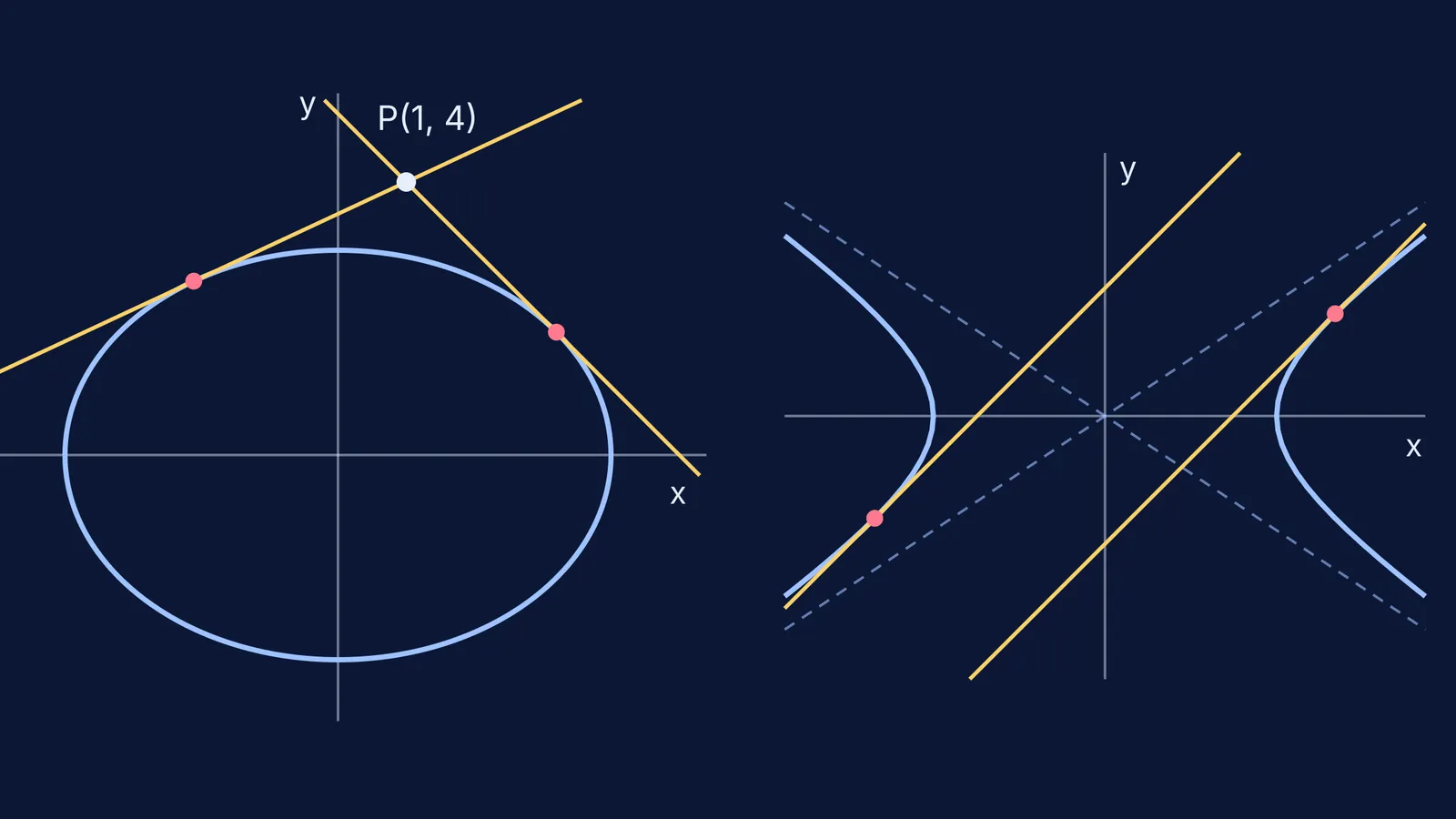
What are the tangents from (1, 4) to x²/16 + y²/9 = 1?
Here a² = 16, b² = 9, h = 1, k = 4. The point is outside, since 1/16 + 16/9 > 1. The slope equation (1 − 16)m² − 8m + (16 − 9) = 0 becomes 15m² + 8m − 7 = 0, which factors as (m + 1)(15m − 7) = 0.
m = −1: c = 5, and 25 = 16 + 9. Tangent y = −x + 5, touching at (16/5, 9/5).
m = 7/15: c = 53/15, and 2809/225 = 784/225 + 2025/225. Tangent 15y = 7x + 53, touching at (−112/53, 135/53).
The diagram at the top is drawn from these numbers.
When are the two tangents perpendicular?
The product of the roots of the slope equation is (k² − b²)/(h² − a²); setting it to −1 gives h² + k² = a² + b².
Perpendicular tangents to the ellipse x²/a² + y²/b² = 1 meet on the circle x² + y² = a² + b², called the director circle (Wikipedia, Ellipse: orthoptic). For the hyperbola x²/a² − y²/b² = 1 the circle is x² + y² = a² − b², and when a ≤ b there are no perpendicular pairs at all (Wikipedia, Hyperbola: orthogonal tangents).
For (1, 4), 1 + 16 = 17 is not 25, and indeed (−1) × (7/15) is not −1.
A five-step checklist for exam questions
Put the curve in standard form; read off a², b² and the sign.
Given a slope: use c² = a²m² ± b² (hyperbola: check |m| > b/a first).
Given a point: set c = k − mh and solve for m.
If the m² coefficient is zero, add x = h.
Substitute one contact point back into the curve.
If a check fails, retrace the expansion of (k − mh)² first. The Fermi Problem Library has worked problems with a step-by-step solver that explains the reasoning rather than printing an answer, so you can find the line where your working went wrong. If slope form itself feels shaky, the Fermi Concept Library gives each concept its own lesson. For general curves, see how to find the tangent to a curve parallel to a given line.


