

On this page
In coordinate geometry and calculus, finding the exact point where a curve runs parallel to a straight line is a common task. You will see this frequently in the Class 12 mathematics curriculum under the application of derivatives.
The core idea relies on one simple rule: parallel lines always have the same slope. If a tangent line is parallel to a given line, you already know the tangent's slope. You just need to find where on the curve the slope matches that number.
How Do You Find the Point on the Curve?
The derivative of a curve's equation, dy/dx, gives you a formula for the slope of the tangent at any general point (x, y) along the function. By finding the slope of the given line and setting dy/dx equal to it, you create an algebraic equation that reveals the exact x-coordinate where the two slopes match.
If you find yourself struggling to calculate derivatives for more complex functions, the Fermi Problem Library has worked problems with a step-by-step solver that explains the reasoning rather than printing an answer. This is especially helpful if you need to review how to apply the chain rule or product rule before tackling tangent problems.
What Are the Steps to Solve Tangent Problems?
Whenever you face a question asking for a tangent parallel to a line, follow this reliable sequence:
Find the slope of the given line (m). If the line is in the standard form Ax + By + C = 0, rearrange it to the slope-intercept form y = mx + c to see the slope clearly.
Find the derivative of the curve (dy/dx). This mathematical expression represents the slope of the tangent at any point.
Equate the two slopes. Set dy/dx = m.
Solve the resulting equation for x. This gives you the precise x-coordinate of the point of contact.
Substitute this x-value back into the original curve's equation to find the corresponding y-coordinate.
Once you have both coordinates, you have found your point of tangency. If the question also asks for the equation of the tangent line itself, you can write it using the point-slope form: y - y₁ = m(x - x₁).
How Does a Complete Example Work?
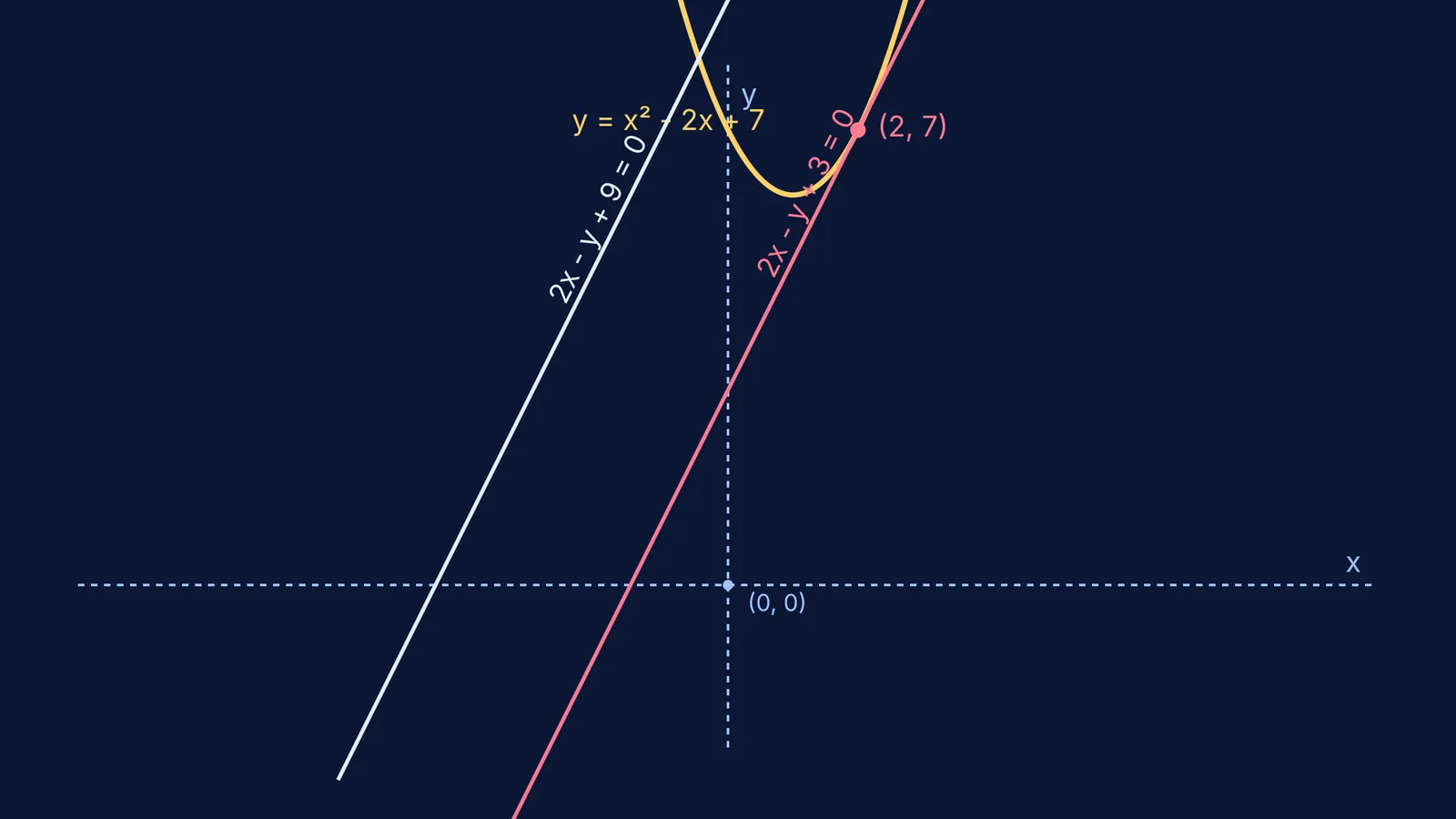
Let's apply the framework to a classic problem: Find the point on the curve y = x² - 2x + 7 where the tangent is parallel to the line 2x - y + 9 = 0.
Step 1: Find the slope of the given line. Rearrange 2x - y + 9 = 0 into the y = mx + c format. y = 2x + 9 The slope (m) of this line is 2.
Step 2: Find the derivative of the curve. Take the equation y = x² - 2x + 7 and differentiate it with respect to x. dy/dx = 2x - 2
Step 3: Equate the slopes. Since the tangent is parallel to the line, their slopes are equal. 2x - 2 = 2
Step 4: Solve for x. 2x = 4 x = 2
Step 5: Find the y-coordinate. Substitute x = 2 back into the original equation of the curve (not the line or the derivative). y = (2)² - 2(2) + 7 y = 4 - 4 + 7 y = 7
The point on the curve where the tangent is parallel to the given line is (2, 7).
If you need to find the equation of this tangent line, you know it passes through (2, 7) and has a slope of 2. Using y - y₁ = m(x - x₁), we get y - 7 = 2(x - 2), which simplifies to 2x - y + 3 = 0.
What If the Function Is Complex?
While polynomials are straightforward, the same logic applies to any differentiable curve. You might encounter scenarios where the curve is defined differently. For instance, if the curve is given in terms of a third variable, you will need to review Differentiating parametric functions to find dy/dx first.
Similarly, if the question involves more complex substitutions, practicing Differentiating one expression with respect to another can build your confidence. Finally, if you are asked to determine whether this point represents a local maximum or minimum on the curve, you would need to evaluate Second-order derivatives.


