

On this page
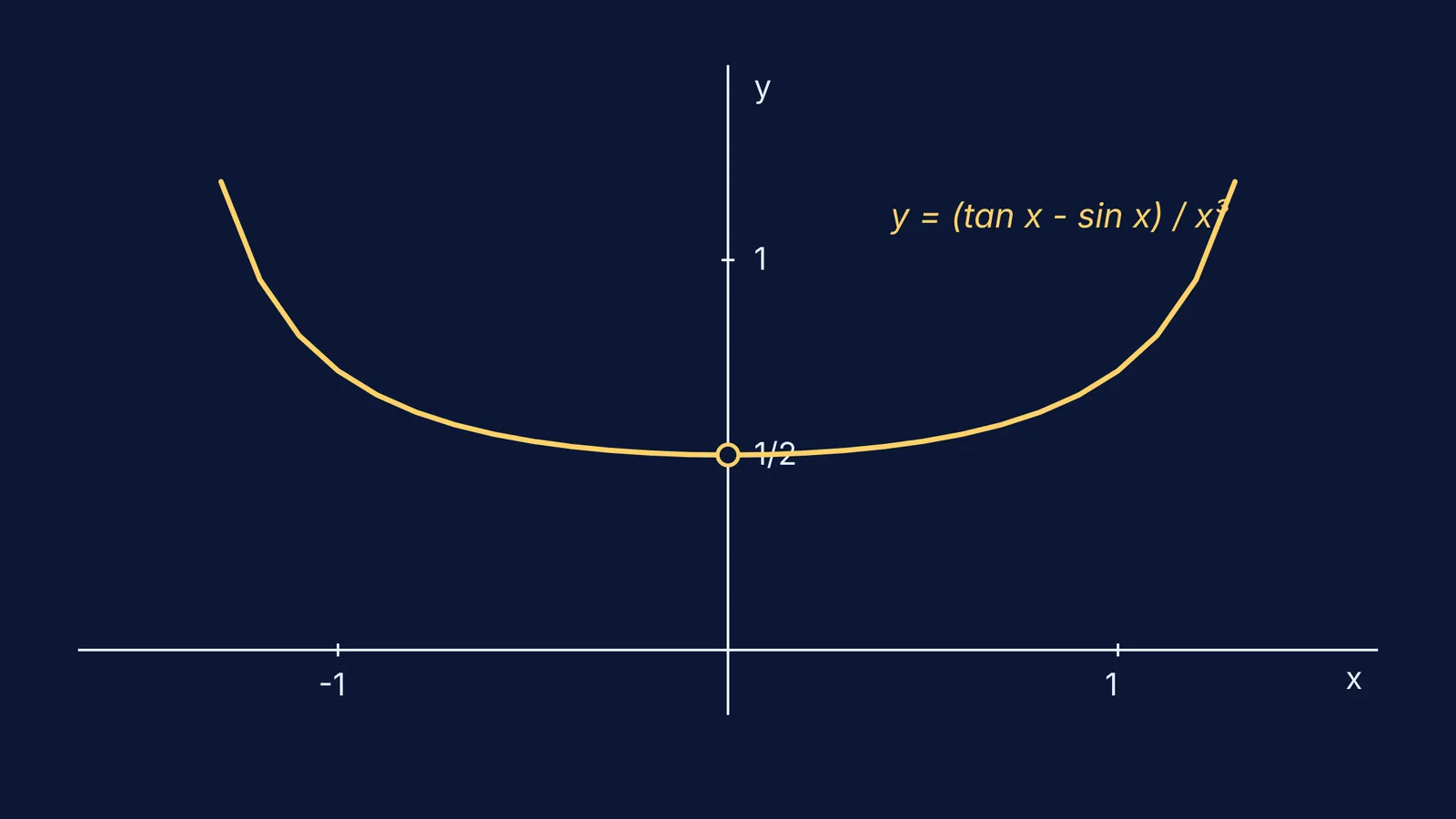
Evaluating limits with trigonometric functions and powers of `x` can seem daunting when direct substitution leaves you with an undefined answer. The limit of `(tan x - sin x) / x³` as `x → 0` is a classic calculus problem that tests your algebra skills.
Why does direct substitution fail?
When you substitute `x = 0` into `(tan x - sin x) / x³`, both the numerator and denominator become zero. This creates an indeterminate form of `0/0`.
At this point, many students immediately reach for L'Hôpital's rule or write out the Taylor series for sine and tangent. While those methods work, applying L'Hôpital's rule three times requires heavy differentiation, and expanding series can lead to sign errors. There is a faster, cleaner path using algebra and standard limit laws, which allow us to break a complex function into manageable pieces.
How do you factorise the expression?
The trick is to convert everything to sines and cosines. We know that `tan x = sin x / cos x`. Let's substitute this into the numerator:
`tan x - sin x = (sin x / cos x) - sin x`
Now, factor out `sin x`:
`sin x [ (1 / cos x) - 1 ]`
To combine the terms in the bracket, find a common denominator:
`sin x [ (1 - cos x) / cos x ]`
Because `(sin x / cos x)` is `tan x`, we can pull that back together. The numerator neatly simplifies to:
`tan x (1 - cos x)`
Now, rewrite the original fraction by splitting the `x³` in the denominator into `x` and `x²`:
`[ (tan x) / x ] × [ (1 - cos x) / x² ]`
This separation is the key to solving the limit. Instead of one complicated fraction, you now have a product of two simpler fractions. The product limit law states that the limit of a product is the product of the limits, provided they both exist. This is a fundamental rule of calculus, as outlined by OpenStax Calculus on LibreTexts/02%3A_Limits/2.03%3A_The_Limit_Laws).
What standard limit values do you need?
Now we take the limit as `x → 0` for each part separately.
The tangent limit:
The limit of `(tan x) / x` as `x → 0` is `1`. You can prove this by rewriting it as `(sin x / x) × (1 / cos x)`. Since the standard limit of `(sin x) / x` is `1`, and `cos 0` is `1`, the result is `1 × 1 = 1`.
The cosine limit:
We need the limit of `(1 - cos x) / x²` as `x → 0`. To find this without series, multiply the numerator and denominator by the conjugate, `(1 + cos x)`:
`(1 - cos x)(1 + cos x) / [ x² (1 + cos x) ]`
`= (1 - cos² x) / [ x² (1 + cos x) ]`
Since `1 - cos² x = sin² x`, this becomes:
`(sin² x / x²) × [ 1 / (1 + cos x) ]`
As `x → 0`, the term `(sin x / x)²` approaches `1² = 1`. The second part becomes `1 / (1 + cos 0) = 1 / (1 + 1) = 1/2`.
So, the limit of `(1 - cos x) / x²` is exactly `1/2`.
How do you calculate the final answer?
Finally, we multiply our two evaluated limits together:
`Limit = 1 × 1/2 = 1/2`
How does L'Hôpital's rule compare?
While we solved this using algebra and standard limits, another valid approach is L'Hôpital's rule, which states that for a `0/0` indeterminate form, you can differentiate the numerator and denominator. Let's see what happens if you choose that path.
Taking the first derivative of the top gives `sec² x - cos x`, and the bottom gives `3x²`. Evaluating this at `x = 0` gives `(1 - 1) / 0`, which is still `0/0`. You must differentiate again.
The second derivative of the numerator is `2 sec² x tan x + sin x`, and the denominator becomes `6x`. Substituting `x = 0` gives `(0 + 0) / 0`, leaving you with yet another `0/0` form.
Taking the third derivative gives `2(2 sec² x tan² x + sec⁴ x) + cos x` for the top, and `6` for the bottom. Finally, substituting `x = 0` into this lengthy expression yields `(2(0 + 1) + 1) / 6 = 3/6 = 1/2`.
As you can see, applying L'Hôpital's rule requires you to take three successive derivatives involving chain rules and product rules. This creates multiple opportunities to drop a coefficient or misplace a sign. While it provides the correct answer, the algebraic factorisation method is often safer and faster in an exam setting.
What are two common mistakes to avoid?
Stopping at the first simplification: Some students factor out `sin x` to get `sin x (1/cos x - 1) / x³` and then try to evaluate it immediately. Because `1/cos 0 - 1 = 0` and the denominator is `0`, they get stuck in another `0/0` loop. You must group the terms strategically so they match known standard limits.
Dropping powers of x: When splitting `x³` into `x` and `x²`, it is easy to accidentally write `(tan x) / x` and `(1 - cos x) / x`. If you do that, the second limit evaluates to `0` (since the limit of `(1 - cos x) / x` is `0`), giving a final answer of `0` instead of `1/2`. Always check that the powers of `x` in your separated fractions multiply back to the original denominator.
By relying on standard trigonometric limits rather than expanding series, you save time and reduce the chance of algebraic mistakes. If you are reviewing calculus before a major test and find yourself stuck on indeterminate forms, you can solve similar limits step by step with the Fermi Problem Library, a step-by-step solver that explains the reasoning.
For more visual ways to understand calculus, you can explore the derivative as the slope of a tangent. If you are looking to apply graphing techniques elsewhere, see our guide on finding the number of solutions of a trigonometric equation.


