

On this page
When angles go up by the same step, as in sin x + sin 2x + ... + sin nx, one formula turns the sum into a single fraction.
What is the formula for the sum of sines in arithmetic progression?
Take n angles a, a + d, ..., a + (n − 1)d, where the common difference d is not a multiple of 2π (360°).
sin a + sin(a + d) + ... + sin(a + (n − 1)d) = [sin(nd/2) / sin(d/2)] × sin(a + (n − 1)d/2), as stated on ProofWiki's page on the sum of sines of an arithmetic sequence of angles.
cos a + cos(a + d) + ... + cos(a + (n − 1)d) = [sin(nd/2) / sin(d/2)] × cos(a + (n − 1)d/2), the matching result on ProofWiki's cosine page.
ProofWiki's first version sums from k = 0 to n (n + 1 terms); the form above is rewritten for n terms. In words:
The ratio: sin of (number of terms × half the step) over sin of half the step.
Then sin (or cos) of the average of the first and last angles.
Quick check: with n = 2 the formula gives [sin d / sin(d/2)] sin(a + d/2) = 2 cos(d/2) sin(a + d/2), the sum-to-product formula you already know.
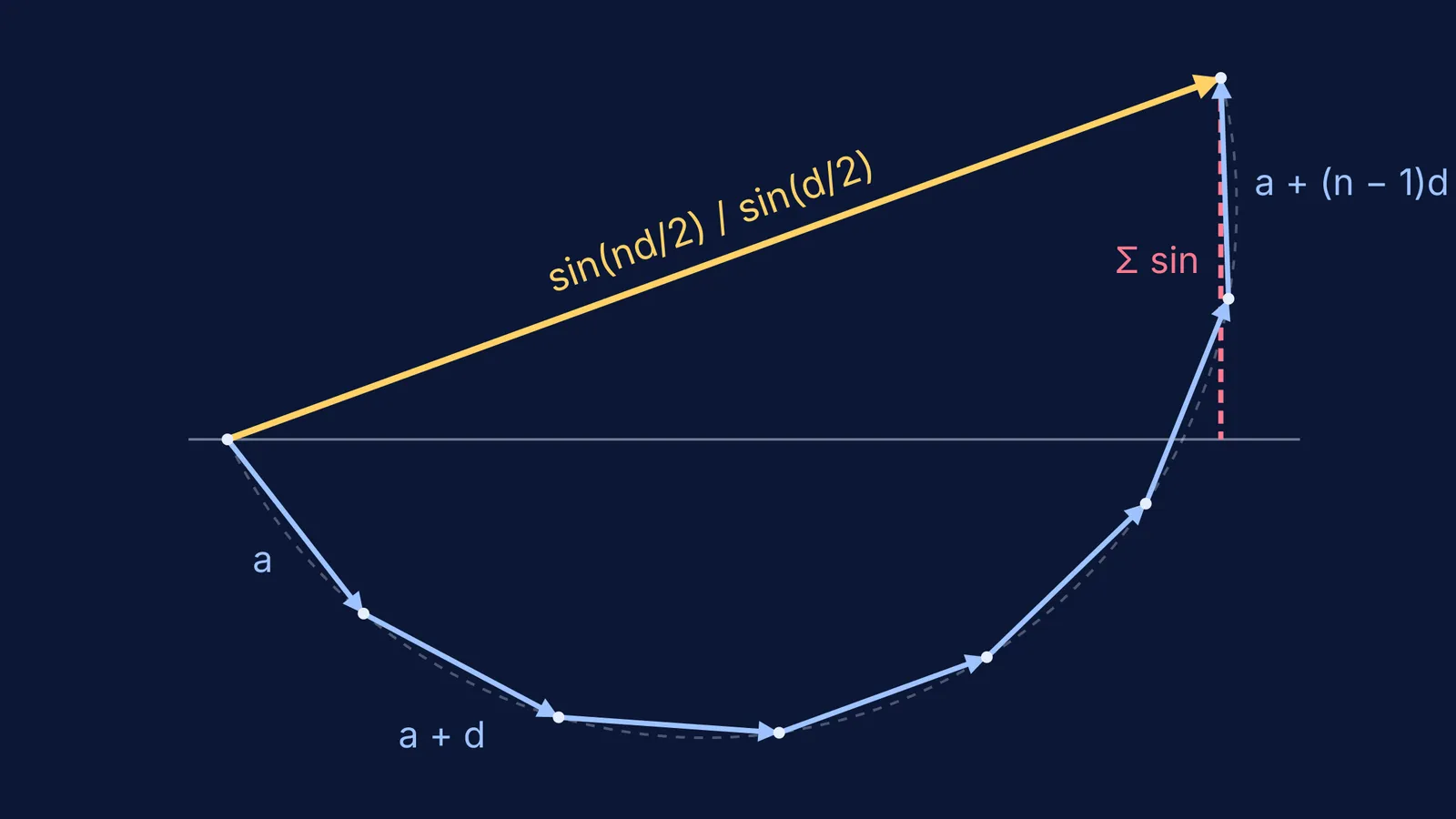
Geometrically, unit arrows at these angles laid tip to tail sit on a circle. The arrow from start to finish has length |sin(nd/2)/sin(d/2)|, lies along the average angle, and its height is the sine sum. If d is a multiple of 2π the formula breaks, but then every term equals sin a and the sum is n sin a.
How do you derive it by telescoping?
Multiply every term by 2 sin(d/2). The identity 2 sin A sin B = cos(A − B) − cos(A + B), covered in our post on converting products like 2 sin A cos B into sums, turns each term into a difference:
2 sin(d/2) sin(a + kd) = cos(a + (k − 1/2)d) − cos(a + (k + 1/2)d).
For k = 0 this is cos(a − d/2) − cos(a + d/2); for k = 1 it is cos(a + d/2) − cos(a + 3d/2). Each negative term cancels the positive term of the next one, just as 1/n − 1/(n + 1) collapses in the telescoping sum of 1 over n(n + 1). Only the two ends survive:
2 sin(d/2) × S = cos(a − d/2) − cos(a + (n − 1/2)d).
Now use cos C − cos D = 2 sin((C + D)/2) sin((D − C)/2). The half-sum is a + (n − 1)d/2 and the half-difference is nd/2. Divide by 2 sin(d/2) and the formula appears. For cosines, 2 sin(d/2) cos(a + kd) = sin(a + (k + 1/2)d) − sin(a + (k − 1/2)d) telescopes the same way.
How do you use it on cosine sums?
Example: find cos(2π/7) + cos(4π/7) + cos(6π/7).
Here n = 3, d = 2π/7, and the average of the first and last angles is 4π/7.
Sum = [sin(3π/7) / sin(π/7)] × cos(4π/7).
2 sin(3π/7) cos(4π/7) = sin π + sin(−π/7) = −sin(π/7).
So the sum = −sin(π/7) / (2 sin(π/7)) = −1/2.
Check it on a calculator in radian mode: 0.6235 − 0.2225 − 0.9010 = −0.5000.
How do products of cosines use the same trick?
For products where each angle doubles (x, 2x, 4x, ...), multiply by sin x and let 2 sin x cos x = sin 2x fold them up one factor at a time. Wikipedia's list of trigonometric identities gives the general result: cos x · cos 2x · cos 4x ··· cos(2^(k−1) x) = sin(2^k x) / (2^k sin x).
With x = 20° and k = 3: cos 20° cos 40° cos 80° = sin 160° / (8 sin 20°) = 1/8, because sin 160° = sin 20°. This is Morrie's law; Wikipedia says Richard Feynman named it after Morrie Jacobs, a boy he knew in childhood.
With x = π/7 and k = 3 the product is sin(8π/7) / (8 sin(π/7)) = −1/8. Since cos(4π/7) = −cos(3π/7), this gives cos(π/7) cos(2π/7) cos(3π/7) = 1/8.
The sum formula needs equal gaps (an AP); this product trick needs doubling angles (a GP).
How do you solve any AP trig sum step by step?
Write down a, d and n. Count carefully: x to nx is n terms, but 0 to nx is n + 1.
Write sin(nd/2) / sin(d/2), times sin or cos of the average angle, (first + last)/2.
Simplify with known values or one product-to-sum step.
Test with n = 2 or a calculator.
If your answer keeps going wrong at step 2 or 3, the Fermi Problem Library has worked problems with a step-by-step solver that explains the reasoning rather than printing an answer. If the product-to-sum formulas feel shaky, the Fermi Concept Library gives every concept in mathematics its own lesson and its place in the map.
Try one now: write sin 1° + sin 2° + ... + sin 89° in closed form, then check it on your calculator.


