

On this page
When you study sequences, you will often see geometric progressions where each term grows or shrinks by a constant multiplier. When this multiplier—the common ratio, r—is negative, the behaviour of the series changes significantly. The terms flip back and forth across zero, creating an alternating sequence.
Why does a negative common ratio make terms alternate?
A geometric progression (GP) is a sequence where each term is found by multiplying the previous one by a fixed non-zero number. If the first term (a) is positive and the common ratio (r) is negative, the second term (ar) becomes negative. The third term (ar²) multiplies that negative value by the negative ratio again, making it positive.
This repeated multiplication causes the adjacent terms in the series to alternate between positive and negative signs.
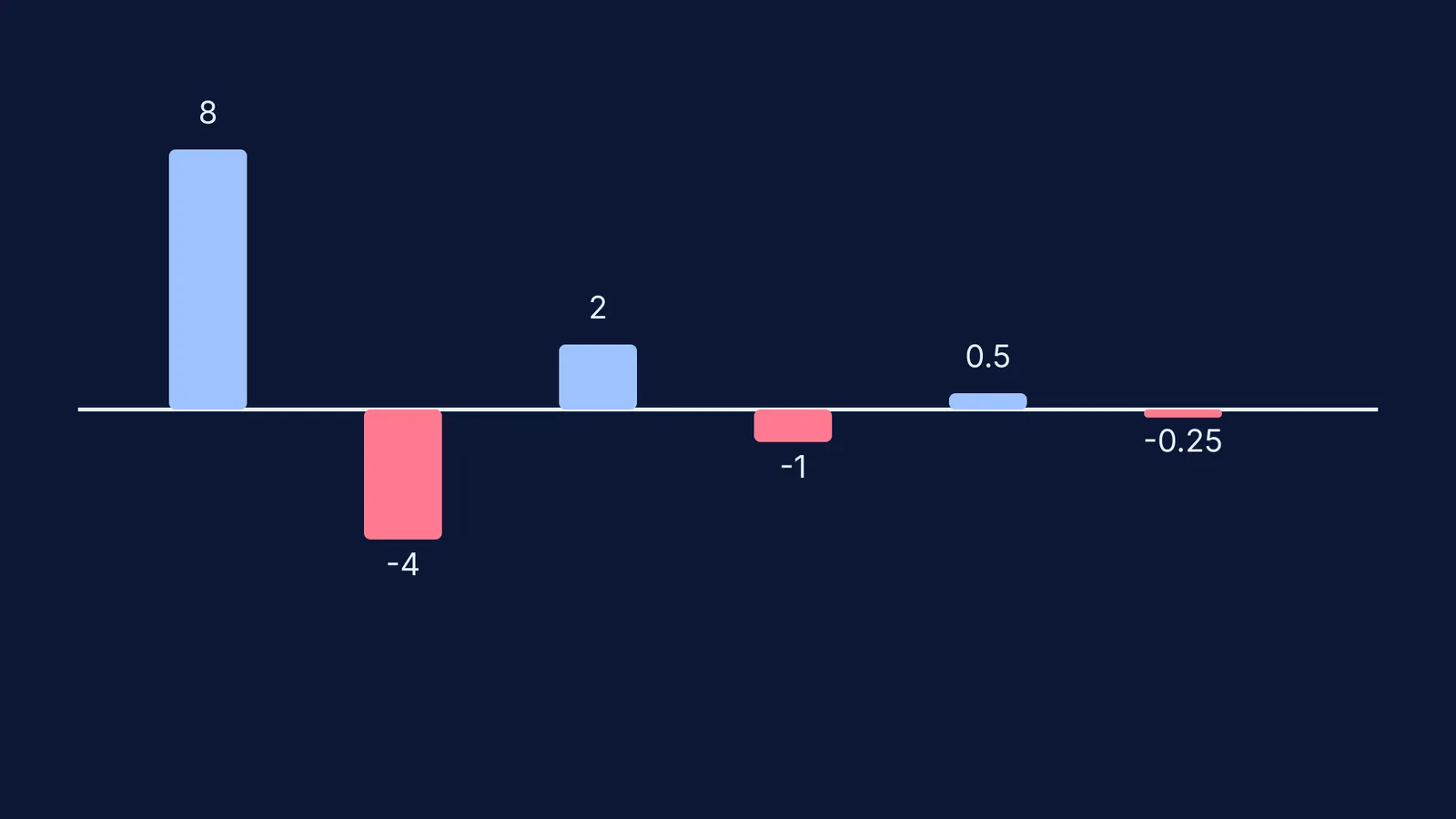
For example, consider a sequence with a first term of 8 and a common ratio of -1/2. The terms are 8, -4, 2, -1, 0.5, -0.25, and so on. Understanding why these signs change is crucial before you attempt to sum them. If you ever struggle with the core rules of multiplication, reviewing Why Is a Negative Times a Negative Positive? can help build a stronger foundation.
How do you find the sum of n terms with a negative ratio?
The standard formula for the sum of the first n terms of a GP is Sn = a(1 - rⁿ) / (1 - r). This equation applies whether the common ratio is positive or negative.
However, you must check whether n is even or odd. When n is an even number, a negative rⁿ becomes positive. When n is an odd number, rⁿ remains negative, meaning you will subtract a negative number (which is the same as adding it) in the numerator.
Worked Example: Sum of 3 terms Let us find the sum of the first 3 terms (n=3) for our GP where a = 8 and r = -1/2.
Set up the formula: S₃ = 8(1 - (-1/2)³) / (1 - (-1/2))
Calculate the powers: (-1/2)³ = -1/8.
Substitute back: S₃ = 8(1 - (-1/8)) / (1 + 1/2)
Simplify the fractions: S₃ = 8(1 + 1/8) / (3/2) = 8(9/8) / (3/2)
Final result: S₃ = 9 / 1.5 = 6.
If you frequently drop negative signs while practising, the Fermi Problem Library explains the reasoning behind each line of algebra in a step-by-step solver, helping you spot algebraic slips before they become a habit. You can also explore how these formulas behave for different ranges in our guide to the Sum of n terms of a GP when r is less than 1.
What happens in an infinite series when r = -1/2?
An infinite geometric series converges if and only if the magnitude of the common ratio is strictly less than one (|r| < 1).
When the common ratio falls in this range, the sum of the series does not blow up to infinity. Instead, the partial sums oscillate above and below the final limit as they converge toward it. The formula for the sum to infinity is S∞ = a / (1 - r).
For our example where a = 8 and r = -1/2: S∞ = 8 / (1 - (-1/2)) = 8 / 1.5 = 16/3.
Because the ratio is negative, the denominator becomes (1 + |r|), which is greater than 1. This mathematical property means the infinite sum of an alternating geometric series will always be smaller in magnitude than the first term. To master the proofs behind convergence and divergence, you can study them deeply in the Fermi Concept Library, which breaks down the logic instead of asking you to memorise formulas.
What if the negative ratio is exactly -1?
If the common ratio is -1 or lower (r ≤ -1), the infinite series diverges.
The most famous example is Grandi's series, which is the divergent infinite series 1 - 1 + 1 - 1 + ..., named after the Italian mathematician Guido Grandi. Here, the first term is a = 1 and the common ratio is r = -1.
If you try to sum this sequence step by step, the total jumps between 1 (for an odd number of terms) and 0 (for an even number of terms). Because the sequence never settles on a single number, standard calculus considers it divergent. Keeping track of these boundary conditions prevents you from applying the sum-to-infinity formula where it does not belong.
In advanced calculus, alternating geometric progressions often appear within power series. For example, the expansion of 1/(1+x) produces 1 - x + x² - x³ + ..., which acts as an alternating GP when x is positive. Understanding how to manipulate these alternating terms is incredibly useful when you study Limits using series expansions: sin x, eˣ and ln(1 + x).


