

On this page
When evaluating the integral ∫ x³ e^(x²) dx, your first impulse might be to apply integration by parts right away. After all, the integrand multiplies an algebraic power by an exponential term. In the CBSE Class 12 mathematics syllabus, students learn the LIATE rule to assign parts.
Yet applying that rule directly creates a roadblock. Setting u = x³ leaves dv = e^(x²) dx. Because e^(x²) has no elementary antiderivative, you cannot find v in closed form.
This impasse matches findings by researchers Vahid Borji and Vicenç Font. In a 2019 study in the EURASIA Journal of Mathematics, Science and Technology Education, they observed that calculus students frequently struggle with integration by parts because they apply formulas mechanically without checking if their choices produce a simpler integral. To evaluate ∫ x³ e^(x²) dx, you must simplify the integrand's structure first.
How do you solve the integral using substitution and parts?
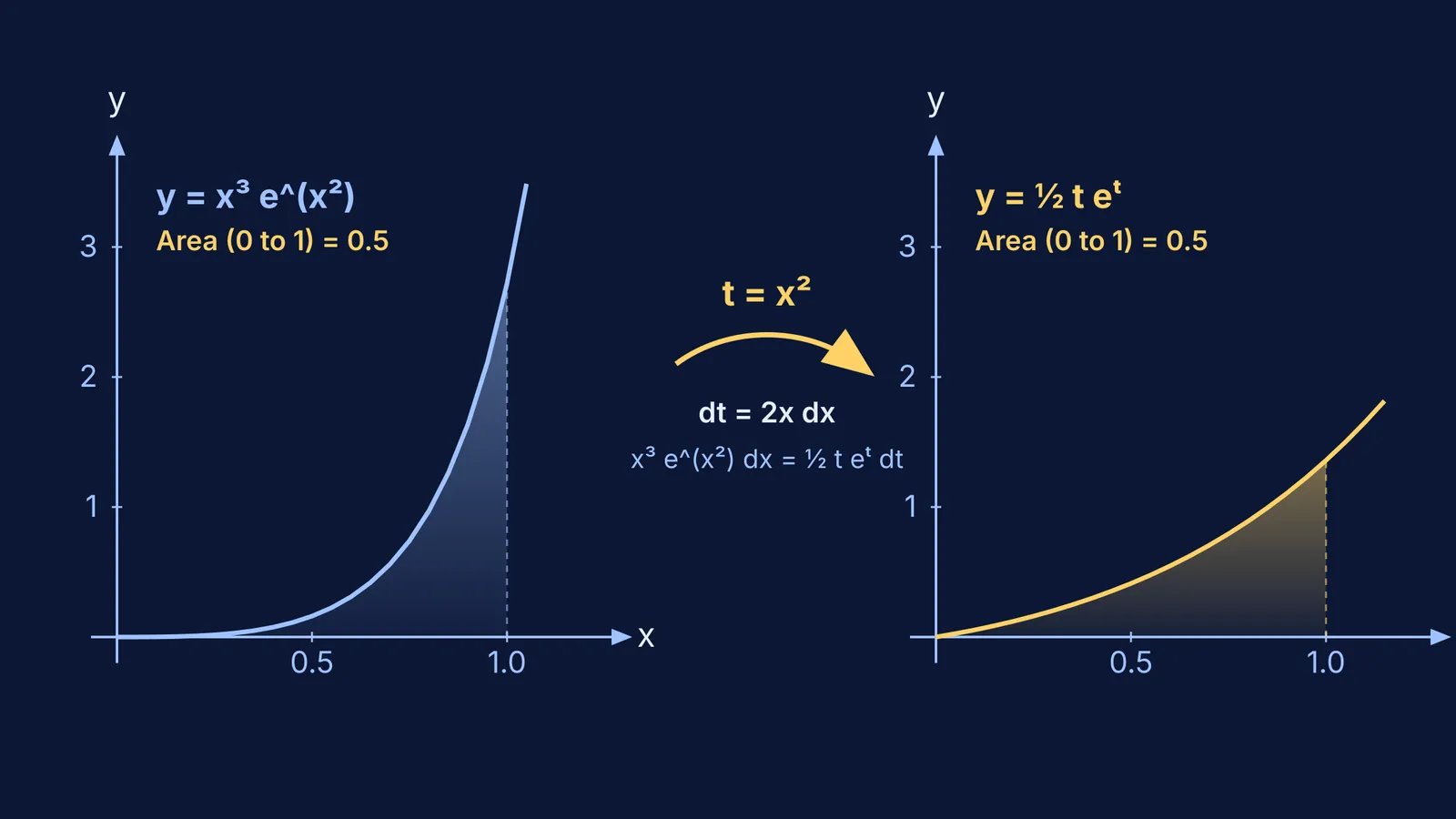
The breakthrough comes from splitting one factor of x to supply the differential for substitution:
∫ x³ e^(x²) dx = ∫ x² e^(x²) (x dx)
Now substitute t = x²:
Let t = x².
Differentiate: dt = 2x dx, so x dx = dt / 2.
Replace variables: x² becomes t, e^(x²) becomes eᵗ, and x dx becomes dt / 2.
Factoring out 1/2 leaves:
(1/2) ∫ t eᵗ dt
This converts the problem into standard integration by parts, as presented in NCERT Class 12 Mathematics Part II. Using the parts formula ∫ u dv = u v − ∫ v du:
Let u = t, giving du = dt.
Let dv = eᵗ dt, giving v = eᵗ.
Evaluating gives:
∫ t eᵗ dt = t eᵗ − ∫ eᵗ dt = (t − 1)eᵗ + C
Multiplying by the outer 1/2:
(1/2)(t − 1)eᵗ + C
Substituting back t = x² yields the final answer:
(1/2)(x² − 1)e^(x²) + C
When you are unsure whether an algebraic rewrite simplifies an integral, the Fermi Problem Library offers worked problems with a step-by-step solver that explains the reasoning rather than printing an answer.
Can you solve this integral by parts directly?
You can solve it using parts directly, provided you group the factors strategically:
∫ x³ e^(x²) dx = ∫ (x²) · (x e^(x²) dx)
Here, split the integrand into:
u = x², so du = 2x dx.
dv = x e^(x²) dx, so v = (1/2) e^(x²).
Applying integration by parts:
∫ u dv = x² · (1/2) e^(x²) − ∫ (1/2) e^(x²) (2x dx) = (1/2) x² e^(x²) − (1/2) e^(x²) + C = (1/2)(x² − 1)e^(x²) + C
While this avoids an explicit variable swap, calculating v requires an implicit mental substitution during the parts setup. In a 1988 study in Cognitive Science, psychologist John Sweller demonstrated that tracking simultaneous sub-goals overloads working memory. Splitting the problem into two sequential steps—substitution first, then parts—reduces errors during timed tests. For related techniques, see our guides on the integral of sec³ x using parts and definite integration by parts with limits.
How do you spot when an integral requires combined methods?
In competitive exams like JEE Main, identifying compound integration patterns saves crucial time. In a study of 50 undergraduate students published in the International Journal of Mathematical Education in Science and Technology, researcher Nevin Mahir noted that while students handle individual procedures well, they struggle when problems demand structural flexibility.
Use this checklist to identify integrals requiring substitution followed by parts:
Identify the composite power: Find nonlinear terms like e^(x²), sin(x²), or cos(x³).
Inspect the polynomial degree: An odd power like x³ or x⁵ supplies x dx for substitution while leaving even powers to convert into t or t².
Check the transformed expression: Ensure the new integral reduces to a standard polynomial-exponential product, or explore how substitution pairs with partial fractions.
You can verify any antiderivative by differentiating. Applying the product rule to (1/2)(x² − 1)e^(x²) returns x³ e^(x²).
To explore how these methods connect across calculus, the Fermi Concept Library includes every concept in mathematics, each with its own lesson and its place in the map.


