

On this page
Calculus is the heaviest unit in the 2024-25 CBSE Class 12 mathematics exam, accounting for 35 out of the total 80 marks (CBSE Curriculum 2024-25). A major chunk of that comes from definite integrals and their applications.
When a problem asks you to integrate the product of two functions between specific limits, you use integration by parts. The standard indefinite formula is ∫ u dv = uv − ∫ v du.
But when limits are involved, students face a choice: do you evaluate the limits at the very end, or do you apply them to the first part immediately?
Evaluating the limits straight away on the uv term is almost always the better choice. It keeps your working tidy, minimises the number of terms you have to carry forward, and drastically reduces the chances of a sign error.
How do you do integration by parts with limits?
When you add lower limit a and upper limit b to the integration by parts formula, it becomes: ∫ u dv from a to b = [uv] from a to b − ∫ v du from a to b
Notice the square brackets on the uv term. This means you plug in the upper limit b, subtract what you get when you plug in the lower limit a, and compress that entire section into a single number before you worry about the second integral.
Why does this matter? If you leave the limits until the end, you end up dragging a large polynomial or trigonometric expression through multiple lines of working. When you finally substitute the numbers, you are staring at a massive bracketed expression filled with negative signs. That is where mistakes happen.
By evaluating the limits on uv immediately, you often find that terms turn to zero. This clears the clutter from your page and lets you focus all your attention on evaluating the remaining ∫ v du.
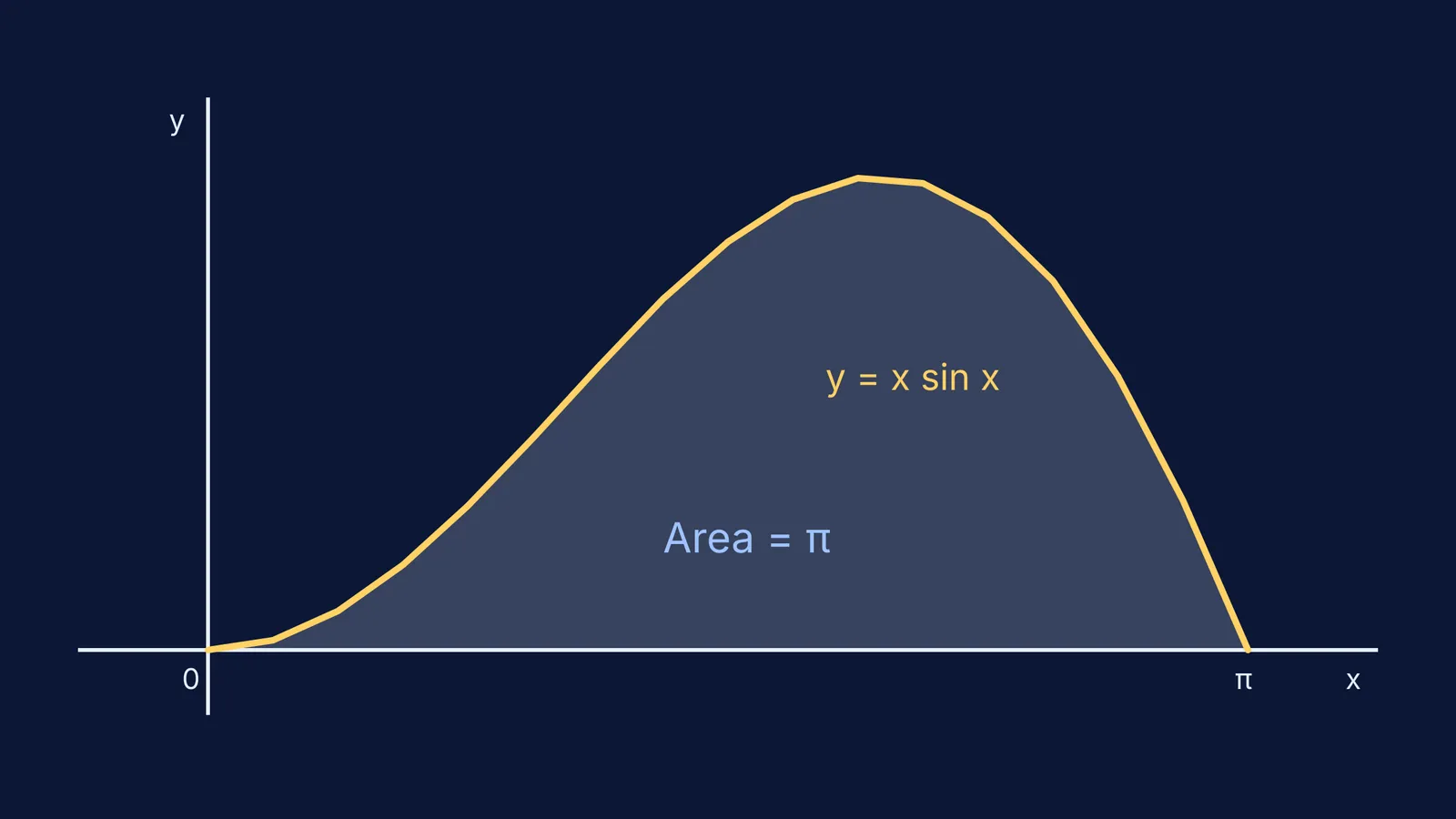
What is the integral of x sin x from 0 to π?
Let's see this in action by integrating x sin x from 0 to π. This requires choosing our terms carefully. We use the ILATE rule (Inverse, Logarithmic, Algebraic, Trigonometric, Exponential) to pick u. Since x is algebraic and sin x is trigonometric, we set:
u = x, which means du = dx
dv = sin x dx, which means v = −cos x
Now, we feed these into our definite integration by parts formula: ∫₀^π x sin x dx = [−x cos x]₀^π − ∫₀^π (−cos x) dx
Instead of carrying that first bracket down the page, we evaluate it straight away. The upper limit evaluation is (−π × cos π). Since cos π = −1, this becomes π. The lower limit evaluation is (−0 × cos 0), which is simply 0. So the entire [−x cos x]₀^π term simplifies to π − 0 = π.
The problem is now much shorter: ∫₀^π x sin x dx = π + ∫₀^π cos x dx
Next, integrate cos x to get sin x, and apply the limits: = π + [sin x]₀^π
Evaluate the sine terms: sin π − sin 0 = 0 − 0 = 0.
Add it all together: π + 0 = π.
The final answer is exactly π. By evaluating the first part early, we avoided tangling the negative signs of the cosine evaluation with the negative signs of the integral formula.
How can you track signs without making mistakes?
Sign errors are the most common reason students lose marks in long calculus questions. To stop this happening, use a strict routine:
Write the formula explicitly. Never skip writing [uv] − ∫ v du. Seeing the minus sign in the formula reminds you that everything following it will have its sign flipped.
Pull constants out early. If your v term has a negative sign (as −cos x did in our example), pull it outside the integral immediately to turn the minus in the formula into a plus.
Use safety brackets. When evaluating an upper and lower bound, always write it as (upper result) − (lower result). Never try to multiply the negative sign through in your head.
If you are struggling to spot where your working goes wrong, the Fermi Problem Library has worked problems with a step-by-step solver that explains the reasoning rather than printing an answer. It helps you see exactly which negative sign or limit substitution threw you off course.
Once you have mastered applying limits straight away on standard problems, you can tackle more advanced patterns. For instance, you might encounter cyclic functions like Integrating eᵃˣ sin bx, or you might need to handle repeating boundaries as shown in Integrating over n periods.
When should you apply limits at the end instead?
While applying limits immediately to the uv term is usually best, there are rare cases where evaluating everything at the end makes sense. If your v term is an extremely complex rational function, separating the bounds evaluation might temporarily clutter your working more than keeping it as an indefinite integral until the final step. However, for standard exam problems involving exponential or trigonometric functions, the immediate substitution method remains the safest choice. Practising this early evaluation technique builds the mathematical stamina needed for high-stakes exams, where time and accuracy are both critical.
Calculus problems reward neatness. Make the uv evaluation your first priority, and the rest of the problem will fall into place.


