

On this page
How many subsets have an even number of elements?
When you have a finite set of n elements, the total number of subsets is 2ⁿ, as defined in Class 11 textbooks from the National Council of Educational Research and Training. When n ≥ 1, exactly half of these subsets contain an even number of elements. That means the number of subsets with an even number of elements is always 2ⁿ⁻¹.
The empty set, ∅, has 0 elements. Because 0 is an even integer, ∅ is always counted as an even subset. The remaining even subsets have sizes 2, 4, 6, and so on. Exactly 50% of all subsets have an even size, and 50% have an odd size (NCERT).
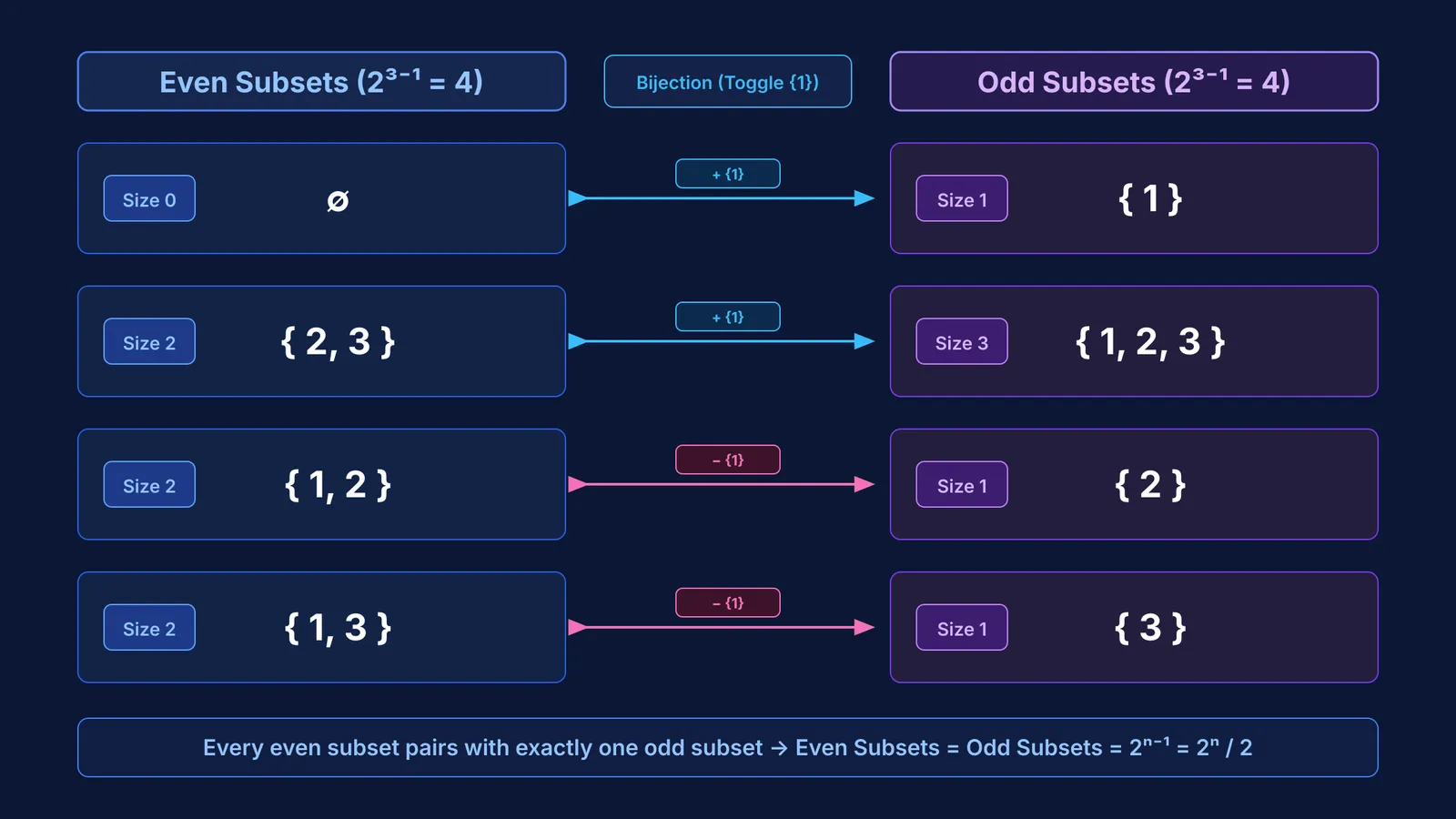
Whether n is even or odd, the subsets split precisely down the middle. For instance, a set with 3 elements has 2³ = 8 subsets: 4 even and 4 odd. If you want to strengthen foundational definitions across sets and functions, the Fermi Concept Library covers every concept in physics, chemistry, biology, mathematics and computing, each with its own lesson and its place in the map.
Why does pairing subsets prove the count is 2ⁿ⁻¹?
The most intuitive proof uses a one-to-one matching rule known as a bijection. In their book *Proofs that Really Count: The Art of Combinatorial Proof*, mathematicians Arthur Benjamin and Jennifer Quinn show that an involution on the power set pairs every even subset with an odd one (Benjamin and Quinn, 2003).
Pick any single element from the original set. Call this element x. For any subset S:
If S contains x, remove x to produce a partner subset S ∖ {x}.
If S does not contain x, add x to produce a partner subset S ∪ {x}.
Adding or removing one element changes the size of the subset by 1. Therefore, every even subset is mapped to an odd subset, and every odd subset is mapped to an even subset.
Applying this rule twice returns the original subset. This means no subset is missed and none is counted twice. Because every even subset is matched with exactly one odd subset, both groups must be equal in size. With 2ⁿ total subsets, each half must contain 2ⁿ / 2 = 2ⁿ⁻¹ subsets. This pairing principle connects directly to finding the number of subsets containing a particular element, which uses the same inclusion-exclusion perspective.
How does the binomial theorem prove the alternating sum is zero?
Combinatorics also provides an algebraic proof using binomial expansions, formalised in Class 11 mathematics (NCERT). A subset of size k can be chosen from n elements in ⁿCₖ ways. As explored in why binomial coefficients are combinations, summing all selections gives:
ⁿC₀ + ⁿC₁ + ⁿC₂ + ... + ⁿCₙ = 2ⁿ.
The even and odd subsets correspond to the even and odd index sums:
Even sum = ⁿC₀ + ⁿC₂ + ⁿC₄ + ... Odd sum = ⁿC₁ + ⁿC₃ + ⁿC₅ + ...
Now consider the binomial expansion of (1 + x)ⁿ, documented in Richard Stanley's *Enumerative Combinatorics* (Stanley, 2011):
(1 + x)ⁿ = ⁿC₀ + ⁿC₁ x + ⁿC₂ x² + ⁿC₃ x³ + ... + ⁿCₙ xⁿ.
Setting x = −1 gives:
(1 − 1)ⁿ = ⁿC₀ − ⁿC₁ + ⁿC₂ − ⁿC₃ + ... 0 = (ⁿC₀ + ⁿC₂ + ⁿC₄ + ...) − (ⁿC₁ + ⁿC₃ + ⁿC₅ + ...).
This directly yields:
ⁿC₀ + ⁿC₂ + ⁿC₄ + ... = ⁿC₁ + ⁿC₃ + ⁿC₅ + ...
Because the two sums are equal and add up to 2ⁿ, each sum must equal 2ⁿ⁻¹. This algebraic cancellation is the same mechanism used in how to expand (x + y)ⁿ + (x − y)ⁿ. When working through complex binomial identities, the Fermi Problem Library has worked problems with a step-by-step solver that explains the reasoning rather than printing an answer.
What does a 4-element set look like in practice?
To see how the pairing rule from Benjamin and Quinn operates in practice (Benjamin and Quinn, 2003), take the set {1, 2, 3, 4} with n = 4. The power set contains 2⁴ = 16 subsets.
Choosing element 1 as our toggle item pairs the 8 even subsets with the 8 odd subsets:
∅ (size 0) pairs with {1} (size 1)
{2, 3} (size 2) pairs with {1, 2, 3} (size 3)
{2, 4} (size 2) pairs with {1, 2, 4} (size 3)
{3, 4} (size 2) pairs with {1, 3, 4} (size 3)
{1, 2} (size 2) pairs with {2} (size 1)
{1, 3} (size 2) pairs with {3} (size 1)
{1, 4} (size 2) pairs with {4} (size 1)
{1, 2, 3, 4} (size 4) pairs with {2, 3, 4} (size 3)
The binomial counts verify the total: ⁴C₀ + ⁴C₂ + ⁴C₄ = 1 + 6 + 1 = 8 even subsets, while ⁴C₁ + ⁴C₃ = 4 + 4 = 8 odd subsets.


