

On this page
Most students first meet combinations (ⁿCᵣ) while calculating probabilities, such as choosing an 11-player cricket team from 15 candidates. In Class 11, the exact same symbol reappears in algebra. The NCERT textbook introduces the Binomial Theorem through mathematical induction, leading many to treat ⁿCᵣ as an algebraic formula to memorize rather than a counting tool. Yet binomial coefficients are combinations in the truest sense.
What happens when you multiply brackets by hand?
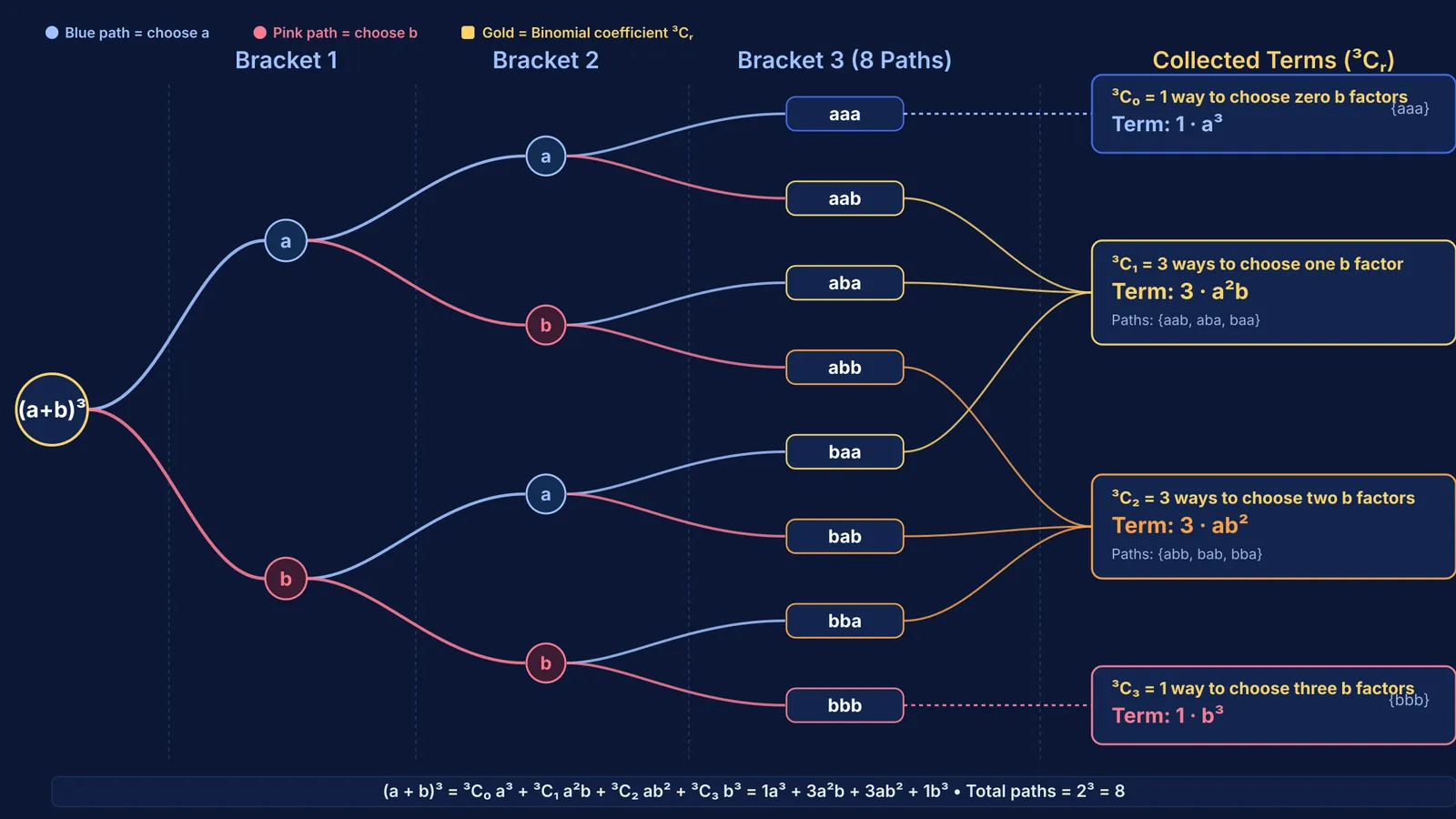
To see the counting logic, write out (a + b)³ as three separate factors:
(a + b)³ = (a + b)(a + b)(a + b)
By the distributive property, expanding these brackets requires picking one term from each bracket. With 3 brackets and 2 choices per bracket (a or b), the multiplication produces 2 × 2 × 2 = 8 raw terms:
aaa
aab
aba
abb
baa
bab
bba
bbb
When collecting like terms, you are counting how many paths yield each specific product:
For a³, pick a from all 3 brackets (and b from 0): only aaa (1 term).
For a²b, pick b from 1 bracket and a from 2: aab, aba, baa (3 terms).
For ab², pick b from 2 brackets and a from 1: abb, bab, bba (3 terms).
For b³, pick b from all 3 brackets: bbb (1 term).
Adding them gives 1a³ + 3a²b + 3ab² + 1b³. The coefficients 1, 3, 3, 1 simply count how many ways you can select b from the brackets.
Why are binomial coefficients combinations?
Expanding (a + b)ⁿ means multiplying n identical brackets. Every term is a product of n factors, one chosen from each bracket.
To form the general term aⁿ⁻ʳ bʳ, you must choose b from exactly r brackets, leaving the remaining n − r brackets to supply a. The coefficient is simply the number of distinct ways to choose which r brackets out of n supply b.
The coefficient of aⁿ⁻ʳ bʳ in (a + b)ⁿ is ⁿCᵣ because it counts the ways to choose r brackets to supply the factor b out of n available factors. Selecting r items from n distinct items without regard to order is the definition of ⁿCᵣ = n! / (r!(n − r)!).
In a study on combinatorial thinking in *The Journal of Mathematical Behavior*, researcher Elise Lockwood (Lockwood, 2013) showed that students struggle when manipulating formulas without picturing the set of outcomes. Here, the brackets form that concrete set of outcomes.
When practicing with the Fermi Problem Library, the step-by-step solver explains the reasoning rather than printing an answer, showing how algebraic coefficients trace back to combinatorial choices.
How do combinations prove classic binomial identities?
This combinatorial viewpoint makes standard identities straightforward without algebraic induction:
Symmetry (ⁿCᵣ = ⁿCₙ₋ᵣ): Choosing r brackets to supply b automatically leaves n − r brackets to supply a. Because selecting who is in is the same as selecting who is out, the coefficients are symmetric.
Sum of coefficients (∑ ⁿCᵣ = 2ⁿ): Each of the n brackets offers 2 choices. The total number of terms before grouping is 2ⁿ. Setting a = 1 and b = 1 tallies all outcomes, matching the rule for the number of subsets and the power set.
Pascal's recurrence (ⁿCᵣ = ⁿ⁻¹Cᵣ₋₁ + ⁿ⁻¹Cᵣ): Consider the final bracket. If it supplies b, the first n − 1 brackets must supply r − 1 copies of b (in ⁿ⁻¹Cᵣ₋₁ ways). If it supplies a, the first n − 1 brackets must supply all r copies of b (in ⁿ⁻¹Cᵣ ways).
In India, this recurrence was known long before Blaise Pascal. Acharya Pingala's *Chandaḥśāstra* (c. 3rd–2nd century BCE) and Halayudha's 10th-century commentary *Mṛtasañjīvanī* described this staircase arrangement as the *Meru Prastara* to count metres with short and long syllables, as discussed in our post on sums of binomial coefficients.
How do you apply the combination method to expansion problems?
Use this selection perspective to evaluate terms without index confusion:
Count the brackets: For (2x + 3)⁴, identify n = 4 identical brackets.
Target the power: To find the coefficient of x², choose (2x) from 2 brackets and 3 from the remaining 2.
Count the ways: Choose 2 brackets from 4 in ⁴C₂ = 6 ways.
Multiply terms: Each choice contributes (2x)² × 3² = 4x² × 9 = 36x². The coefficient is 6 × 36 = 216.
This approach eliminates the index errors common in the binomial theorem for JEE, where students misidentify whether the r in Tᵣ₊₁ should be 2 or 3.
If you want to build deep intuition, Fermi's AI tutor works out what you already know and builds a plan for the session, deciding whether to explain, ask, or show so you understand every step.


