

On this page
Many IUPAC questions in school ask you to name a structure. The harder skill is going the other way: someone hands you "5-chloro-4-methylhex-3-en-2-one" and you have to draw it. NCERT's Class 11 chemistry unit on organic basics lists both skills in its objectives: name compounds by the IUPAC system and "derive their structures from the given names" (NCERT Class 11 Chemistry, Unit 8).
The good news is that the name was designed for this. The publisher's description of the IUPAC Blue Book, the rule book for organic names, says nomenclature carries a relationship to the structure "in order that the reader or listener can deduce the structure from the name" (Nomenclature of Organic Chemistry, IUPAC Recommendations 2013, RSC). So you are not guessing. You are decoding.
How do you read an IUPAC name?
Read it in this order, not left to right:
Root: meth, eth, prop, but, pent, hex... tells you how many carbons are in the parent chain.
Unsaturation: "-an-" means only single bonds; "-en-" or "-yn-", with a locant, tells you where a double or triple bond sits.
Suffix: "-ol", "-al", "-one", "-oic acid" and so on is the principal functional group, with its own locant.
Prefixes: everything in front of the root (methyl, ethyl, chloro, bromo, nitro) is a substituent hanging off a numbered carbon.
The prefixes are written in alphabetical order, and multiplying prefixes such as di- and tri- do not change that order (IUPAC P-14.5.1). That is why you see "2-chloro-3-methyl" rather than "3-methyl-2-chloro", and why "dimethyl" is filed under m, not d.
How do you draw the structure step by step?
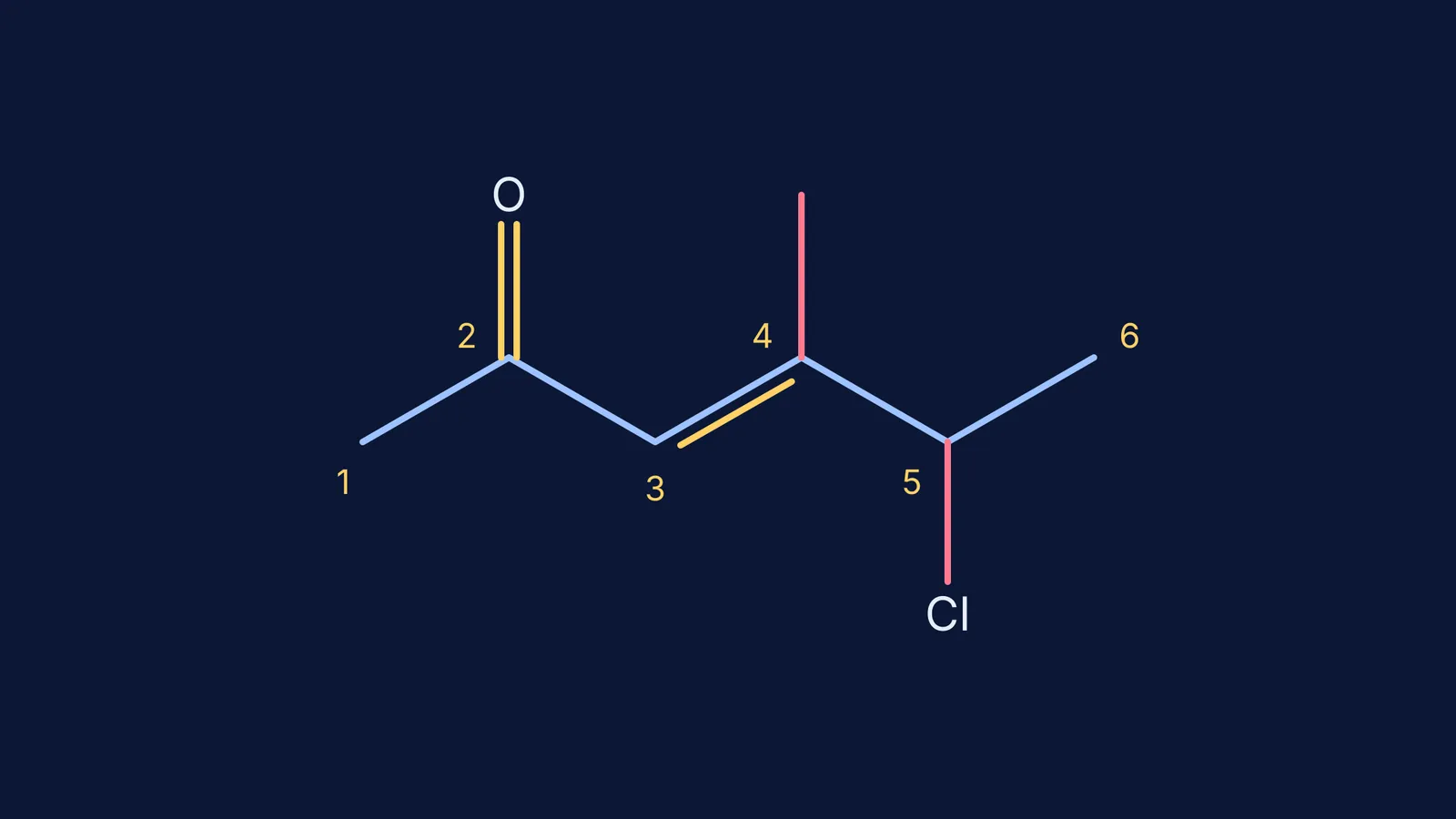
Work through "5-chloro-4-methylhex-3-en-2-one" with a pencil.
Draw the parent chain. "Hex" means six carbons. Draw a zigzag of six points and number them 1 to 6 from the left.
Place the principal group. "-2-one" is a ketone at C2, so put a C=O on carbon 2.
Place the multiple bond. "-3-en-" is a double bond starting at C3, so C3=C4.
Add the substituents. "4-methyl" puts a CH3 on C4. "5-chloro" puts a Cl on C5.
Fill in hydrogens. Give every carbon four bonds. You get CH3-CO-CH=C(CH3)-CH(Cl)-CH3.
Count the atoms as a quick sanity check: seven carbons in total (six in the chain plus the methyl), one oxygen and one chlorine, so C7H11ClO.
How do you check that your structure matches the name?
Now forget the name you were given and name your own drawing from scratch. If it comes back the same, your drawing is right. If not, either your drawing or the given name has a problem.
For our example:
Principal group: the ketone, so the suffix is -one.
Parent chain: the longest chain through the C=O has six carbons. Going up into the methyl branch gives only five.
Numbering: from the left the ketone is at C2; from the right it would be at C5. IUPAC chooses the lowest set of locants, compared term by term at the first point of difference (IUPAC P-14.3.5), so you number from the left.
Prefixes: chloro at 5 and methyl at 4, cited alphabetically.
You get 5-chloro-4-methylhex-3-en-2-one again. Done.
What if the name you were given is wrong?
The round trip also catches names that are not correct IUPAC names, which helps when a multiple-choice question offers one.
"2-ethylbutane": draw four carbons with an ethyl on C2. Re-name it and the longest chain is five carbons, so the correct name is 3-methylpentane.
"4-methylpentane": draw it, number from the other end, and the methyl lands on C2. The correct name is 2-methylpentane.
"3-methyl-2-chlorobutane": the structure is fine, but the prefixes are not in alphabetical order. It should be 2-chloro-3-methylbutane.
For more practice with small chains, our post on the isomers of pentane and their names walks through three structures that differ only in branching.
The 2013 IUPAC recommendations reversed an older rule for choosing the principal chain of an open-chain compound: chain length is now the first criterion and unsaturation the second (IUPAC P-44.3.2).
For tie-breaking when a chain has both a double and a triple bond, see our guide to numbering enynes.
A five-minute drill for the week
Take five names from your textbook exercises.
Draw each structure using the order above, without looking at the answer.
Cover the name, re-name your drawing, and compare.
Write down every mismatch and which step caused it: chain, numbering, suffix or alphabetical order.
After a week, your mismatch list tells you which rule you keep forgetting. If you use an AI chatbot to check your answers, read where chatbots slip on IUPAC names first, and keep doing the round trip yourself.
If one step keeps tripping you up, the Fermi Problem Library has worked problems with a step-by-step solver that explains the reasoning rather than printing an answer. If the gap is the idea itself, such as what counts as the principal group, the Fermi Concept Library gives each chemistry concept its own lesson.


