

On this page
Students often look for a Class 8 chapter called "Stars and the Solar System" and cannot find it. The ideas are still in the NCERT books, spread across classes. This post shows where each one now sits, explains the core facts, works two short calculations, and ends with a sky-watching routine.
Where are stars and planets in the current books?
NCERT's Class 8 book is Curiosity, marked "Reprint 2026-27". It has no chapter titled "Stars and the Solar System", and the older Class VIII book's 2024-25 reprint did not have one either. Instead:
Class 6 Curiosity, "Beyond Earth" covers stars, constellations, the Pole Star and the solar system.
Class 8 Curiosity, "Keeping Time with the Skies" covers phases of the Moon, lunar and solar calendars, and artificial satellites.
Class 8 Curiosity, "Our Home: Earth, a Unique Life Sustaining Planet" revisits the planets and asks why Earth supports life.
If your school uses a different book, check its contents page. The facts below come from these NCERT chapters.
What exactly is a constellation?
The Class 6 chapter explains that people once called patterns of stars constellations, and drew imaginary lines between the stars to recognise them. Today the term means a defined region of the sky. In the early twentieth century, the International Astronomical Union (IAU) listed 88 official constellations, dividing the whole sky into 88 regions.
Some to know:
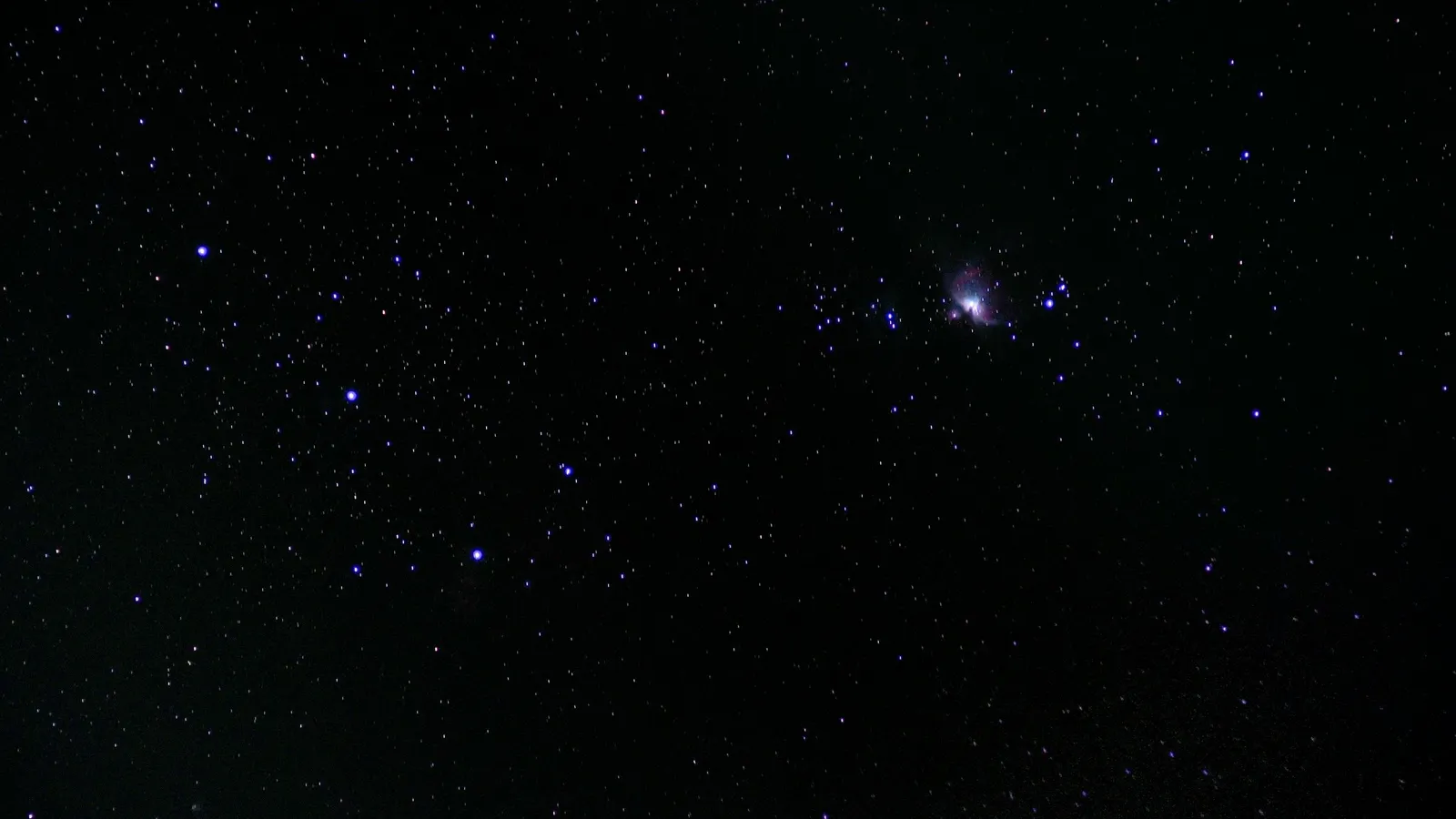
Orion, drawn as a hunter, has three stars in a row for its belt.
Canis Major contains Sirius, the brightest star in the night sky.
The Big Dipper, called Saptarishi in India, lies in Ursa Major.
The Pole Star (Polaris, or Dhruva tara) is part of the Little Dipper. It appears nearly fixed in the north, so it shows direction in the northern hemisphere. It cannot be seen from the southern hemisphere.
What do the planets of our solar system look like?
The Sun is a star, the closest one to us. The Class 6 chapter says it is about 100 times larger than Earth in diameter and about 150 million km away. That distance is one astronomical unit (au).
Eight planets orbit the Sun in nearly circular paths: Mercury, Venus, Earth, Mars, Jupiter, Saturn, Uranus and Neptune. The Class 8 chapter groups them: the first four are small and rocky; the outer four are large and made mostly of gases.
You might expect the planet closest to the Sun to be hottest. The Class 8 book points out the exception: Venus is hotter than Mercury because its atmosphere, almost entirely carbon dioxide, traps heat. This is the greenhouse effect. The same effect, in a milder form, keeps Earth at a temperature that suits life.
Worked example 1: how old is sunlight when it reaches you?
The Sun is about 150 million km away. Light in vacuum travels at 299,792,458 m/s, about 300,000 km per second.
Time = distance ÷ speed = 150,000,000 km ÷ 300,000 km/s = 500 s.
500 s = 8 minutes 20 seconds.
So the sunlight you see left the Sun a little over 8 minutes ago. A common slip is mixing units: dividing kilometres by metres per second gives an answer 1,000 times too small. Convert first.
Worked example 2: why lunar calendars drift
The Class 8 chapter says one cycle of Moon phases takes about 29.5 days, and a lunar year of 12 lunar months is 354 days. Seasons repeat about every 365 days.
Gap per year = 365 − 354 = 11 days.
After 3 years the gap is 3 × 11 = 33 days, more than one lunar month.
The chapter explains that luni-solar calendars handle this by adding an extra month, Adhika Maasa, every two to three years, so festivals stay in their seasons.
Which mistakes cost marks?
"Constellations are groups of stars close together." Officially, they are regions of the sky; the lines are imaginary.
"Mercury is the hottest planet." It is Venus.
"The Pole Star is visible from everywhere." Not from the southern hemisphere.
"The Sun is not a star." It is, the nearest one.
A sky-watching routine for two weeks
Night 1: Find the Big Dipper or Orion, depending on the season, and sketch it.
Every second night: Sketch the Moon's shape and note the date. Watch it move from crescent to gibbous.
Day 7: Redo the sunlight sum for a distance of 1.5 au, or 225 million km (answer: 750 s, 12.5 minutes).
Day 14: Explain to someone at home why Venus is hotter than Mercury.
If orbits and phases are hard to picture, the Fermi Simulation Lab has interactive simulations for ideas that are easier to see than read. To see how astronomers worked out planetary orbits, read our post on Kepler's laws, and for India's early astronomy, our post on Aryabhata.
Step outside tonight, find one star pattern, and draw it before you forget.


