

On this page
Preparing a standard solution of oxalic acid is Experiment 2.1 in the NCERT Class XI chemistry lab manual. Three slips are easy to make: using the wrong molar mass, leaving crystals on the watch glass, and adding water past the mark. Here is the method from the NCERT Class XI Laboratory Manual, Unit 2, step by step.
How much oxalic acid do you need for 0.1 M?
The NCERT Class XI Laboratory Manual defines a standard solution as a solution of exactly known concentration. Lab oxalic acid is the hydrated crystal, (COOH)₂·2H₂O, and NCERT uses a molar mass of 126 g/mol for it. PubChem lists oxalic acid dihydrate at 126.07 g/mol.
The manual's formula is molarity = (mass in g × 1000) ÷ (molar mass × volume in mL). Rearranged for the mass:
250 mL of 0.1 M: 0.1 × 126 × 250 ÷ 1000 = 3.1500 g
250 mL of 0.05 M (an NCERT discussion question): 1.575 g
The trap is the anhydrous formula. PubChem gives anhydrous oxalic acid a molar mass of 90.03 g/mol. Using 90 would have you weigh about 2.25 g of crystals, which gives roughly 0.07 M instead of 0.1 M. Check that the bottle says dihydrate.
What is weighing by difference in a chemistry practical?
NCERT's Experiment 2.1 uses three weighings, each noted to the fourth decimal place:
Weight 1: the empty, clean, dry watch glass or weighing tube.
Weight 2: the watch glass with about 3.15 g of oxalic acid on it.
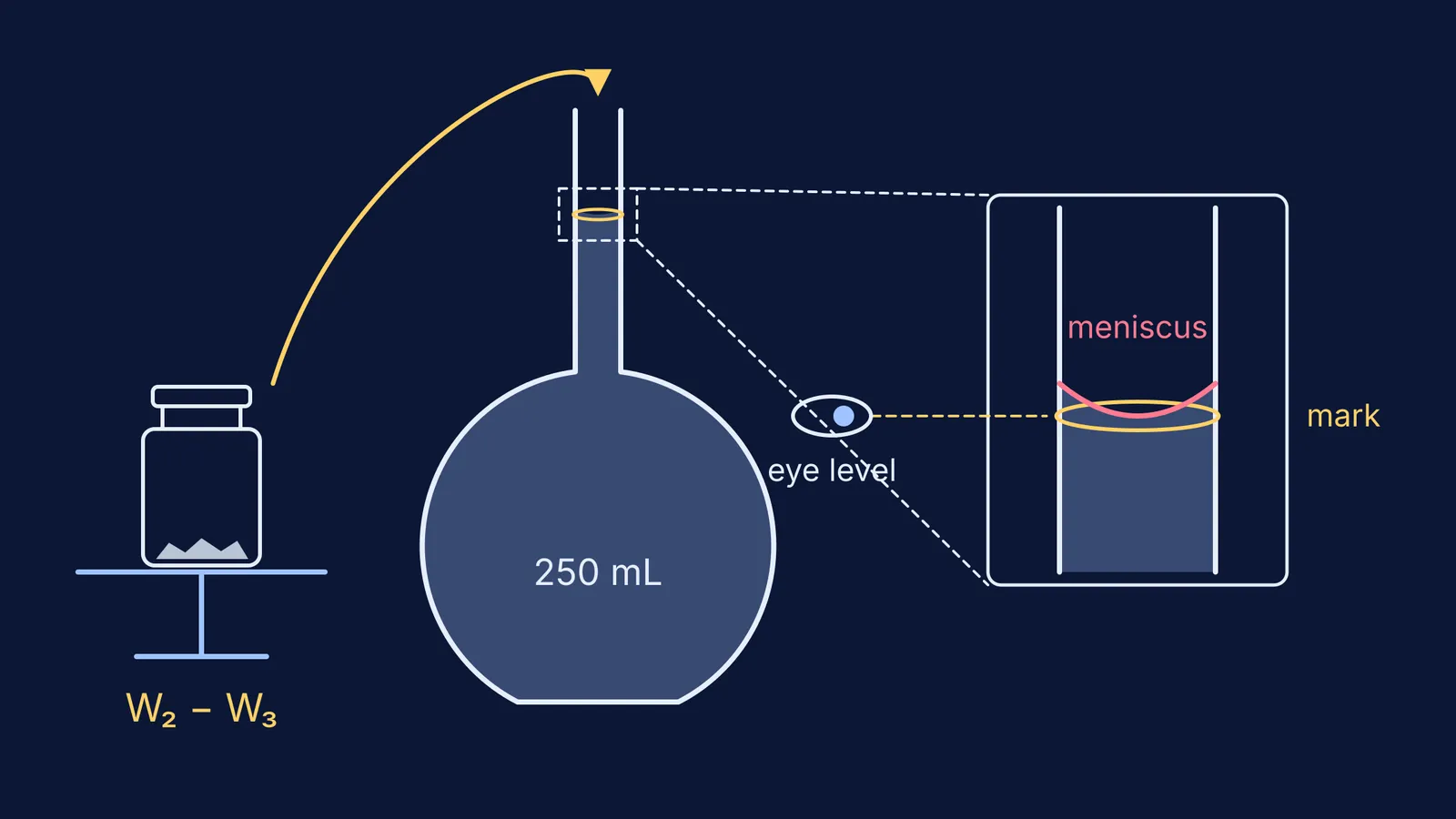
Weight 3: the same watch glass after you have tipped the acid into the flask.
The mass in the flask is Weight 2 minus Weight 3, not Weight 2 minus Weight 1. The manual's discussion questions call this "weighing by transfer".
Worked example: Weight 1 = 18.4206 g, Weight 2 = 21.5832 g, Weight 3 = 18.4212 g. The glass is 0.6 mg heavier than at the start because a few crystals stuck to it. Mass transferred = 21.5832 − 18.4212 = 3.1620 g, so molarity = 3.1620 × 1000 ÷ (126 × 250) = 0.1004 M. Label the flask 0.1004 M and use that value in later titrations.
How do you transfer and make up to the mark without losing acid?
These steps follow NCERT's procedure and precautions:
Hold a funnel in the ring clamp of an iron stand, with its stem in the neck of a clean, dry 250 mL measuring (volumetric) flask.
Tip the acid from the watch glass into the funnel, then weigh the empty watch glass (Weight 3).
Wash the funnel several times with small amounts of distilled water, so every stuck crystal runs into the flask.
While washing, keep the liquid below a quarter of the flask's volume.
Swirl until every crystal has dissolved, then add more distilled water with shaking.
Add the last few millilitres dropwise until the lower edge of the meniscus just touches the etched mark.
Stopper the flask, shake it thoroughly so the solution is uniform, and label it.
The manual explains that the flask's neck is narrow to reduce error in adjusting the meniscus. Keep your eye level with the mark, so its front and back edges look like one line.
What errors and viva questions do examiners ask about?
NCERT's Unit 6 on titrimetric analysis defines a primary standard as a compound whose total impurities do not exceed 0.01–0.02%, and names oxalic acid among the substances that can be used as one. It lists sodium hydroxide as a secondary standard, which cannot be used to prepare a standard solution by direct weighing; see why NaOH is not a primary standard.
Questions to prepare for, drawn from NCERT's discussion questions and precautions:
Hydrated or anhydrous formula, and the basicity of oxalic acid (it is 2).
Why a volumetric flask, and not a beaker or measuring cylinder?
Why distilled water, and not tap water?
Why weigh the watch glass again after the transfer?
Why calculate the strength to the fourth decimal place?
In Class 12, the NCERT Class XII manual titrates potassium permanganate against 0.1 M oxalic acid prepared by this method. For the rinsing rules there, read why burettes are rinsed with solution and flasks only with water.
A checklist before your practical
Write the molarity formula and the 3.1500 g working at the top of your record.
Draw a small table for Weight 1, Weight 2 and Weight 3.
Have a spatula, a wash bottle of distilled water and a dropper ready.
After making up to the mark: stopper, shake, and label with the exact molarity.
For practice, try how to calculate the mass of solute for a given molarity. If the arithmetic is where you slip, the Fermi Problem Library has worked problems with a step-by-step solver that explains the reasoning rather than printing an answer.


