

On this page
In floral morphology, stamens rarely stand entirely alone. They often fuse with one another or attach to other parts of the flower, creating structures that help plants control how their pollen is delivered. Whether you are identifying epipetalous, epiphyllous, monoadelphous stamens, or other variations, understanding these fusions is key.
Botanists divide these fusions into two main categories: cohesion and adhesion. Knowing the difference, and the specific terms that fall under each, is a high-yield topic for exams and a foundation for understanding plant families.
What is the difference between cohesion and adhesion of stamens?
The rule is simple: cohesion means "sticking together," while adhesion means "sticking to something else."
When stamens fuse with other stamens in the same floral whorl, it is called cohesion (Wikipedia). When they attach to a different floral whorl, such as the petals or sepals, it is called adhesion. Both terms describe structural adaptations that define entire plant families.
If you are memorising these terms, the Fermi Concept Library holds every concept in physics, chemistry, biology, mathematics and computing, each with its own lesson and its place in the map. It shows you how these stamen arrangements fit into the larger pattern of a flower's structure rather than treating them as isolated facts.
What are monoadelphous, diadelphous and polyadelphous stamens?
These three terms all describe the cohesion of filaments. When stamens fuse by their filaments (the stalks) but leave their anthers (the pollen-bearing tips) free, they form bundles, a condition known as adelphy.
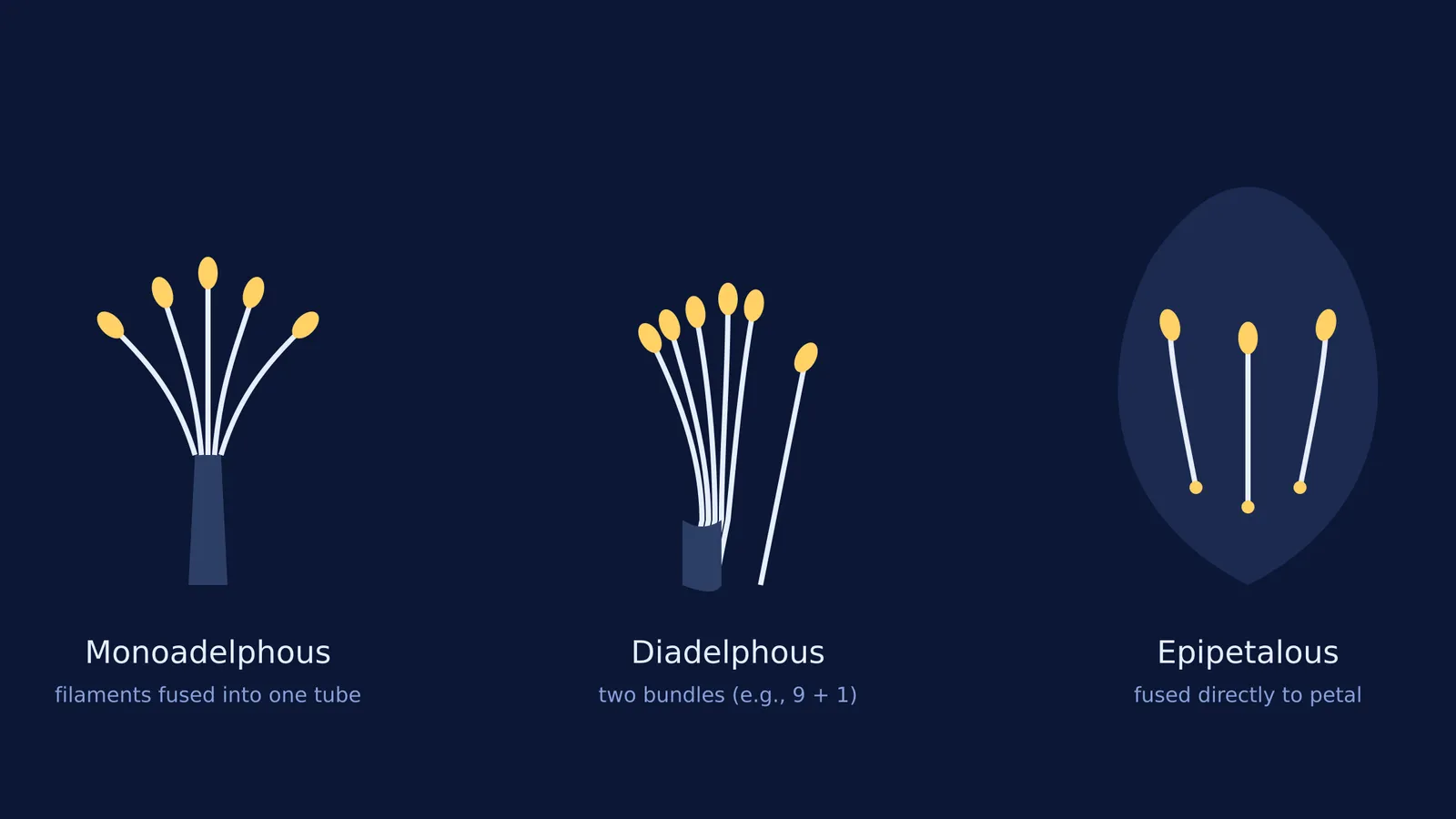
Monoadelphous: All the filaments are united into a single bundle or a staminal tube around the pistil. You will see this in the mallow family (Malvaceae); for example, the China rose (Hibiscus) has a prominent central tube of fused filaments (Wikipedia).
Diadelphous: The filaments are united into two distinct bundles. This is the hallmark of the pea family (Fabaceae), which typically features a 9+1 arrangement: nine stamens fused together and one standing free (Wikipedia).
Polyadelphous: The filaments fuse into three or more separate bundles. Citrus flowers are a classic example of this arrangement.
Sometimes, it is the anthers that fuse while the filaments stay separate. This is called the syngenesious condition, a defining feature of the sunflower family (Asteraceae). If both the filaments and the anthers are fused throughout their length, the stamens are synandrous. In extreme cases of fusion, such as in certain members of the gourd family (Cucurbitaceae) or *Phyllanthus*, the stamens can even form a solid ring around the female reproductive parts of the flower (Wikipedia).
What does epipetalous and epiphyllous mean?
When stamens attach to other parts of the flower, it is a case of adhesion. The terms for adhesion tell you exactly what the stamens are attached to.
Epipetalous: The stamens are fused directly to the petals (the corolla). The nightshade family (Solanaceae) shows this clearly; if you pull apart a brinjal flower, you will find the stamens attached to the base of the petals (Wikipedia).
Epiphyllous: Also called epitepalous, this occurs when stamens are fused to the perianth (the tepals). This happens in flowers where the sepals and petals look identical and are not differentiated, such as in lilies (Liliaceae).
Why do flowers fuse their stamens?
These fusions are not just random variations; they are precise evolutionary adaptations for reproduction. Cohesion and adhesion change how the flower presents its pollen. For example, a staminal tube forces a visiting insect to brush against the anthers in a specific way as it reaches for nectar, ensuring pollen is picked up and carried to the next flower. By studying these variations, you are looking at the mechanical engineering of a plant's reproductive system.
When you learn about these arrangements, you also begin to see how plant families evolved distinct strategies to survive. The solitary free stamen in a diadelphous flower, for instance, provides a gap that lets insects access nectar at the base of the flower.
How can you study floral morphology for exams?
Morphology can feel like a heavy list of terms to memorise. The most effective way to retain them is to study them alongside other floral characteristics. For instance, when you learn about the diadelphous stamens of a pea, link it immediately to its vexillary aestivation and its marginal placentation.
Grouping these features by plant family rather than by the individual term ensures you build a complete picture of the flower in your mind. Reviewing how multiple morphological traits come together in a single species helps you navigate from general floral structure down to specific adaptations like stamen cohesion and adhesion. By understanding the underlying logic of a flower's design, you can remember its specific features far more reliably.


