

On this page
The helical spring practical looks simple: hang a spring, add weights, measure the stretch. The usual slips are units, which way round the axes are, and points taken after the spring stops obeying Hooke's law. Here is the method, with worked readings.
What does the helical spring practical ask you to do?
The aim in the NCERT Class 11 physics laboratory manual (Project 9) is to study the spring constant of a helical spring from its load-extension graph. You need a spring with a pointer, a rigid clamp stand, a hanger with five or six known slotted masses, and a metre scale.
The spring constant is the restoring force per unit extension, K = F/x, measured in N/m. Hooke's law says that for small deformations, stress and strain are proportional (NCERT Class 11 Physics, Mechanical Properties of Solids). For a spring, extension rises in step with load: a straight line.
How do you take the readings?
Hang the spring from a rigid support so it hangs freely and vertically.
Fix the scale beside the spring so the pointer moves over it without touching.
Note the scale's least count (usually 1 mm) and the pointer reading with nothing on the spring.
Add the hanger, then one slotted mass at a time, reading the pointer once the spring stops moving.
Convert each total mass to force with F = mg, and each reading to extension by subtracting the starting reading.
Take the masses off one at a time and read the pointer again on the way down.
Step 6 is your best check on the elastic limit.
How do you find the spring constant from a load-extension graph?
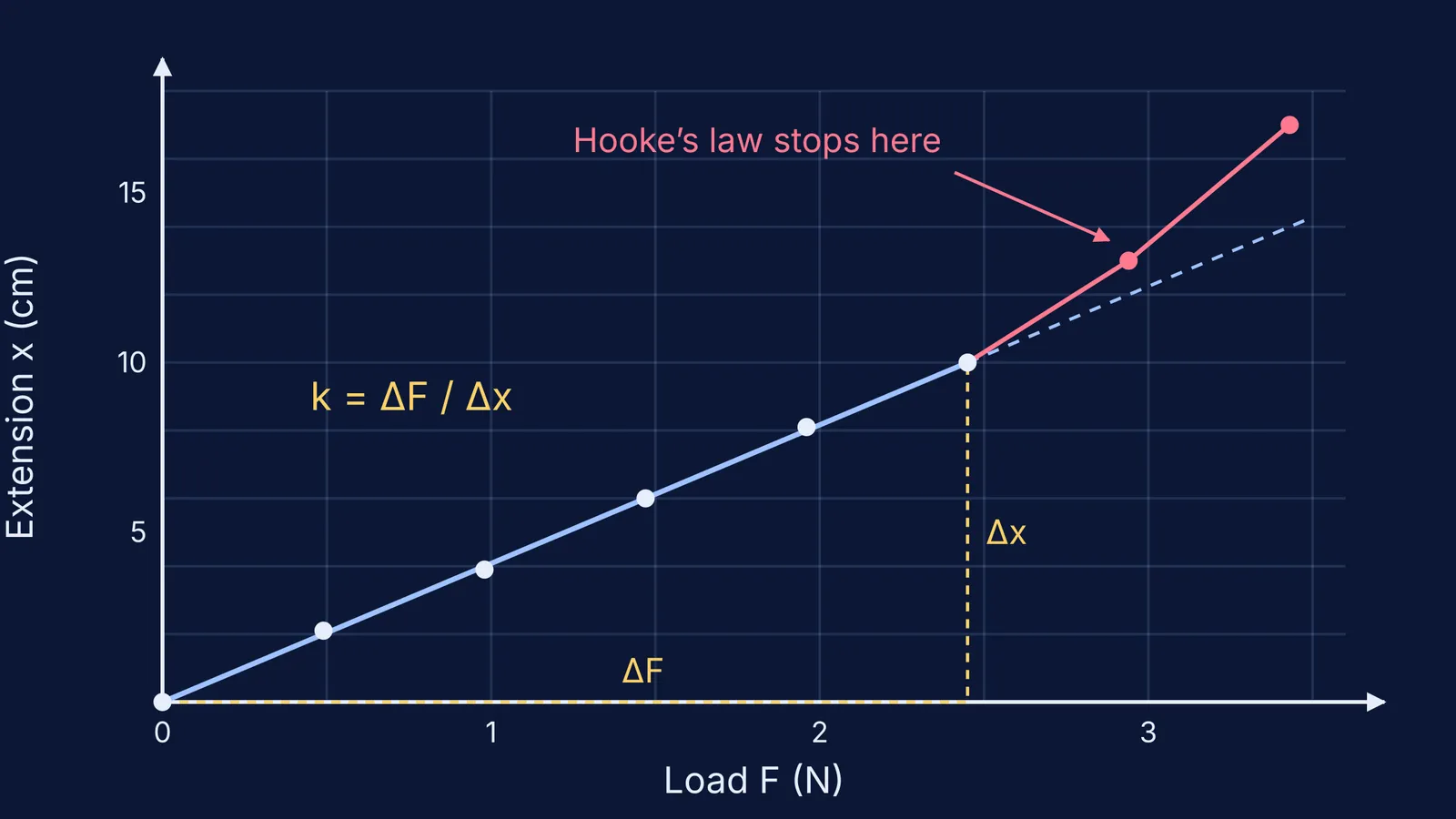
First check your axes. The NCERT manual puts force F on the x-axis and extension x on the y-axis, so the slope is x/F, and the spring constant is k = 1/slope (NCERT lab manual, Fig. P 9.2). If your teacher asks for force on the y-axis instead, the slope is k directly.
Here are illustrative readings in 50 g steps (total mass including the hanger, g = 9.8 m/s²), as mass: load, extension:
50 g: 0.49 N, 2.1 cm
100 g: 0.98 N, 3.9 cm
150 g: 1.47 N, 6.0 cm
200 g: 1.96 N, 8.1 cm
250 g: 2.45 N, 10.0 cm
300 g: 2.94 N, 13.0 cm
350 g: 3.43 N, 17.0 cm
Draw the best straight line through the origin and the first five points, then pick two points on it far apart, as the manual suggests: O at (0, 0) and A at (2.45 N, 10.0 cm).
Convert to SI units first: 10.0 cm = 0.100 m.
Slope = Δx/ΔF = 0.100 m ÷ 2.45 N = 0.0408 m/N.
k = 1/slope = 2.45 N ÷ 0.100 m = 24.5 N/m.
Use the line, not one row of the table: the line averages out reading errors. For scales and best-fit lines, see our guide on how to draw a graph in your physics practical file.
How do you spot the elastic limit on the graph?
In the readings above, the line predicts 12.0 cm at 2.94 N, but the spring stretched to 13.0 cm. At 3.43 N the gap grows to 3 cm: the points curve away from the line.
On a stress-strain curve, Hooke's law holds only up to the proportional limit. Just beyond it, the material still returns to its original size when unloaded, up to the yield point, also called the elastic limit. Past that, it keeps a permanent set: some stretch stays with no load (NCERT Class 11 Physics, section 8.4).
Two signs to watch for:
The graph bends: you have passed the limit of proportionality, so leave those points out of k.
The pointer does not come back: if the empty spring no longer reads its starting value after unloading, the elastic limit has been crossed and the spring is permanently stretched.
This is why the manual's precautions say to choose slotted masses according to the spring's elastic limit.
What mistakes cost marks in this practical?
Plotting mass in grams instead of force in newtons.
Leaving extension in cm when you work out k in N/m.
Giving the slope as k when force is on the x-axis.
Forgetting the hanger's mass.
If the slope step keeps tripping you up in exam questions, the Fermi Problem Library has worked problems with a step-by-step solver that explains the reasoning rather than printing an answer. The same k sets the spring's period of oscillation; read our simple harmonic motion simulation and its five predictions, or try the interactive simulations in the Fermi Simulation Lab.
Before your practical, plot these readings and check you get 24.5 N/m.


