

On this page
Sound numericals in Class 11 and JEE Main usually ask you to scale the speed to a new temperature, decide whether pressure matters, or explain why sound is faster on a humid day. All three come from one formula.
Why does sound travel faster in warm air?
The NCERT Class 11 chapter on Waves gives the speed of sound in a gas as v = √(γP/ρ), where γ is the ratio of specific heats, P the pressure and ρ the density. This is Laplace's correction. Newton assumed the pressure changes were isothermal and got 280 m/s for air at STP, about 15% too low. Laplace pointed out that they are so fast that there is little time for heat to flow, so they are adiabatic. With γ = 7/5 for air, the formula gives 331.3 m/s, which agrees with the measured value.
With the ideal gas law, ρ = PM/(RT), where M is the molar mass, Laplace's formula becomes:
v = √(γRT/M)
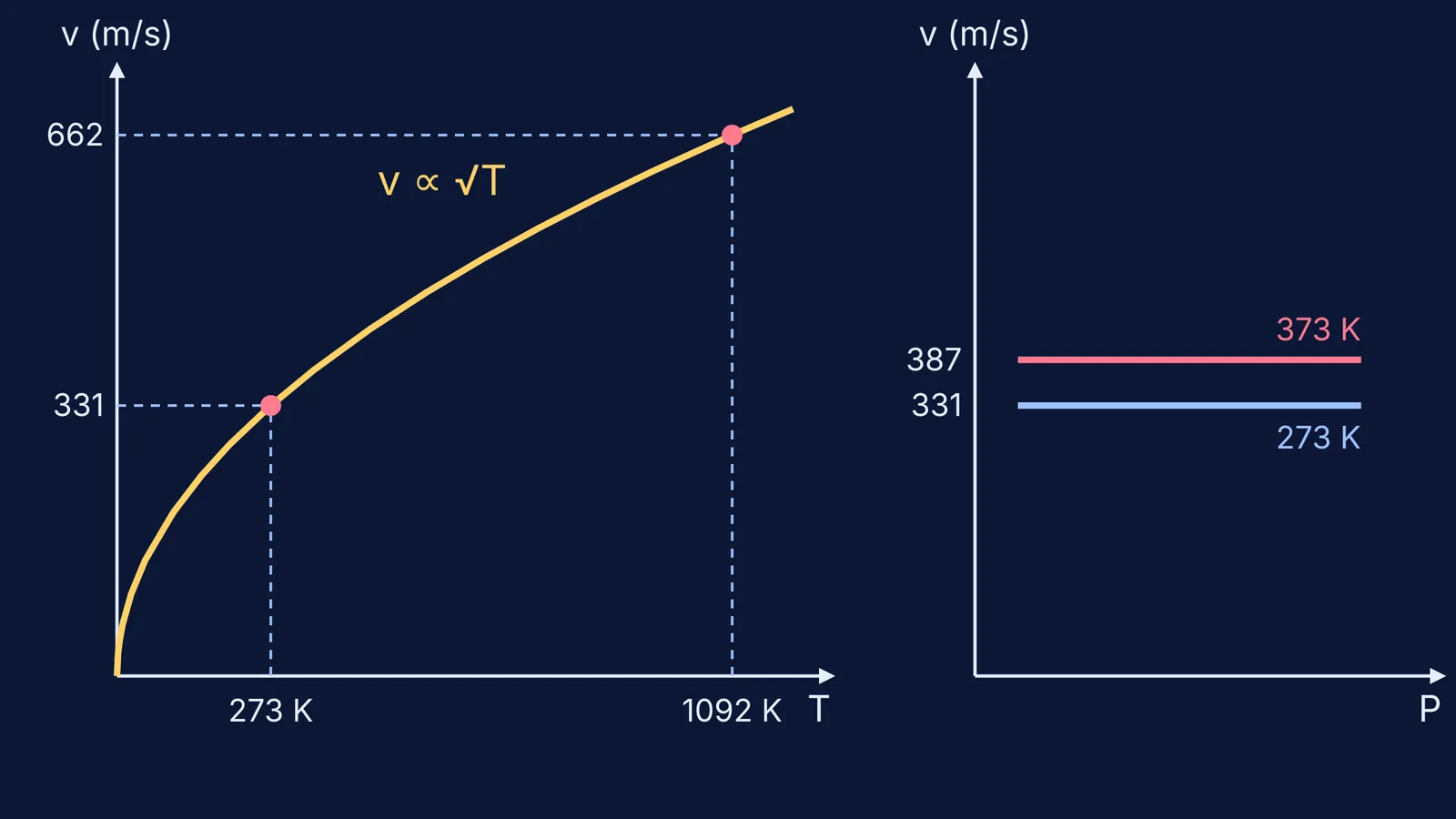
NASA's Glenn Research Center uses the same relation, with R/M as one constant and T on an absolute scale. For one gas, γ, R and M are fixed, so v ∝ √T, with T in kelvin. For the molecular picture, the ratio of the speed of sound to the RMS speed of gas molecules shows that both scale the same way.
Why does pressure alone not change the speed of sound?
Look at v = √(γP/ρ) again. Raise the pressure of an ideal gas at a fixed temperature and the density rises in exactly the same ratio, because ρ = PM/(RT). P/ρ stays equal to RT/M, so the speed does not move. The Wikipedia summary of the physics puts it the same way: at constant temperature, the effects of pressure and density cancel out exactly.
So if a question says "pressure is doubled at constant temperature", the answer is "no change". Pressure matters only when it also changes the temperature, as in an adiabatic compression.
Molar mass does matter, which is why sound is four times faster in hydrogen than in oxygen; see why the speed of sound in hydrogen and oxygen is in the ratio 4:1.
Does sound travel faster in humid air?
Yes, a little. NOAA explains that at the same temperature and pressure, moist air has the same number of molecules as dry air, but some of them are light water molecules in place of heavier nitrogen and oxygen. So humid air is less dense.
That means a smaller M. NCERT uses 29 g/mol for air; water (H₂O) is 2 + 16 = 18 g/mol. Suppose 3 in every 100 molecules are water:
M = 0.97 × 29 + 0.03 × 18 = 28.67 g/mol
v(humid)/v(dry) = √(29/28.67) ≈ 1.006, about 0.6% faster
Water vapour also lowers γ slightly, trimming that gain. A precise calculation including humidity, for 0 °C to 30 °C, was published by Owen Cramer in the Journal of the Acoustical Society of America in 1993. The overall effect of humidity is an increase of about 0.1 to 0.6%, according to the same Wikipedia summary. Temperature matters far more.
How do you find the speed of sound at a new temperature?
Write v₂/v₁ = √(T₂/T₁) and use kelvin. The values below start from NCERT's 331 m/s for air at 0 °C and 343 m/s at 20 °C (NCERT Waves, Table 14.1).
Speed at 27 °C. v = 331 × √(300/273) = 331 × 1.048 ≈ 347 m/s.
Temperature at which the speed doubles from its 0 °C value. √(T/273) = 2, so T = 4 × 273 = 1092 K, which is 819 °C. Doubling the speed needs four times the absolute temperature, not twice.
Temperature at which the speed is 1.5 times its value at 27 °C. T = (1.5)² × 300 = 675 K, which is 402 °C.
Pressure doubled at 20 °C. The speed stays 343 m/s.
A 35 °C afternoon. Exact: 343 × √(308/293) ≈ 351.7 m/s. Shortcut: near room temperature, v ≈ 331 + 0.6θ m/s, with θ in °C (the 0.606 m/s per °C coefficient). That gives 331 + 21 = 352 m/s.
The shortcut is the slope of √T: Δv ≈ (v/2T)ΔT, and 331/(2 × 273) ≈ 0.61 m/s per degree. Use it only for small changes near room temperature. Temperature differences also bend sound, which is why you can hear distant trains more clearly at night.
For practice, find the speed at 100 °C (about 387 m/s). If you get stuck on the setup rather than the arithmetic, the Fermi Problem Library has worked problems with a step-by-step solver that explains the reasoning rather than printing an answer. To revisit adiabatic processes and γ first, the Fermi Concept Library gives each concept its own lesson and its place in the map.


