

On this page
When you study the kinetic theory of gases, you encounter two fundamental speeds: the root-mean-square (RMS) speed of the gas molecules and the speed of sound through that same gas. Both depend heavily on temperature and the mass of the particles, but they measure distinctly different phenomena. The RMS speed describes the chaotic, random thermal motion of individual particles bouncing around in all directions. In contrast, the speed of sound measures how fast a coordinated, macroscopic pressure wave can travel through that moving swarm of particles.
Because a sound wave relies on molecules physically bumping into one another to pass the kinetic energy along, it makes intuitive physical sense that the wave cannot travel faster than the molecules themselves. You cannot pass a message faster than the messengers are running.
What is the relation between speed of sound and rms speed?
For an ideal gas, the root-mean-square speed of its molecules is derived from the Maxwell-Boltzmann distribution. It is given by the equation v_rms = √(3RT/M) (Source). In this formula, R represents the universal gas constant (8.314 J/(mol·K)), T is the absolute temperature measured in Kelvin, and M stands for the molar mass of the gas in kilograms per mole.
The speed of sound in the same ideal gas is described by the Newton-Laplace equation as v_sound = √(γRT/M) (Source). Here, γ (gamma) is the adiabatic index, defined as the ratio of the gas's specific heat at constant pressure to its specific heat at constant volume (Cp/Cv).
By taking the ratio of the speed of sound to the RMS speed, the temperature and molar mass terms cancel out entirely. This leaves behind a simple, purely mathematical relation that depends on nothing but the gas's atomicity: v_sound / v_rms = √(γ/3)
Or, rearranged to solve for the sound speed: v_sound = v_rms × √(γ/3)
Because the adiabatic index γ is determined by the degrees of freedom of the gas molecules, it has a maximum possible value of 5/3 (about 1.667) for monatomic gases. Consequently, γ is always strictly less than 3. This means the fraction √(γ/3) is always less than 1, proving mathematically that sound invariably travels slower than the average thermal speed of the molecules carrying it.
Why is sound slower than the molecules?
You might wonder why the wave does not simply match the speed of the molecules. The physical reason lies in the chaotic nature of thermal motion and the ways molecules store energy.
First, the RMS speed accounts for motion in all three spatial dimensions. However, a sound wave propagates in one specific direction. A molecule moving rapidly perpendicular to the wave's path does not help carry the pressure wave forward as effectively as one moving directly along the path.
Second, polyatomic molecules can store kinetic energy in ways that do not help them move through space. When a diatomic gas undergoes adiabatic compression during a sound wave, some of the work done goes into making the molecules rotate rather than translating them faster. Monatomic gases, which only store energy in translation, pass the wave along more efficiently, leading to a higher sound speed relative to their RMS speed (Source).
How does the ratio change with the type of gas?
Because the only variable that alters the ratio between these two speeds is the atomicity of the gas, we can calculate fixed ratios for different gas types.
Monatomic gases: For a monatomic noble gas like helium or neon, γ is approximately 1.667 (Source). The ratio √(1.667/3) is about 0.745. This means the speed of sound is roughly 75% of the molecules' RMS speed.
Diatomic gases: For a diatomic gas like nitrogen, oxygen, or air at room temperature, the added rotational degrees of freedom bring γ down to exactly 1.4 (Source). The ratio √(1.4/3) is approximately 0.683, making the speed of sound about 68% of the RMS speed.
Polyatomic gases: For a non-linear triatomic gas like water vapour, γ drops further to roughly 1.333 (Source). The ratio √(1.333/3) gives roughly 0.667, meaning sound travels at about 67% of the RMS speed.
If you are dealing with an environment containing multiple gases in a single container, you will first need to calculate the average molar mass of a gas mixture and the γ of a gas mixture before applying these overarching equations.
How to calculate the speed of sound from rms speed?
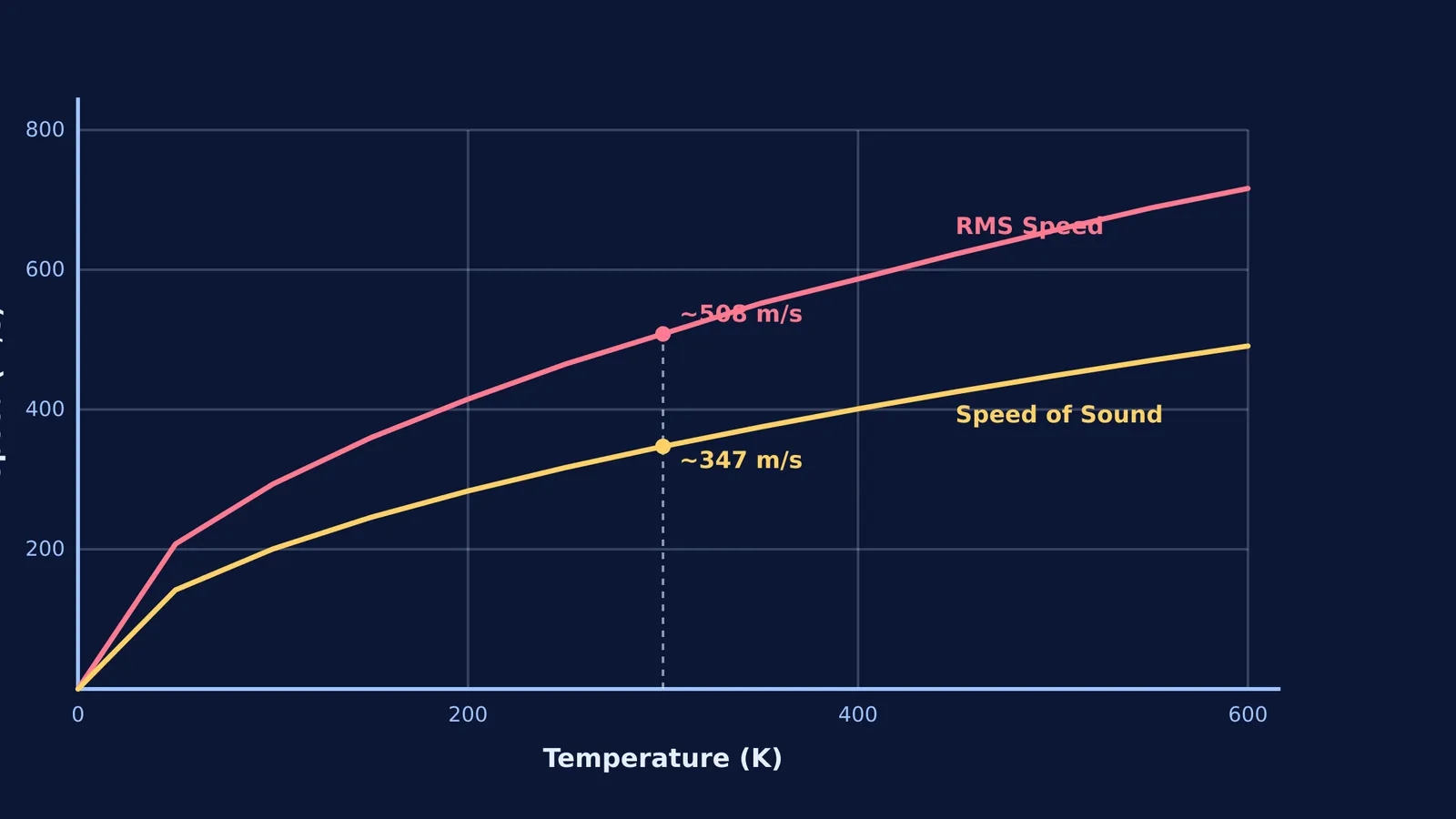
Let's test this relationship with a practical, worked example using dry air at a comfortable room temperature of 300 K.
First, we identify the constants. The molar mass of dry air is approximately 0.0289652 kg/mol (Source).
We calculate the RMS speed using the standard formula: v_rms = √((3 × 8.314 × 300) / 0.0289652) ≈ 508 m/s.
Air is predominantly composed of diatomic gases (nitrogen and oxygen), so we use γ = 1.4.
We apply our derived ratio: v_sound = 508 × √(1.4 / 3) ≈ 347 m/s.
This theoretical result perfectly matches the accepted real-world speed of sound in air at 300 K. Notice how the chaotic molecular speed sits high above 500 m/s, but the coordinated energy transfer (the sound wave) lags considerably behind at 347 m/s.
Understanding how these thermodynamic properties dictate wave behaviour also explains the 90-degree phase shift between displacement and pressure waves in sound. If you find the mathematical derivations tricky to remember, the Fermi Concept Library covers every concept in physics, chemistry, biology, mathematics and computing, each with its own lesson and its place in the map. When you move on to practising these numericals for your exams, taking a difficult question to the Fermi Problem Library gives you a step-by-step solver that explains the reasoning rather than printing an answer, helping you spot exactly where your calculations went off track.


