

On this page
Why does sound travel faster in lighter gases?
Sound waves are longitudinal mechanical waves that advance through alternating compressions and rarefactions. When an acoustic source compresses a layer of gas, the local pressure increases and pushes neighbouring particles forward. Because accelerating any mass requires mechanical work, the inertia of gas molecules directly governs how rapidly this disturbance travels. Lighter particles with less mass accelerate more readily under the same pressure gradient, allowing acoustic wavefronts to advance faster. According to the historical account in Wikipedia's Speed of Sound, Isaac Newton originally modelled this propagation as an isothermal process, but his formula underestimated experimental values by roughly 15%.
In 1816, Pierre-Simon Laplace corrected Newton's derivation by recognizing that sound oscillations occur too quickly for heat to transfer between compressions and rarefactions. As explained in our guide to Laplace's correction to the speed of sound, sound propagation is truly adiabatic, giving the wave speed v = √(γ P / ρ), where γ is the adiabatic index, P is pressure, and ρ is density. Substituting the ideal gas equation P/ρ = R T / M, as detailed in OpenStax University Physics, yields the standard relation v = √(γ R T / M). This formula demonstrates that at a constant absolute temperature T, acoustic velocity scales inversely with the square root of molar mass M.
How do you calculate the ratio of speed of sound in hydrogen and oxygen?
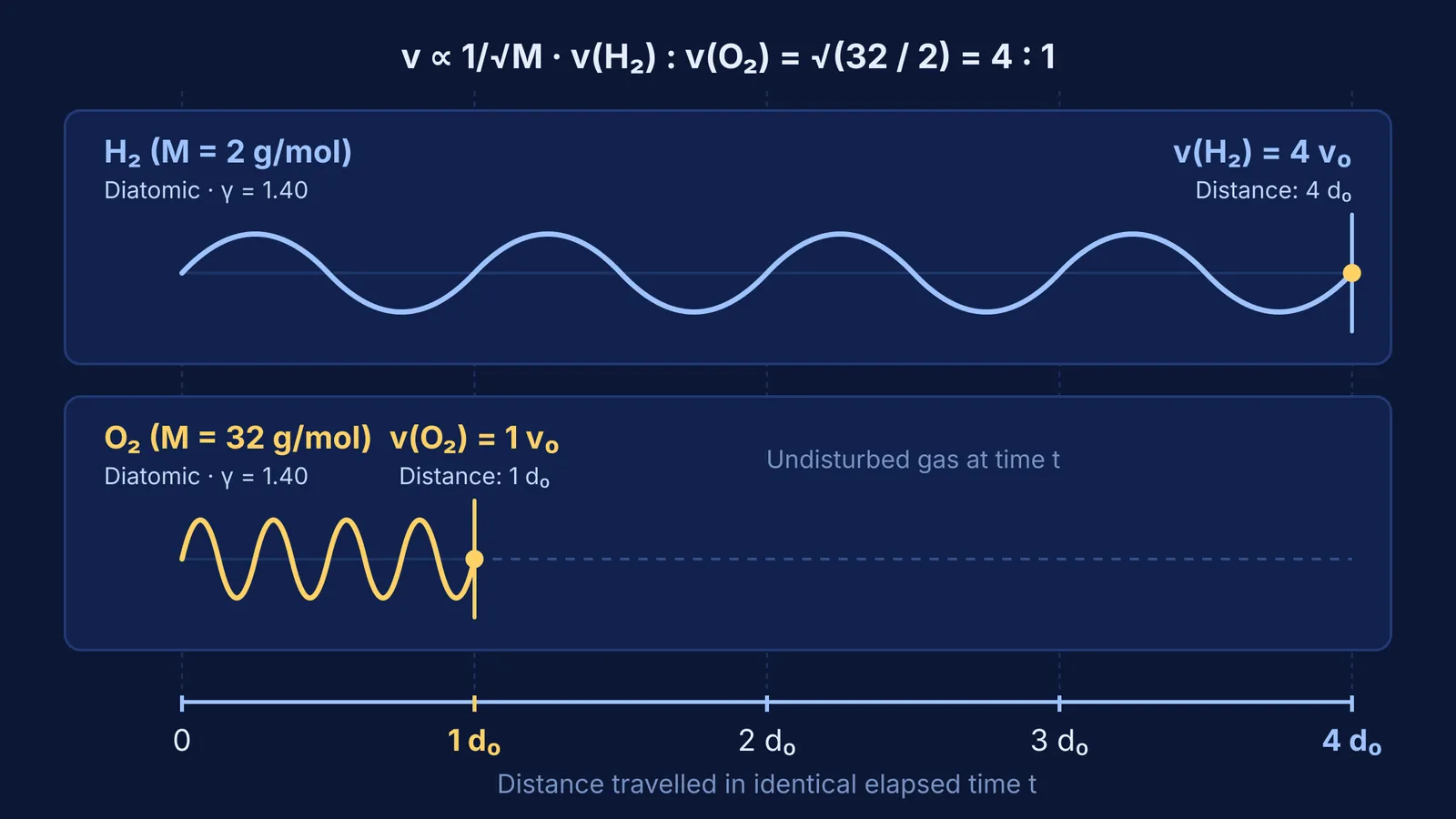
To determine the speed ratio between hydrogen and oxygen, you must evaluate both the molecular structure and the molar mass of each gas. Hydrogen (H₂) and oxygen (O₂) are both homonuclear diatomic gases. At room temperature, diatomic molecules possess 5 degrees of freedom (3 translational and 2 rotational), which gives both gases an identical heat capacity ratio of γ = 7/5 = 1.40, a result derived from the kinetic theory of gases and documented in the Engineering ToolBox. Because γ, the universal gas constant R, and absolute temperature T are identical for both gases, they cancel out in the ratio.
Taking standard molar masses of M₁ ≈ 2 g/mol for hydrogen and M₂ ≈ 32 g/mol for oxygen, the comparison simplifies directly:
v(H₂) / v(O₂) = √(M(O₂) / M(H₂)) = √(32 / 2) = √16 = 4.
Sound travels 4 times faster in hydrogen than in oxygen. If the question asks for the reciprocal ratio of oxygen to hydrogen, the result is v(O₂) / v(H₂) = 1/4 = 0.25.
Consider a practical example: a loudspeaker emits a tone with a frequency of 500 Hz into two separate tubes containing hydrogen and oxygen at 0 °C. Following the wave relation v = f λ documented in OpenStax University Physics, the wavelength in hydrogen (v ≈ 1,280 m/s) is λ = 1,280 / 500 = 2.56 m. In oxygen (v ≈ 320 m/s), the wavelength is λ = 320 / 500 = 0.64 m. The sound wave stretches over 4 times the distance in hydrogen for every single cycle of oscillation.
How do laboratory measurements compare with the 4:1 prediction?
Real-world measurements closely match the ideal gas calculation while revealing minor deviations caused by molecular interactions. In OpenStax University Physics, reference tables list the measured speed of sound at 0 °C (273.15 K) as 1,290 m/s for hydrogen and 316 m/s for oxygen, yielding an experimental ratio of 1,290 / 316 ≈ 4.08. Thermophysical tables in the NIST Chemistry WebBook record 1,261.1 m/s for hydrogen and 314.8 m/s for oxygen at 0 °C and 1 atm, producing a ratio of 4.01. At a warmer room temperature of 27 °C (300 K), reference data from the Engineering ToolBox lists 1,320 m/s for hydrogen and 330 m/s for oxygen, matching the theoretical 4.00 ratio.
Beyond ambient gases, hydrogen's light molecular mass enables extreme acoustic velocities in extreme states of matter. Research published in Science Advances indicates that solid atomic metallic hydrogen possesses the highest theoretical sound speed of any condensed material, approaching 36,000 m/s under megabar pressures.
In physics classrooms, students demonstrate these acoustic properties using a resonance tube experiment. By tuning an open acoustic column until standing wave resonances appear, one can measure successive antinode positions and derive sound velocity directly from the resonance spacing.
What mistakes do students make in exam questions?
Competitive exams like JEE Main and NEET-UG frequently feature gas ratio questions because they test both wave mechanics and chemical thermodynamics. Common errors include:
Inverting the ratio: Reading "hydrogen to oxygen" but mistakenly computing v(O₂) / v(H₂) = 1/4 instead of 4:1. Always confirm which gas belongs in the numerator before bubbling an answer sheet.
Ignoring atomicity: Assuming v ∝ 1/√M holds when comparing different gas classes. For instance, comparing monatomic helium (γ = 5/3 ≈ 1.67, M = 4 g/mol) with diatomic hydrogen (γ = 7/5 = 1.40, M = 2 g/mol) requires keeping the γ factor in the formula, as outlined in OpenStax University Physics.
Assuming pressure changes speed: Believing that increasing gas pressure makes sound travel faster. At constant temperature, Boyle's law dictates that density increases in exact proportion to pressure, keeping P/ρ unchanged.
To avoid formula reversals on test day, the Fermi Problem Library offers worked problems with a step-by-step solver that explains the reasoning rather than printing an answer. If you find wave pressure and molecular displacements difficult to visualize, the Fermi Simulation Lab provides interactive simulations for the ideas that are easier to see than to read. For a complete conceptual review of degrees of freedom and adiabatic expansions, the Fermi Concept Library organizes every concept in physics, chemistry, biology, mathematics and computing, each with its own lesson and its place in the map.


