

On this page
When a moving vehicle travels along a straight road, its journey can be recorded as odometer readings at fixed clock times. In Class 7, calculating speed from a distance-time table turns static measurements into a clear understanding of motion, rate of change, and consistency.
What is the formula for speed in Class 7 Science?
Speed measures how fast or slow an object covers ground. Speed is defined as the total distance covered by an object divided by the total time taken to cover that distance, as specified in the NCERT Class 7 Science curriculum.
In plain text:
speed = distance ÷ time
The International Bureau of Weights and Measures establishes the metre per second (m/s) as the coherent derived unit of speed in the BIPM SI Brochure. In daily road travel, distances are measured in kilometres and durations in hours, giving kilometres per hour (km/h). Building on the standard measurement of length and motion in Class 6, Class 7 problems require handling both units.
How do you calculate speed from equal steps in a table?
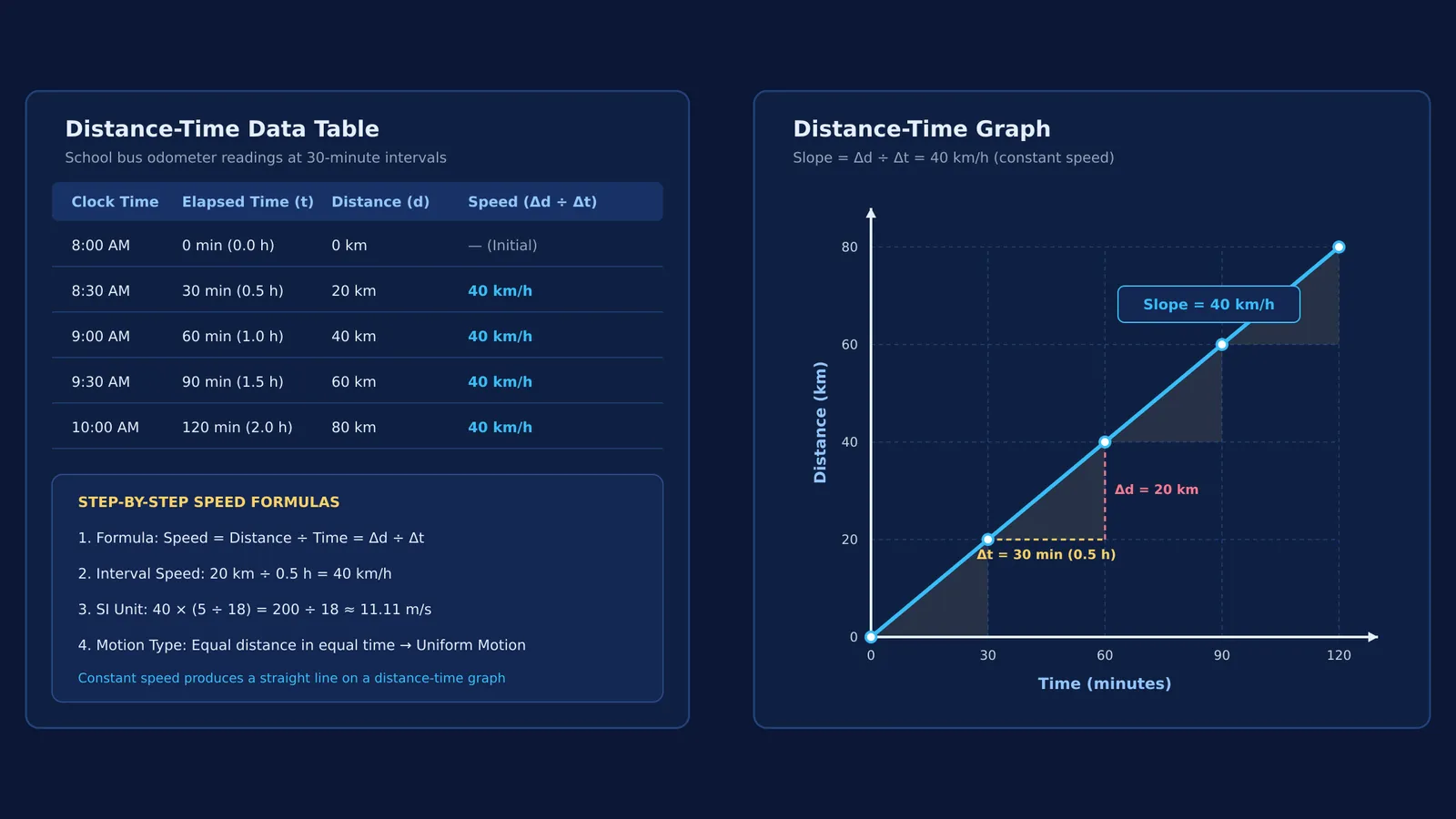
A distance-time table pairs clock readings with cumulative distance from a starting point, a standard exercise featured in the NCERT Class 7 Science curriculum. Consider a school bus recorded every 30 minutes:
At 8:00 AM: elapsed time = 0 minutes, odometer distance = 0 km
At 8:30 AM: elapsed time = 30 minutes, odometer distance = 20 km
At 9:00 AM: elapsed time = 60 minutes, odometer distance = 40 km
At 9:30 AM: elapsed time = 90 minutes, odometer distance = 60 km
At 10:00 AM: elapsed time = 120 minutes, odometer distance = 80 km
To compute the speed across any step:
Find the elapsed time (Δt). Between 8:00 AM and 8:30 AM, elapsed time is 30 minutes, or 0.5 hours (30 ÷ 60).
Find the distance covered (Δd). Here, distance is 20 km − 0 km = 20 km.
Divide distance by time: speed = Δd ÷ Δt = 20 km ÷ 0.5 h = 40 km/h.
Verify subsequent intervals. Between 8:30 AM and 9:00 AM, the bus travels another 20 km in 0.5 hours, giving 40 km/h again.
How do you convert speed between km/h and m/s?
Exam questions frequently ask for speed in metres per second (m/s). The conversion follows from base unit definitions recognized in the BIPM SI Brochure:
1 kilometre equals 1,000 metres.
1 hour equals 3,600 seconds (60 minutes × 60 seconds).
Dividing 1,000 metres by 3,600 seconds simplifies to 5/18 (approximately 0.278 m/s). To convert km/h to m/s, multiply by 5/18. To convert m/s to km/h, multiply by 18/5.
Applying this rule to our bus speed:
speed in m/s = 40 × (5 ÷ 18) = 200 ÷ 18 ≈ 11.11 m/s
You can verify this directly from base quantities: 20,000 metres travelled in 1,800 seconds (30 minutes) yields 20,000 m ÷ 1,800 s = 11.11 m/s.
How can you spot uniform motion from a table?
A distance-time table reveals whether motion is steady before you plot a graph. An object moving along a straight line with a constant speed is said to be in uniform motion, according to the NCERT Class 7 Science curriculum.
To spot uniform motion from a table:
Check that successive time intervals (Δt) are equal.
Confirm that the distance covered (Δd) in each interval is identical.
When both conditions hold, the object covers equal distances in equal time steps, demonstrating uniform motion. If the distance steps vary—such as 15 km, 25 km, and 10 km across consecutive half hours—the motion is non-uniform, and dividing total distance by total time gives the average speed.
To connect timing methods to speed, explore how pendulums and speed work in Class 7. These tabular skills also prepare students for position-time graphs and equations of motion in Class 9.
What common mistakes do students make with motion tables?
Physics education research highlights typical obstacles students face when reading kinematics data. In a study published in the *American Journal of Physics*, researchers found that students often confuse coordinates or table heights with rates of change, treating numbers as static points rather than slopes (McDermott, Rosenquist, and van Zee, 1987).
Three errors occur frequently on exams:
Dividing cumulative distance by interval time: taking total distance (80 km) and dividing by one 30-minute interval instead of the full 120 minutes.
Forgetting unit conversions: dividing kilometres by minutes and labelling the answer "km/h".
Checking only the first interval: assuming constant speed without testing every row.
When students encounter challenging multi-step calculations, the Fermi Problem Library provides worked problems with a step-by-step solver that explains the reasoning rather than printing an answer. For mastering the foundational ideas of speed and motion, the Fermi Concept Library covers every concept in physics, chemistry, biology, mathematics and computing, each with its own lesson and its place in the map.


