

On this page
A good speech and a good debate have the same bones: you greet the audience, take a position, give reasons, and end on a line people remember. Here is what CBSE tests, a format and a sample.
Is speech writing in the Class 12 English paper?
Not in 2026-27. The CBSE English Core syllabus for Classes 11 and 12 (2026-27) puts speech and debate in Class 11, as two long writing tasks of 120-150 words each, worth 5 marks each.
The Class 12 creative writing section in the same syllabus covers a notice, an invitation and reply, a letter, and an article or report.
The skill still pays in Class 12. The syllabus gives 5 marks in both classes to an internal assessment of speaking, judged on interaction, fluency, pronunciation and language. And assemblies, house debates and inter-school contests do not follow the board paper.
What is the speech writing format?
In the Class 11 marking scheme, each task splits as 1 mark for format, 2 for content and 2 for expression. Format is the easiest mark to secure and the easiest to throw away. A common layout:
A title: the topic in a few words.
The address: "Good morning, respected Principal, teachers and my dear friends."
One line introducing yourself and the topic: "I, Riya of Class 11 B, am here to speak on..."
An opening hook: a question, a scene the audience can picture, or a fact you are sure of.
Two or three points, one paragraph each, each with a reason and an example.
A close: a call to action or the line you want remembered, then "Thank you."
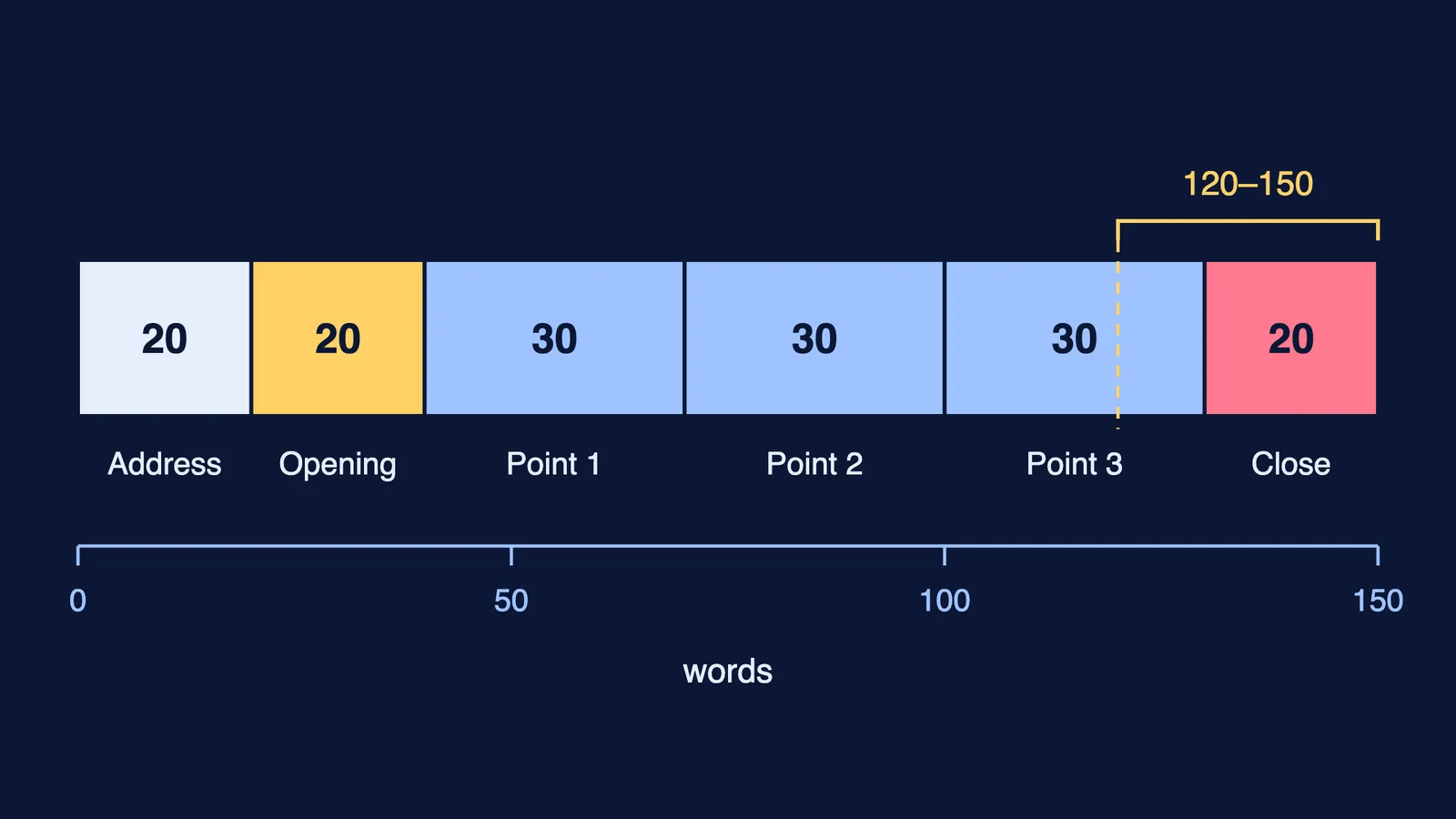
A workable word budget for 150 words: about 20 for the address and introduction, 20 for the opening, 30 for each of three points, and 20 for the close.
How is a debate different from a speech?
A speech informs or persuades; a debate argues for or against a motion. The 2026-27 syllabus says the Class 11 debate is based on visual or verbal inputs and is "thematically related to contemporary, topical issues". Four changes turn a speech into a debate:
Address the chairperson or moderator, the judges and your "worthy opponents".
State your side in the first two lines: "I stand before you to speak for (or against) the motion..."
Give one paragraph to answering the other side.
End by restating your side in a single sentence.
If your motion is on science, our guide to evidence cards and rebuttals for science debates shows how to prepare the facts before you write.
Which rebuttal phrases work in a debate?
A rebuttal names the other side's point fairly, then answers it. These openers keep you polite and on the attack:
"My opponents argue that..., but they overlook..."
"That sounds convincing until we look at..."
"Even if we accept that..., it does not follow that..."
"The real question is not... but..."
"With due respect to the speaker before me..."
"Let me turn that argument around."
Answer the strongest version of their point, not a weak one; a reply to a real argument is harder to dismiss. When a motion turns on a science idea such as radiation or climate, check the idea before you lean on it: the Fermi Concept Library covers every concept in physics, chemistry, biology, mathematics and computing, so your argument rests on what the term actually means.
Sample debate: a Class 11 style answer
Motion: Mobile phones should be allowed in senior secondary classrooms. Side: for.
Phones in class: a tool, not a toy
Good morning, respected judges, worthy opponents and friends. I, Arjun, stand here to speak for the motion that mobile phones should be allowed in senior secondary classrooms.
Picture a physics lesson where the teacher mentions a satellite, and the whole class can watch its orbit in seconds. That is what a phone in a classroom can be.
First, phones put dictionaries, simulations and e-books in every hand, not only in the library. Second, we will use these devices at college and at work; school is where we should learn to use them with discipline.
My opponents say phones distract. But distraction is a rules problem, not a device problem. A simple rule, phones face down until the teacher asks for them, solves it.
Let us teach responsibility instead of banning it. I urge you to support the motion. Thank you.
That answer is about 140 words without the title. Notice the shape: address, side, hook, two reasons, one rebuttal, close.
This week, write one speech and one debate, read each aloud once, then count. For delivery, see how to prepare a two-minute assembly speech, and for comments on a draft without losing your own voice, using AI for feedback on your assembly speech.


