

On this page
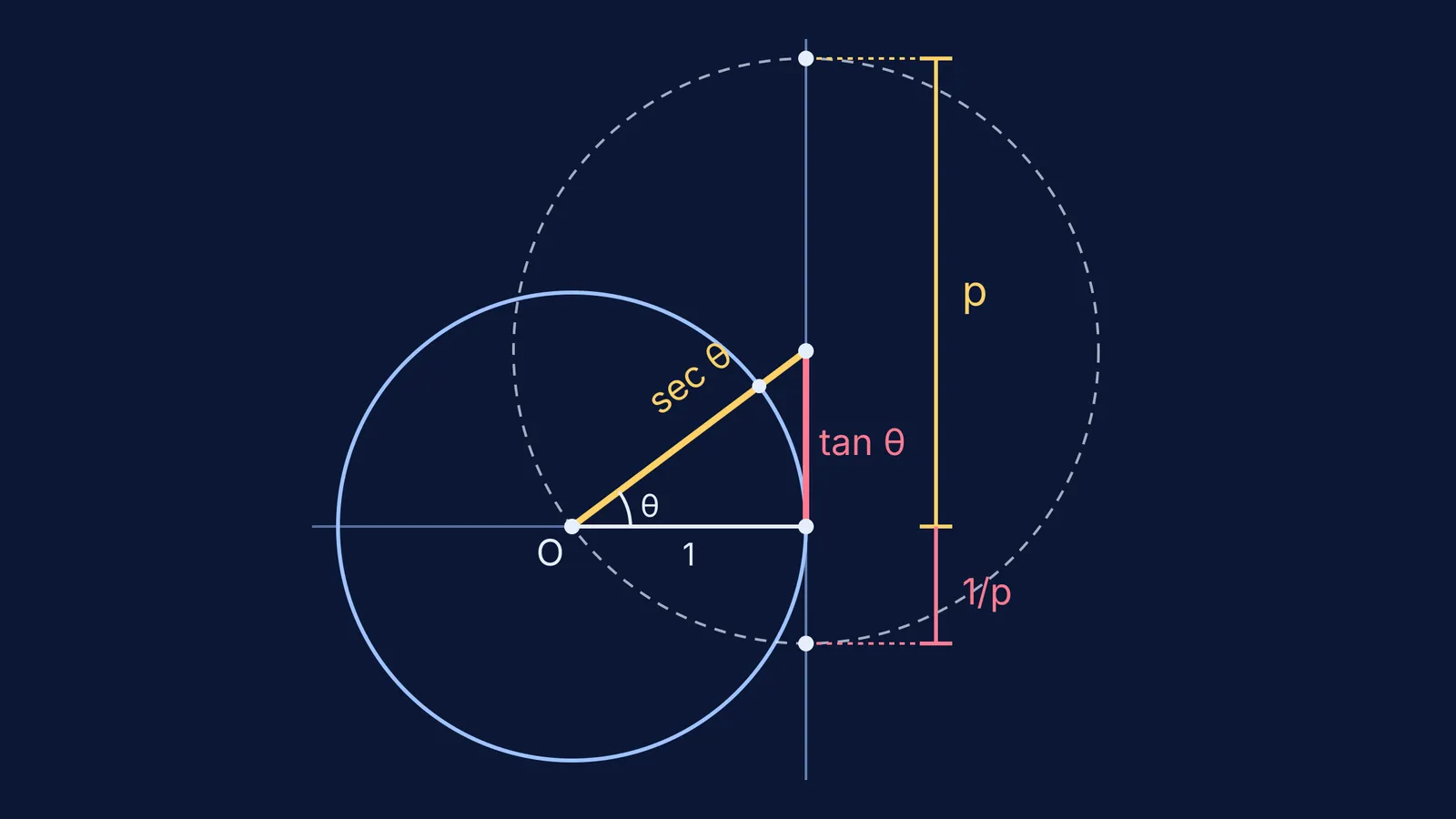
You are given sec θ + tan θ = p and asked for sin θ. Squaring both sides leads to a mess. There is a short route instead, and it also solves the cosec θ + cot θ version.
Why does sec θ − tan θ equal 1/p?
NCERT's Class 10 chapter Introduction to Trigonometry proves 1 + tan²A = sec²A for 0° ≤ A < 90°, and its summary lists it as sec²A − tan²A = 1 (NCERT Class 10 Mathematics, Chapter 8). The left side is a difference of squares, so it factors:
(sec θ + tan θ)(sec θ − tan θ) = 1
You know the first bracket is p. Divide by it:
sec θ − tan θ = 1/p
Dividing by p is always allowed, because p can never be 0: the product of the two brackets is 1. The same NCERT chapter uses this idea in its Example 12, where tan²θ − sec²θ collapses to −1 in the middle of a proof.
How do you find sec θ, tan θ and sin θ from p?
Write both equations: sec θ + tan θ = p and sec θ − tan θ = 1/p.
Add them: 2 sec θ = p + 1/p, so sec θ = (p² + 1)/(2p).
Subtract them: 2 tan θ = p − 1/p, so tan θ = (p² − 1)/(2p).
Divide: tan θ ÷ sec θ = (sin θ/cos θ) × cos θ = sin θ. The 2p cancels, so sin θ = (p² − 1)/(p² + 1).
Get the rest from reciprocals: cos θ = 2p/(p² + 1), cosec θ = (p² + 1)/(p² − 1) and cot θ = 2p/(p² − 1).
What does it look like with real numbers?
Take p = 2.
sec θ − tan θ = 1/2
sec θ = (2 + 1/2)/2 = 5/4
tan θ = (2 − 1/2)/2 = 3/4
sin θ = (3/4) ÷ (5/4) = 3/5, which matches (4 − 1)/(4 + 1)
cos θ = 4/5
Check: 5/4 + 3/4 = 2. That is the 3-4-5 triangle hiding inside the question. With p = 3 you get sec θ = 5/3, tan θ = 4/3 and sin θ = 4/5: the same triangle, with the other acute angle.
A note on signs: if θ is acute, sec θ > 1 and tan θ > 0, so p > 1. If p is between 0 and 1, sin θ comes out negative and θ is not acute.
What if cosec θ + cot θ = q?
The same NCERT chapter proves cot²A + 1 = cosec²A for 0° < A ≤ 90°. So cosec²θ − cot²θ = 1, and the steps repeat:
(cosec θ + cot θ)(cosec θ − cot θ) = 1, so cosec θ − cot θ = 1/q.
Add: cosec θ = (q² + 1)/(2q).
Subtract: cot θ = (q² − 1)/(2q).
Divide: cos θ = cot θ ÷ cosec θ = (q² − 1)/(q² + 1), and sin θ = 1/cosec θ = 2q/(q² + 1).
Notice the swap. With sec + tan, the (p² − 1)/(p² + 1) answer is sin θ. With cosec + cot, the same shape of answer is cos θ. Example: q = 3 gives cosec θ = 5/3 and cot θ = 4/3, so cos θ = 4/5 and sin θ = 3/5.
There is a second way to see the cosec version. cosec θ + cot θ = (1 + cos θ)/sin θ, which simplifies to cot(θ/2). So q = cot(θ/2), and sin θ = 2q/(q² + 1) is the half-angle formula in disguise. Our post on tan half-angle substitution and sin and cos in terms of t shows where that formula comes from.
Where do students go wrong?
Squaring p. (sec θ + tan θ)² = p² gives sec²θ + 2 sec θ tan θ + tan²θ = p², which still tangles two unknowns together.
Forgetting where the ratios exist. sec θ needs cos θ ≠ 0 and cosec θ needs sin θ ≠ 0. Our guide to the domain and range of sec x, cosec x and cot x covers this.
Swapping the sin and cos answers between the sec + tan and cosec + cot versions. Remember the method, not the result.
If your working goes off track, the Fermi Problem Library has worked problems with a step-by-step solver that explains the reasoning rather than printing an answer, so you can see which line broke. If the identities themselves feel shaky, each one has its own lesson in the Fermi Concept Library.
If you use an AI chatbot to check proofs like these, read how to check an AI's proof of a trigonometric identity before you trust its steps.


