On this page
Alternate seating of men and women is a standard Class 11 and JEE Main permutations question. Every version comes down to two questions: row or circle, and are the groups the same size?
Both cases rest on one rule. NCERT's Class 11 chapter on permutations states the multiplication principle: if one event can happen in m ways and the next in n ways, the two together can happen in m × n ways (NCERT Mathematics Class 11, Chapter 6). The same chapter defines n! as the product 1 × 2 × 3 × … × n, so 4! = 24.
How many ways can men and women sit alternately in a row?
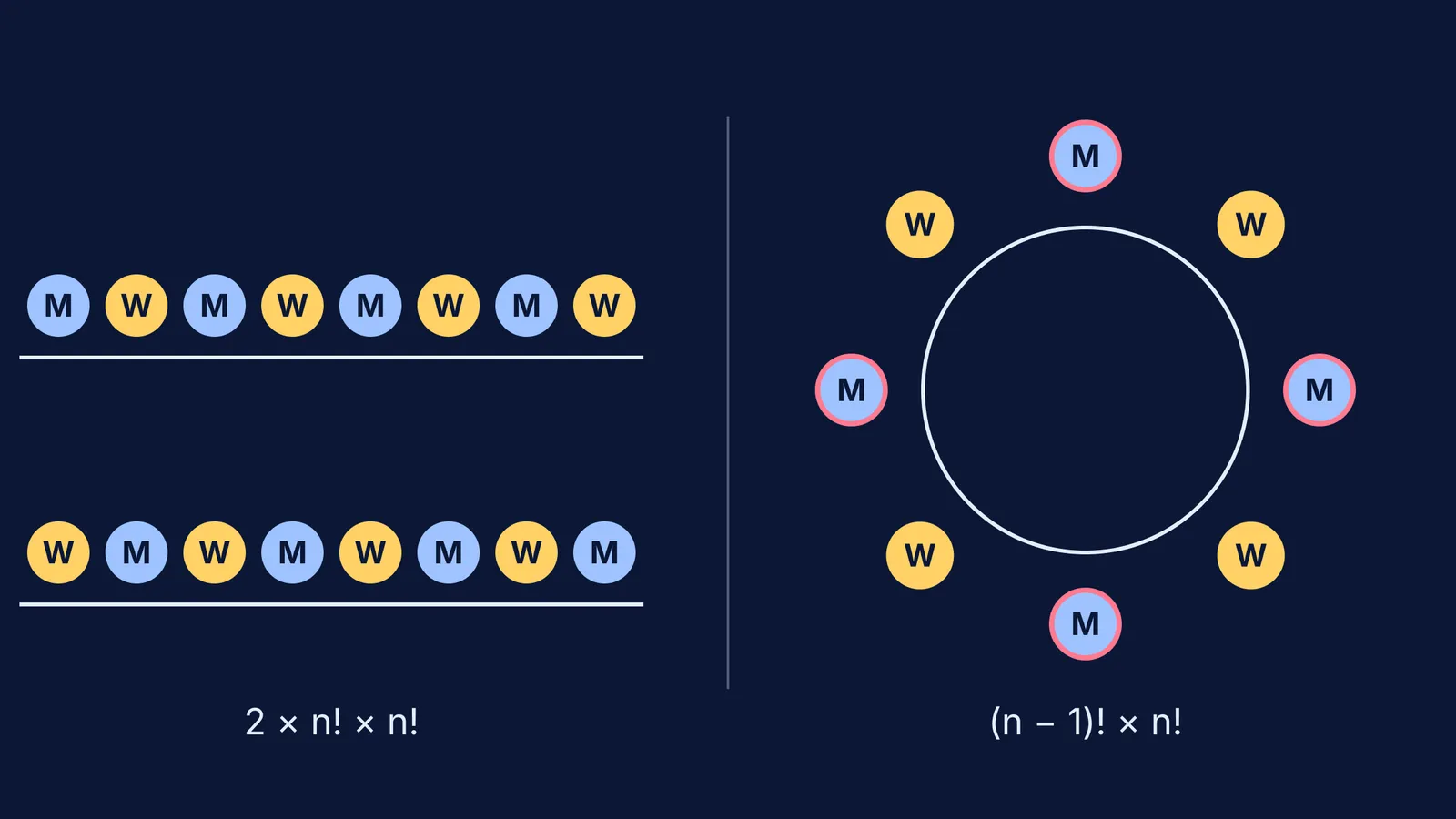
With n men and n women in 2n chairs in a row, there are exactly two patterns: M W M W … M W, or W M W M … W M.
Pick a pattern. The men fill their n seats in n! ways, since n different objects can be arranged in n! orders (NCERT, Theorem 1). The women fill theirs in n! ways. Multiply, then double for the two patterns:
Row, equal groups: 2 × n! × n!
4 men and 4 women: 2 × 24 × 24 = 1152 ways
What if the groups are not the same size?
If there is one more man than woman, say 5 men and 4 women, the row must start and end with a man: M W M W M W M W M. That leaves only one pattern, so by the multiplication principle the count is 5! × 4! = 120 × 24 = 2880 ways. If the groups differ by two or more, two people from the larger group must end up side by side somewhere, so there are 0 alternate arrangements.
Why do you fix one group first at a round table?
A circular permutation is an arrangement of distinct objects around a fixed circle, and n distinct objects can be arranged around one in (n − 1)! ways (Wolfram MathWorld, Circular Permutation). You lose a factor of n because spinning everyone one seat to the left does not give a new seating.
So seat the men first, as a circle: (n − 1)! ways. That creates exactly n gaps, fixed relative to the men, so the women fill them like a row, in n! ways.
Round table, equal groups: (n − 1)! × n!
4 men and 4 women: 3! × 4! = 6 × 24 = 144 ways
This is the gap method for keeping people apart with exactly as many gaps as people to fill.
What changes if the chairs are numbered?
If the chairs are numbered, rotating everyone does give a new seating. The women take the odd or the even chairs, in n! ways each, and the men fill the rest in n! ways. That gives 2 × n! × n!, the same as a row. The Wikipedia article on the ménage problem counts seats this way: 2 × n! ways to seat the women. For 4 and 4 that is 1152, which is 144 × 8: one for each of the 8 rotations.
How do you check your answer in under a minute?
Ask four questions before writing a number down:
Row or circle? A row has fixed ends; a circle does not.
Equal groups, groups differing by one, or by more? That gives 2 patterns, 1 pattern or none in a row.
Are the chairs numbered? If so, treat the circle like a row.
Test n = 2: you should get 2 × 2! × 2! = 8 seatings in a row and 1! × 2! = 2 around a table (MathWorld), few enough to list by hand.
Necklaces can be flipped over, so there you also divide by 2. People at a table cannot, so clockwise and anticlockwise are different seatings. See the guide to circular permutations and necklaces.
What is the harder version where couples cannot sit together?
Add the rule that no husband sits next to his wife and you have the ménage problem. Édouard Lucas posed it in 1891, and Peter Guthrie Tait had posed it independently a few years earlier (Wikipedia). Fix the women, then count the ways to place the men: these are the ménage numbers, which run 1, 2, 13, 80 for 3, 4, 5 and 6 couples (OEIS A000179). With 3 couples and numbered chairs, that comes to 2 × 3! × 1 = 12 seatings.
Most slips here are method slips, not arithmetic: doubling at a table, or forgetting the second pattern in a row. The Fermi Problem Library has worked problems with a step-by-step solver that explains the reasoning rather than printing an answer, so you can see which step went wrong. If the idea behind (n − 1)! itself is shaky, the Fermi Concept Library gives each mathematics concept its own lesson.
Next, try one where a few people must sit together: the bundle method for arrangements with items together uses the same multiply-the-stages habit.