On this page
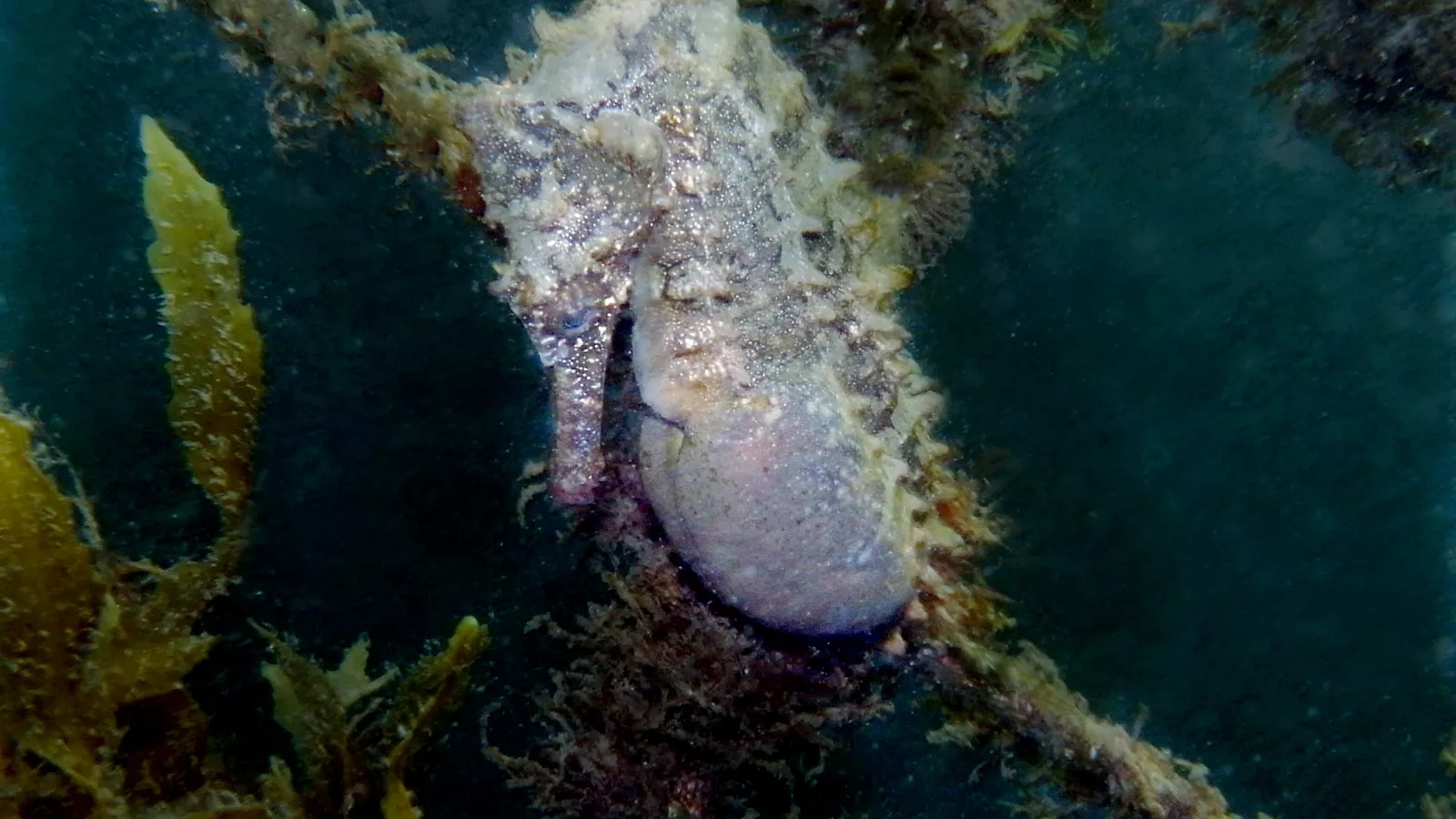
In most animals that carry their young, the mother does the carrying. Seahorses reverse this. The female makes the eggs, but the male gets pregnant, carries the brood and gives birth.
How does a male seahorse get pregnant?
Seahorses usually pair up. According to Project Seahorse, a paired male and female greet each other with a dance, linking tails and circling a shared holdfast for an average of six minutes. During mating, the female transfers her eggs into the male's enclosed brood pouch on his belly, and the male fertilises them.
The exact route the sperm take was a puzzle. A 2007 study of the yellow seahorse in the Journal of Experimental Biology found that the male cannot place sperm directly into his pouch, and that sperm transfer must happen within a window of no more than 6 seconds during mating. The authors suggest the sperm are released into a mixture of ovarian fluid and eggs while the pair are in close contact, and broods can still exceed 100 embryos.
Male pregnancy lasts about 10 days to six weeks, depending on the species and water temperature, says Project Seahorse. In labour the male pumps and thrusts to push the young out of the pouch, and from then on they are entirely independent.
What does the brood pouch do for the babies?
The pouch is far more than a pocket. A 2015 study of the pot-bellied seahorse in Molecular Biology and Evolution describes it as providing protection, gas exchange, osmoregulation (keeping salt and water in balance) and limited nutrient provisioning to the embryos. The same paper notes that live birth has evolved more than 150 times in vertebrates, but that the syngnathid fishes, seahorses and their pipefish relatives, are unique in having male pregnancy.
Carrying embryos raises a problem every pregnant animal faces: the young are genetically partly foreign, so the parent's immune system could attack them. A 2020 study in PNAS compared 12 seahorse and pipefish genomes and found that the evolution of pregnancy came with changes to one arm of the immune system. Some pipefish have lost genes in that pathway, while seahorses carry an unusual version of one of its key genes.
Hormones matter too. Authors of a 2025 Nature Ecology and Evolution paper report in a behind-the-paper post that female seahorses could be induced to grow male-like pouches after treatment with male hormones (androgens).
Why do male seahorses carry the babies instead of females?
Nobody has proven a single cause, but three lines of evidence help.
Certainty of paternity. Because the eggs are fertilised inside his own closed pouch, the male can be sure the young are his, "a confidence that is rare among animals", as Project Seahorse puts it.
Sharing the workload. While the male broods, the female can prepare her next eggs. In a study of dwarf seahorses by Heather Masonjones and Sara Lewis in Animal Behaviour, reported by Science News, males had the capacity to produce 17 percent more offspring than females during a breeding season, and females' time-outs from reproduction were 1.2 times longer than males'. In that species, pregnancy did not make the male the slower sex.
Males can be choosy. A 2009 study in Behavioral Ecology and Sociobiology, summarised by ScienceDaily, found pot-bellied seahorse males preferred larger females, and clutch, egg and offspring size all increase with female body size.
How do you write about seahorse parental care in an exam?
Here is a model 3-mark answer to "Describe parental care in seahorses".
Point 1: The female deposits her eggs into a brood pouch on the male's abdomen, where they are fertilised.
Point 2: The male carries the developing embryos in the pouch, which protects them and supplies oxygen and some nutrients.
Point 3: The male gives birth to free-swimming young; there is no care after birth.
Check your answer against these common slips:
Writing "the male lays eggs". He does not; the female produces them.
Calling it external fertilisation. The eggs are fertilised as they pass into the closed pouch, so compare it carefully with the cases in our post on internal vs external fertilisation.
Treating every pouch as the same. A kangaroo joey enters the pouch after birth, as our post on why kangaroos have a pouch explains, while a seahorse pouch holds eggs from fertilisation onward.
If terms such as viviparity or osmoregulation still feel shaky, the Fermi Concept Library covers every concept in biology, each with its own lesson and its place in the map.
Do seahorses live in India?
Yes. All seahorse species in India were placed on Schedule I of the Wild Life Protection Act, 1972 in 2001, banning their extraction and trade, according to research summarised by Project Seahorse. Before the ban, trawl fisheries in Tamil Nadu and Puducherry accounted for 84% of all trawl catches of seahorses in India. The pregnant fathers in your textbook live off India's coast.