

On this page
Real sandalwood oil is costly, and the reason is biology rather than branding. The smell comes from a few molecules that collect in the dark centre of the trunk. That centre takes decades to grow, on a tree that cannot grow well alone.
What makes sandalwood smell?
The smell of Indian sandalwood (*Santalum album*) comes mostly from molecules called santalols. A 2013 study in PLoS ONE reports that about 90% of the oil is made of four sesquiterpene alcohols: α-santalol, β-santalol, epi-β-santalol and α-exo-bergamotol. It names α- and β-santalol as the most important contributors to the fragrance.
The same paper sets out how the tree makes them. An enzyme called santalene synthase folds a starting molecule, farnesyl diphosphate, into ring-shaped santalenes. The team then showed that cytochrome P450 enzymes from the CYP76F family add an –OH group to make santalols.
In mature wood, as a 2009 paper by J. A. McComb summarises from earlier studies, the oil is usually 50 to 60% α-santalol and 20 to 30% β-santalol, with β-santalol contributing most to the typical sandalwood smell. Leaves like tulsi keep their terpenes in glands at the surface, as our post on why tulsi and mint smell so strong when crushed explains. Sandalwood hides its terpenes deep inside the trunk.
Is sandalwood really a parasite?
Yes, partly. Sandalwood is a root hemiparasite: it makes its own food by photosynthesis, but it taps other plants' roots for some of its water and nutrients. A 2015 paper in Frontiers in Plant Science describes it as a tree that "obtains some of its water and simple nutrients by tapping into other plants through haustoria". Haustoria are small pegs that grow from sandalwood roots and join the host's roots.
This matters for growers. A sandalwood seedling needs a host planted nearby, and the host it gets changes how it grows. In McComb's host trial at Kununurra in Western Australia, a sandalwood clone grew best on *Dalbergia sissoo* (shisham) out of the three hosts compared. At another site the trees also tapped a nearby roadside row of casuarina, and the heights of those casuarinas were significantly reduced.
Why does sandalwood take so long to grow?
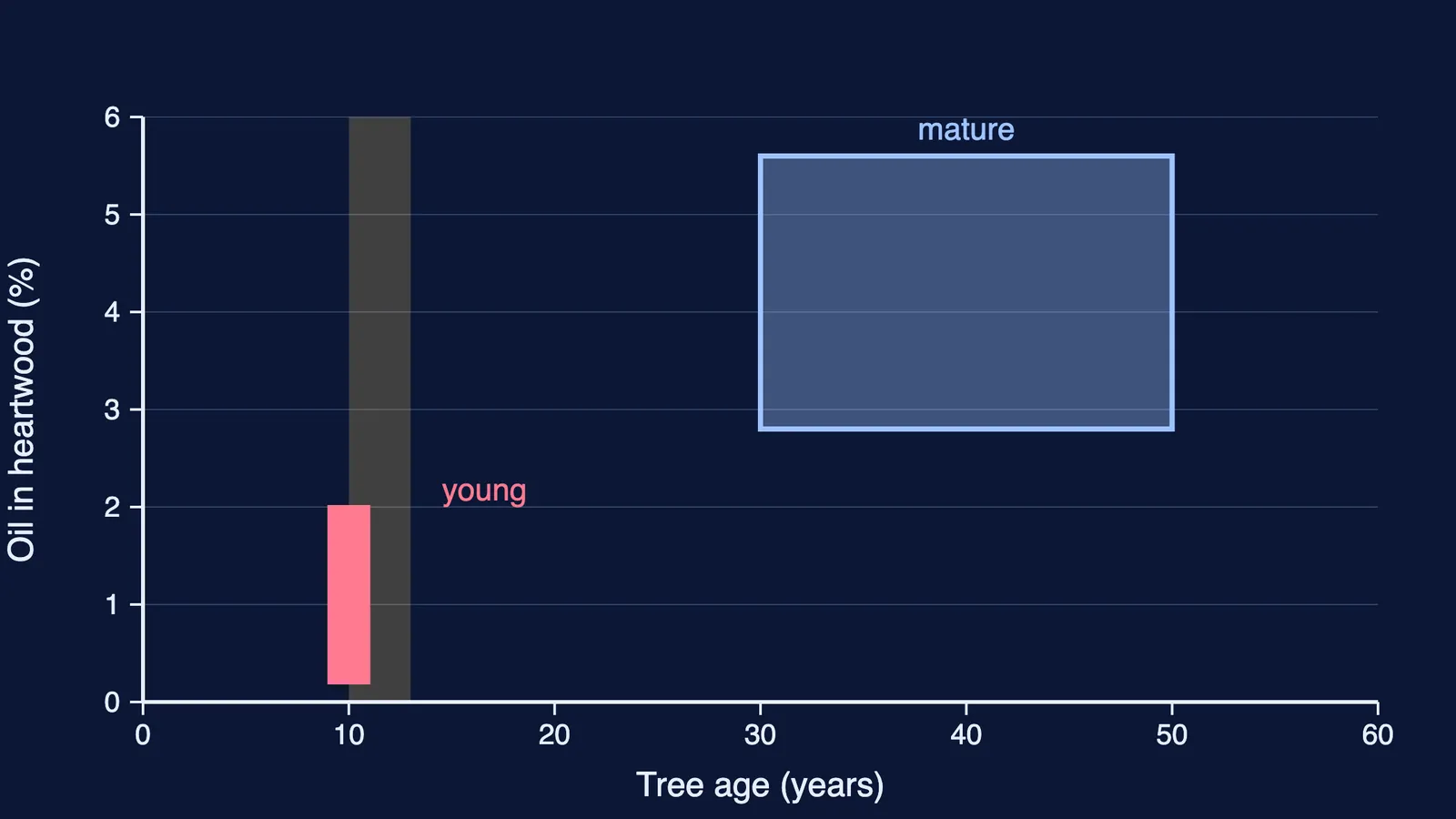
The valuable part is the heartwood, and the oil there builds up slowly. In India, heartwood is generally expected to start forming within 10 to 13 years, McComb notes, while trees in West Timor started anywhere from 14 to 46 years.
The oil also gets better with age. Young trees, about 10 years old, hold 0.2 to 2.0% oil with 60 to 85% santalols, while trees 30 to 50 years old hold 2.8 to 5.6% oil, with about 90% santalols (McComb, 2009). So an older tree gives more oil, and better oil.
The Agroforestree Database says trees reach a harvestable size, over 15 cm thick at chest height, in about 30 years, with about 50 kg of heartwood. Grafted mango trees can skip their slow early years, as in our post on why grafted mango trees fruit years before seedlings. Sandalwood heartwood has no such shortcut: it needs the years.
Why is sandalwood so expensive?
Put the biology together and the price makes sense. Four reasons stack up:
The scented oil sits in the heartwood, so much of the tree is worth little for oil.
Heartwood does not start for a decade or more, and the oil keeps improving up to 30 to 50 years.
Growers have to plant and manage a host plant as well.
Wild trees are being lost. McComb lists poaching, poor growing conditions and spike disease as threats to India's reserves, and the PLoS ONE team writes that disease, grazing animals and unsustainable exploitation have led to the loss of many natural populations.
Worked example: how much oil is in one tree?
Try a quick Fermi estimate using the figures above.
Heartwood in a 30-year tree: about 50 kg (Agroforestree Database).
Oil content of mature heartwood: 2.8 to 5.6% (McComb, 2009).
Low end: 50 kg × 0.028 = 1.4 kg of oil. High end: 50 kg × 0.056 = 2.8 kg.
Santalols at about 90% means roughly 1.3 to 2.5 kg of the molecules that carry the scent.
So three decades of growth gives roughly one to three kilograms of oil per tree. Now run the same steps for a 10-year tree, where the heartwood may only have just started and holds at most 2% oil, and you will see why growers wait.
If words like terpene, haustorium or secondary metabolite are new to you, the Fermi Concept Library gives every concept in chemistry and biology its own lesson and shows where it sits in the map. For more estimates like the one above, the Fermi Problem Library has worked problems with a step-by-step solver that explains the reasoning rather than printing an answer.


