

On this page
If you are studying Class 8 Science or preparing for competitive exams, questions about protected areas can be confusing. The terms are often used interchangeably in everyday conversation, but in biology, they mean very different things. The key difference between a wildlife sanctuary, a national park, and a biosphere reserve lies in how much human activity is allowed and what exactly is being protected.
Here is a breakdown of the official rules for each protected area.
What is a National Park?
A national park is the strictest category of protected area. According to the Wildlife Institute of India (WII), there are 106 national parks in India, covering about 1.35% of the country's geographical area.
The primary goal of a national park is to preserve an entire ecosystem. This includes not just the animals, but the flora (plants), the landscape, and even historical objects found in the area. From large tigers down to the green, brown and red algae in the water bodies, everything within the boundary is fiercely protected.
Because the focus is on complete preservation, human activity is strictly prohibited. According to the NCERT Class 8 Science textbook, activities such as grazing of livestock, hunting, capturing of animals, and collecting firewood or medicinal plants are completely banned. Wildlife is left completely alone to freely use the habitats and natural resources.
Example: Satpura National Park.
What is a Wildlife Sanctuary?
A wildlife sanctuary offers a moderate level of protection, focusing specifically on protecting wild animals from disturbance to them and their habitats. As of current data, India has a massive network of 575 wildlife sanctuaries (WII).
Unlike a national park, a wildlife sanctuary allows limited human activity. The NCERT curriculum clarifies that local people living inside a wildlife sanctuary are permitted to graze their livestock. They are also allowed to collect firewood and medicinal plants, provided these activities do not harm the animals or significantly degrade the habitat.
However, capturing or killing (poaching) animals is strictly prohibited and punishable by law everywhere. The sanctuary provides a safe haven where animals can live and breed, while still accommodating the basic survival needs of the local communities.
Example: Bori Wildlife Sanctuary and Pachmarhi Wildlife Sanctuary.
What is a Biosphere Reserve?
A biosphere reserve is a massive area of protected land designed with a much broader goal: to conserve biodiversity while also protecting the traditional lifestyle of the tribals living in the area.
This is the most inclusive type of protected area. The conservation strategy recognises that humans are an integral part of the ecosystem. A biosphere reserve protects the whole web of life, from large predators down to the smallest microorganisms, viruses, viroids and lichens.
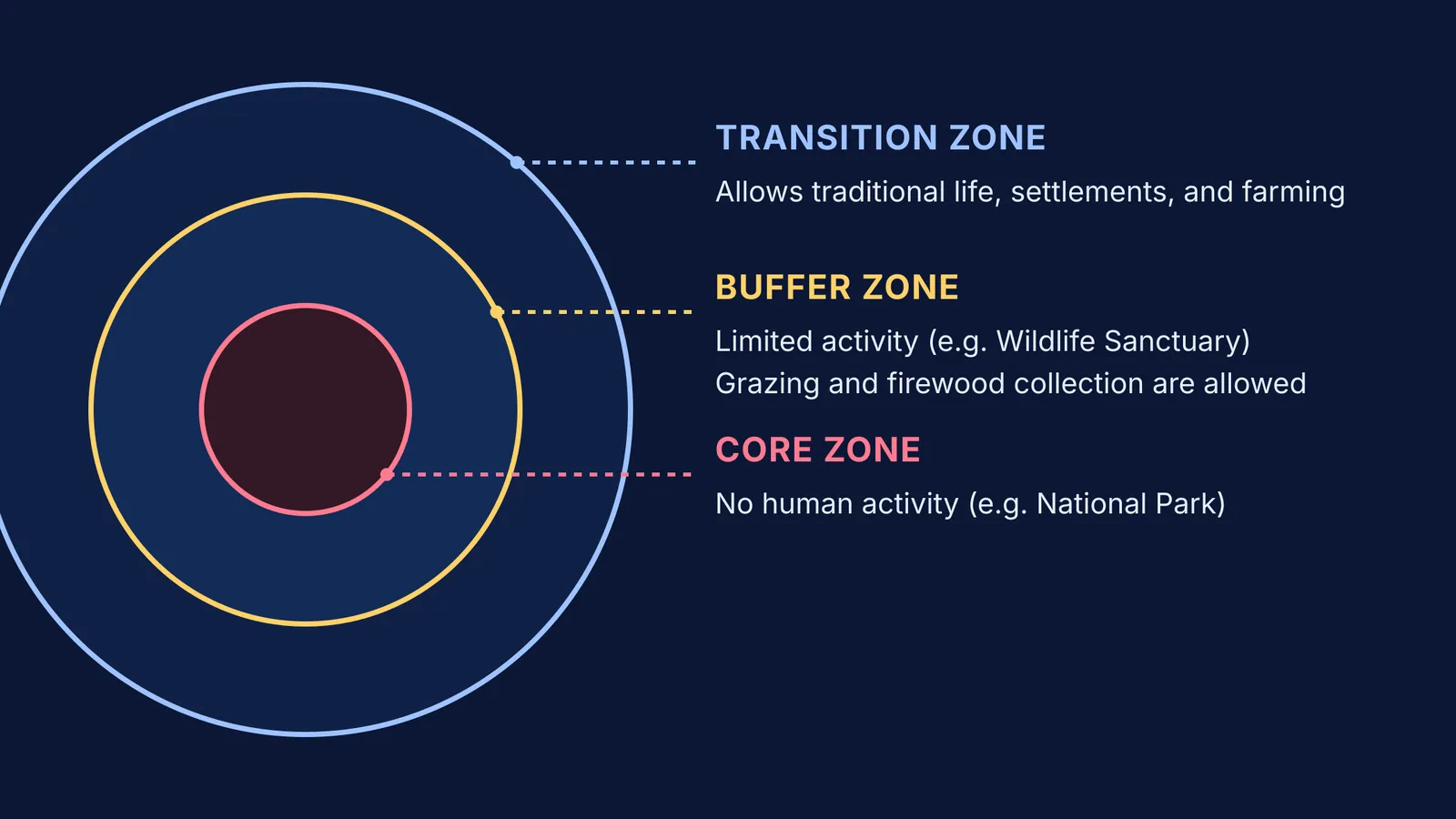
To manage both people and nature, a biosphere reserve is divided into three zones:
Core Zone: The innermost area where no human activity is allowed. This is often a designated national park.
Buffer Zone: Surrounds the core. Limited activities like research, education, and grazing are permitted here. This often acts as a wildlife sanctuary.
Transition Zone: The outermost area where traditional human settlements, farming, and other activities take place.
Because they are so large, biosphere reserves frequently contain other protected areas within their borders. For example, the NCERT textbook notes that the Pachmarhi Biosphere Reserve contains one national park (Satpura) and two wildlife sanctuaries (Bori and Pachmarhi).
If you are struggling to picture how these intricate ecosystems fit together or how energy flows between these zones, the Fermi Concept Library can help. With every concept in physics, chemistry, biology, mathematics and computing, each with its own lesson and its place in the map, you can explore biodiversity at your own pace.
How to remember the differences for your exam?
When answering a board question comparing the three, structure your answer around size and strictness.
National Park: High strictness, moderate size. Focuses on the whole ecosystem. Zero human use allowed.
Wildlife Sanctuary: Moderate strictness, moderate size. Focuses on animals. Local human use is allowed.
Biosphere Reserve: Low strictness in outer zones, massive size. Focuses on biodiversity and human culture. Humans are part of the system.
By understanding what is allowed in each zone, you can easily explain why a national park is not just a bigger wildlife sanctuary, and why a biosphere reserve is the ultimate umbrella for conservation.


