On this page
A charged disc that spins carries its charge round in circles, and charge moving in a circle is a current. That one idea turns a scary-looking JEE problem into a short integral. MIT's 8.02 course notes set exactly this exercise as Problem 9.13.5, "Rotating Disk", and give the hint we use below: slice the disc into thin rings (MIT OpenCourseWare, Chapter 9: Sources of Magnetic Fields).
How do you turn a spinning disc into current rings?
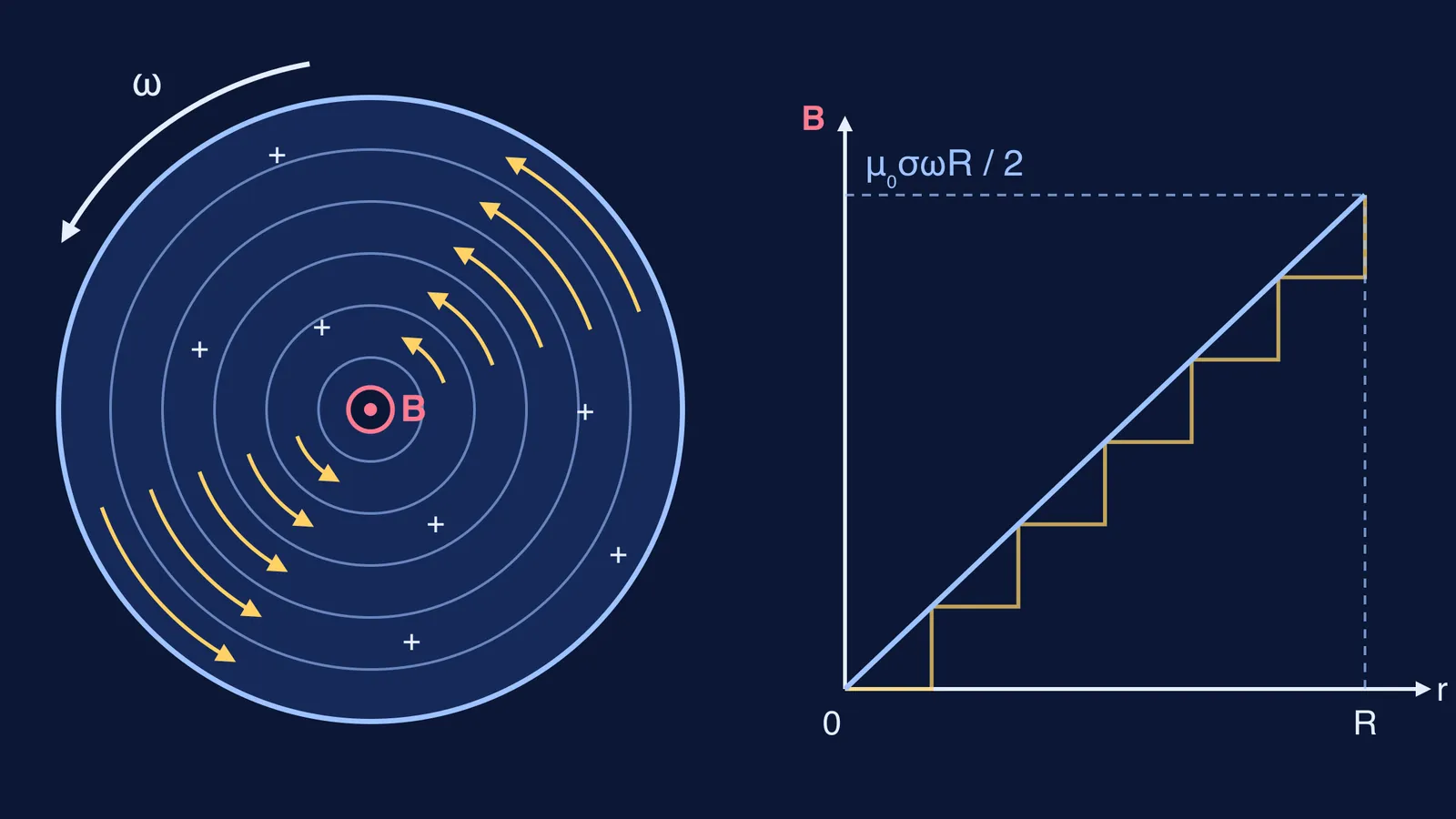
Take a thin ring of the disc at radius r with width dr. Its area is 2πr dr, so it holds charge dq = σ(2πr dr).
The disc turns once every 2π/ω seconds, so this charge passes any fixed point ω/2π times per second. The ring's current is therefore dI = (ω/2π)dq = σωr dr, which is the hint given in the MIT 8.02 notes.
Now you need one standard result. The magnetic field at the centre of a circular loop of radius R carrying current I is B = μ0I/2R (OpenStax University Physics Volume 2, section 12.4). If that formula feels shaky, our post on the Biot-Savart law and Ampere's law shows where it comes from.
What is the magnetic field at the centre of a rotating charged disc?
Apply the loop formula to one ring, with r in place of R:
dB = μ0 dI / 2r = μ0(σωr dr) / 2r = (μ0σω/2) dr
Every ring's field at the centre points the same way along the axis, so the contributions simply add.
B = (μ0σω/2) ∫ dr from 0 to R = μ0σωR/2
The result B = μ0σωR/2 is the answer the MIT problem asks you to show. Use the right-hand rule for direction: curl your fingers the way positive charge moves and your thumb gives B. A negative disc flips it.
Why isn't the answer μ0I/2R with all the charge at the rim?
This is a common wrong answer, and it is worth seeing why it fails. If you put the whole charge Q = σπR² on the rim, the current is I = Qω/2π and the loop formula gives B = μ0σωR/4. That is exactly half the true value.
The real disc spreads its charge over every radius, and the charge nearer the centre counts for more because 1/r is large there. Pushing it all out to the rim weakens the field. Written in terms of total charge, the correct answer is B = μ0Qω/2πR.
Worked example: put numbers in
A plastic disc of radius 0.10 m carries uniform charge density 2.0 × 10⁻⁵ C/m² and spins at 300 rad/s. Use μ0 = 4π × 10⁻⁷ T·m/A, the value given in the MIT notes, equation 9.1.2.
B = ½ × (4π × 10⁻⁷) × (2.0 × 10⁻⁵) × 300 × 0.10
B ≈ 3.8 × 10⁻¹⁰ T
Check with total charge: Q = σπR² ≈ 6.3 × 10⁻⁷ C, and μ0Qω/2πR gives the same 3.8 × 10⁻¹⁰ T.
The field is tiny, well under a billionth of a tesla. In an exam, though, the method is what earns the marks.
How does the same method handle the variations examiners set?
Keep dI = σ(r)ωr dr and change only what the question changes.
Annulus (inner radius a, outer radius b): integrate from a to b to get B = μ0σω(b − a)/2.
Charge density σ = kr²: dB = (μ0kω/2)r² dr, so B = μ0kωR³/6.
Magnetic moment: each ring has moment dm = πr² dI = πσωr³ dr, so m = πσωR⁴/4 = QωR²/4.
The same "add up rings" idea also gives the field at the centre of a flat spiral coil, and the moment calculation links naturally to the magnetic moment of an orbiting electron.
If your answer comes out with R² or a stray 2π, go back to the ring current step: that is where most slips happen. When you want to check a variation step by step, the Fermi Problem Library has worked problems with a step-by-step solver that explains the reasoning rather than printing an answer. If the loop formula itself is the gap, the Fermi Concept Library gives each physics concept its own lesson.
Try the annulus case yourself tonight, then check that it gives μ0σωR/2 when a = 0.