

On this page
In ICSE Class 10 biology, understanding how plants transport water is a core syllabus topic. When you remove a plant's shoot, sap continues to ooze from the stump. This happens because the roots actively absorb minerals, drawing water in and creating a positive pressure that pushes sap upward.
But if root pressure pushes water up, why does a 100-metre tree need a different mechanism? Here is how to set up the experiment to see root pressure in action, and the physics of why it fails in tall trees.
What is the root pressure experiment?
Root pressure is a positive hydrostatic pressure developed in the root xylem. As roots expend metabolic energy to pump mineral ions from the soil into their vascular tissue, they create a strong osmotic gradient. Water naturally follows the minerals into the xylem through osmosis, building up pressure that pushes the sap upward.
To prove this pressure exists and to measure its strength, biologists use the cut stem experiment. When a stem is severed, the upward "push" from the roots is no longer relieved by the plant's leaves. This allows the sap to bleed from the cut surface or rise into an attached tube, providing visible proof of the pressure generated below ground.
How to set up the cut stem experiment?
This practical is a staple of the ICSE biology curriculum because it requires minimal equipment but yields clear, measurable results. Here is the standard checklist:
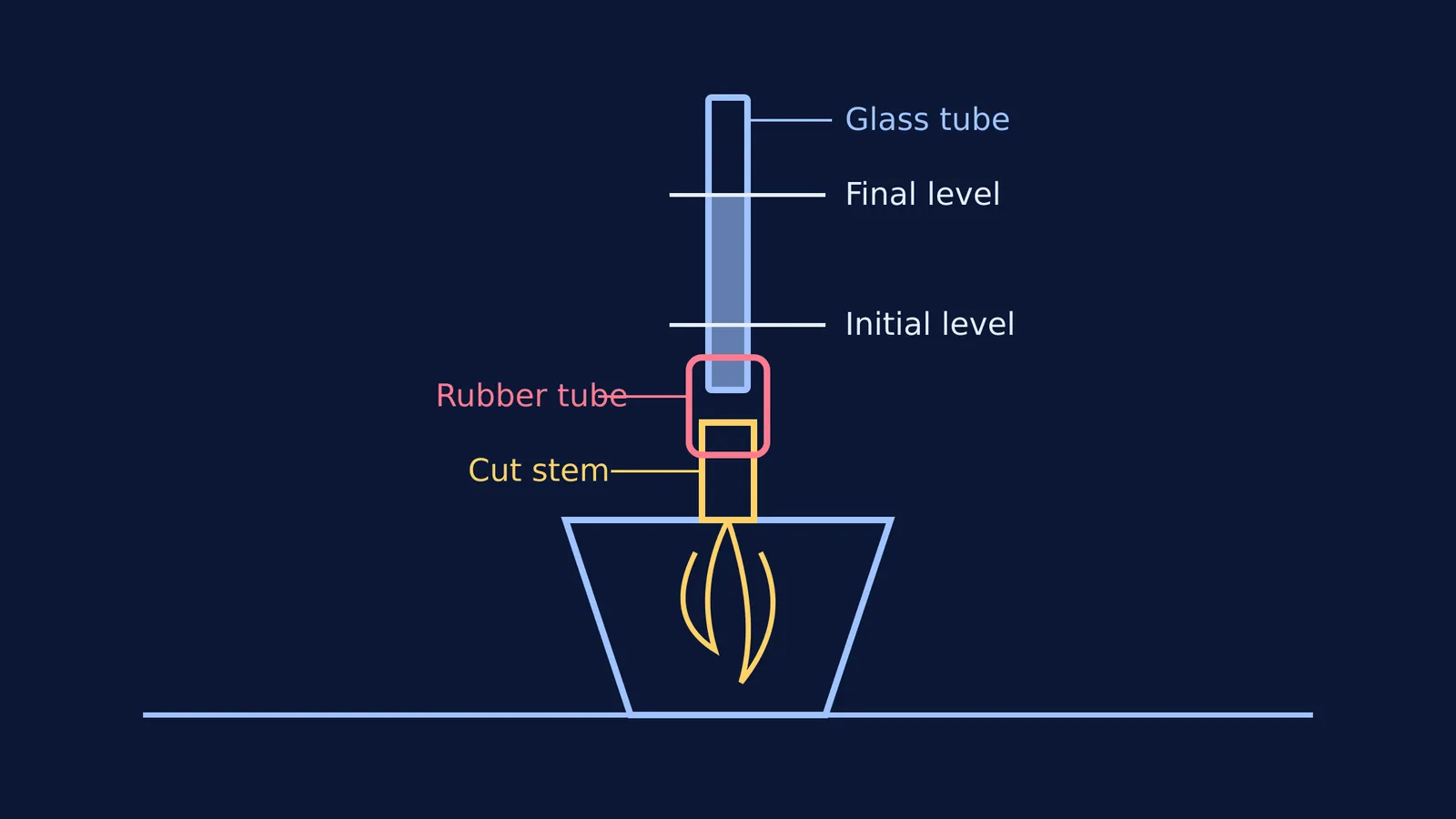
Select a healthy, well-watered herbaceous plant (such as balsam or petunia) in a pot. Water it thoroughly a few hours before you begin so the roots are fully turgid and active.
Using a sharp blade, cut the stem horizontally a few centimetres (about 5 cm) above the soil level.
Immediately slip a strong rubber tube over the cut stump.
Fit a narrow glass tube into the upper end of the rubber tubing. Ensure all connections are completely airtight and watertight; if air leaks in, the pressure will escape.
Pour a small amount of coloured water into the glass tube until it is visible above the rubber connection, and mark this initial water level (M₁).
Leave the setup undisturbed for two to three hours.
You will observe the coloured water rising to a higher, final level (M₂). This rise is the direct physical evidence of root pressure pushing the sap upward. If you replace the open glass tube with a mercury manometer, you can measure the exact pressure the plant generates.
If you struggle to recall the exact setup or the physics behind it during an exam, try visualising the apparatus. The Fermi Concept Library holds a dedicated lesson for every concept in biology, helping you trace exactly where the water enters and how the pressure builds.
Why can't root pressure lift water up tall trees?
The cut stem experiment proves that roots push. But the physics of a water column limits how far that push can realistically reach.
The maximum root pressure ever measured in any plant is approximately 0.6 megapascals (MPa). This pressure is capable of raising a column of water to a height of about 6.87 metres (1).
Many tall trees, such as redwoods and giant eucalyptus, grow to 50 or even 100 metres tall. To push water to the crown of a 100-metre tree from the bottom, a plant would need to generate over 1 MPa of pressure just to counteract gravity, without even accounting for the immense frictional resistance inside the narrow xylem vessels. Furthermore, many tall conifers produce no measurable root pressure at all. Root pressure is useful for small herbaceous plants, and it helps refill air bubbles in the xylem during spring, but it cannot drive the main water supply for a forest canopy.
What pulls water up tall trees instead?
Because the "push" from the roots is too weak, tall trees rely on a "pull" from the leaves, known as the cohesion-tension mechanism.
As water evaporates from the stomata in the leaves—a process called transpiration—it creates a powerful negative pressure, or tension, in the xylem. Because water molecules stick strongly to one another (cohesion) and to the walls of the xylem (adhesion), this tension pulls a continuous, unbroken rope of water all the way from the roots to the canopy.
For a deeper look into the history of how this mechanism was discovered, read about Dixon and Joly: how leaves pull water up the tallest trees. And if you are reviewing how water travels through different plant structures, our guide to Tissues in Class 9: plant and animal tissue types, with examples covers the xylem and phloem in detail.
Planning your biology revision
When preparing for ICSE Biology or NEET-UG, do not just memorise the numbered steps of an experiment. Connect the practical to the broader principles: the cut stem experiment proves root pressure, while the potometer measures transpiration. Understanding the physics of why one mechanism fails where the other succeeds makes the facts stick permanently.


