

On this page
A carrot, the hanging pillars of a banyan and the spikes poking out of mangrove mud are all roots. Each one has changed shape to solve a problem the plant faces where it lives. Learn the problem first and the names, examples and specimens all get easier.
What are root modifications?
A root modification is a root whose shape and structure have changed so it can do a job beyond absorbing water and minerals and anchoring the plant. The National Institute of Open Schooling (NIOS) lesson on the root system says tap roots and adventitious roots can get modified into a variety of forms to perform various functions. That NIOS lesson lists 4 tap-root modifications and 14 adventitious-root modifications; this post covers five of them.
A tap root grows from the radicle of the seed. An adventitious root, in the same lesson, develops from any other part: a node, a stem cutting, a tree branch or the stem base.
NCERT students, note that the 2026-27 reprint of the NCERT Class 11 Biology chapter on morphology of flowering plants goes from the regions of the root straight to the stem, with no section on root modifications. Check your current syllabus to see whether the topic is on it.
What are the types of root modifications with examples?
Examples are from the NIOS root system lesson unless another source is linked.
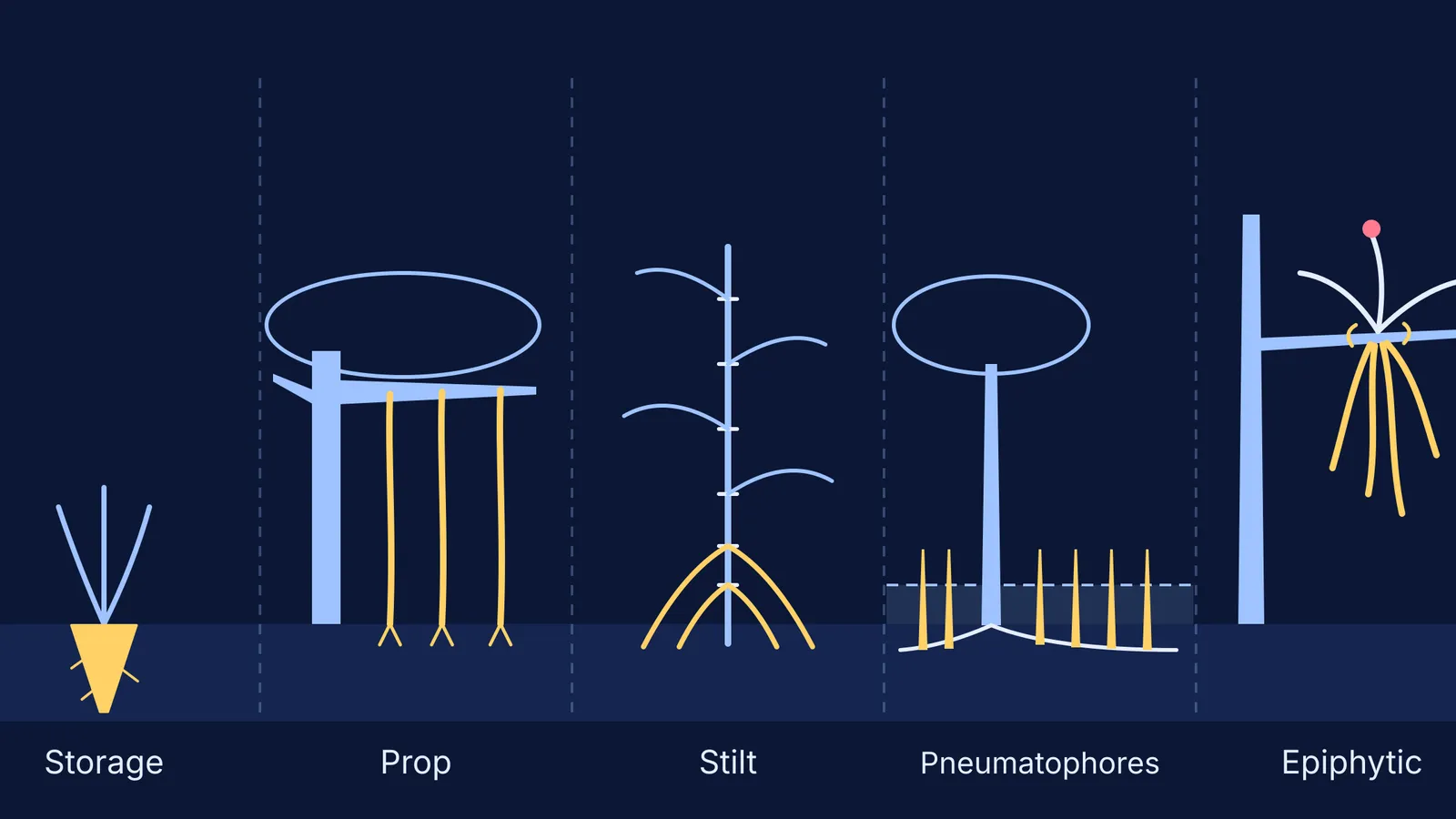
Storage roots. Problem: the plant needs a store of food. Tap roots swell into named shapes: conical in carrot, fusiform (swollen in the middle) in radish, napiform (spherical at the base, then sharply tapering) in turnip. Adventitious roots store food too: tuberous in sweet potato, and fasciculated (in a cluster) in *Dahlia*.
Prop roots. Problem: long, heavy branches need extra support. In the banyan, roots grow from the branches, hang down and enter the ground as supporting pillars.
Stilt roots. Problem: a slender stem needs stronger anchorage. Extra roots grow from nodes near the base of the stem, slant down and enter the soil, as in sugarcane and screwpine. Maize has similar above-ground nodal roots, which researchers call brace roots. A 2022 paper by Hostetler and colleagues notes that plants falling over, called lodging, causes global yield losses of 7-66% in cereal crops.
Pneumatophores. Problem: roots in marshy mud need better gas exchange. Mangroves such as *Rhizophora* send some roots vertically up into the air, against gravity. Their exposed tips, which look like conical spikes coming out of the water, have tiny pores through which the roots respire. More in our explainer on how pneumatophores help mangrove roots breathe.
Epiphytic roots. Problem: an epiphyte grows on another plant, away from the soil. Orchids such as *Vanda* have greenish aerial roots covered by a spongy tissue called velamen, which absorbs moisture from the air. A 2020 study by Hauber and colleagues describes the velamen as made of the walls of dead cells that soak up rain, mist and dew, and observed the process in eight orchid species.
How do you identify a root modification in a specimen?
In a spotting test, ask four questions in order.
Is it a root at all? The NIOS lesson lists the signs: roots are usually not green, have no nodes or internodes, and carry no leaves or buds. Orchid aerial roots are the exception to the colour rule.
Where does it start? From the radicle as the main axis, it is a tap root. From a node, a branch or the stem base, it is adventitious.
Which way does it grow? Down from a branch: prop. Slanting down from the lowest nodes: stilt. Straight up out of mud or water: pneumatophore. Hanging free in the air: epiphytic.
Is it swollen? A fleshy root is a storage root, so name its type: conical, fusiform, napiform, tuberous or fasciculated.
Here is a worked example. Specimen B is swollen and reddish, with no definite shape, and several like it arise along one creeping stem.
Root or stem? No nodes, no eyes, no scale leaves: root.
Origin? It arises from a node of the creeping stem, not the radicle: adventitious.
Swollen? Yes: tuberous, the type NIOS gives for sweet potato.
Your answer: "Specimen B: tuberous adventitious root of sweet potato, modified for food storage. Reasons: no nodes or buds; swollen root arising from a node of a prostrate stem."
For more practice in this format, see our guide to spotting slides and specimens in biology practicals.
How do you remember root modifications for exams?
Make a two-column list: the problem on the left (food store, heavy branches, slender stem, marshy mud, no soil) and the plant on the right. Cover one column and test yourself. Our post on leaf modifications such as phyllodes and pitchers is a good companion.
If words like adventitious or velamen still feel shaky, the Fermi Concept Library gives each concept in biology its own lesson and its place in the map. For help drawing and labelling these roots, Fermi's AI tutor draws the figure with you and checks your understanding as it goes.


