

On this page
Class 11 thermodynamics leans on one idea: the reversible process. It explains a result used in many JEE numericals: a gas does the most work when it expands reversibly. Here is what the two kinds of process are, why that maximum holds, and a worked example you can check.
What is a reversible process in thermodynamics?
A reversible process is one that happens so slowly that the system is always at equilibrium, and its direction can be reversed by an infinitesimally small change in some condition (OpenStax Chemistry 2e, section 16.2).
A reversible process is one where the system and its surroundings can both be restored to exactly their starting states by going backward along the same path (OpenStax University Physics Volume 2, section 4.1).
The slow, step-by-step part has its own name. A quasi-static process takes place in infinitesimally small steps, keeping the system at equilibrium, so pressure and volume follow a well-defined curve (OpenStax University Physics Volume 2, section 3.2). Being quasi-static is needed for reversibility, but it is not enough on its own: friction or heat flowing across a finite temperature gap still makes a process irreversible. Our post on what a quasi-static process really means covers that difference.
What is the difference between reversible and irreversible process?
An irreversible process is the kind we meet in reality almost all the time: the system and its surroundings cannot both be put back to their original states (OpenStax University Physics Volume 2, section 4.1). No real process is truly reversible; the reversible process is an idealisation.
Steps: reversible means infinitesimal steps; irreversible means finite, sudden changes.
Equilibrium: reversible keeps the system in equilibrium at every stage; irreversible passes through states that are not in equilibrium, so pressure and temperature are not even defined for the whole gas.
On a p-V graph: a reversible path is a continuous curve; an irreversible one can only be marked by its end points.
Examples: slow isothermal expansion against a piston adjusted step by step is the ideal case; a gas rushing into a vacuum, heat flowing from hot tea to the air, and a block sliding to rest by friction are irreversible.
Why is work done in a reversible process the maximum?
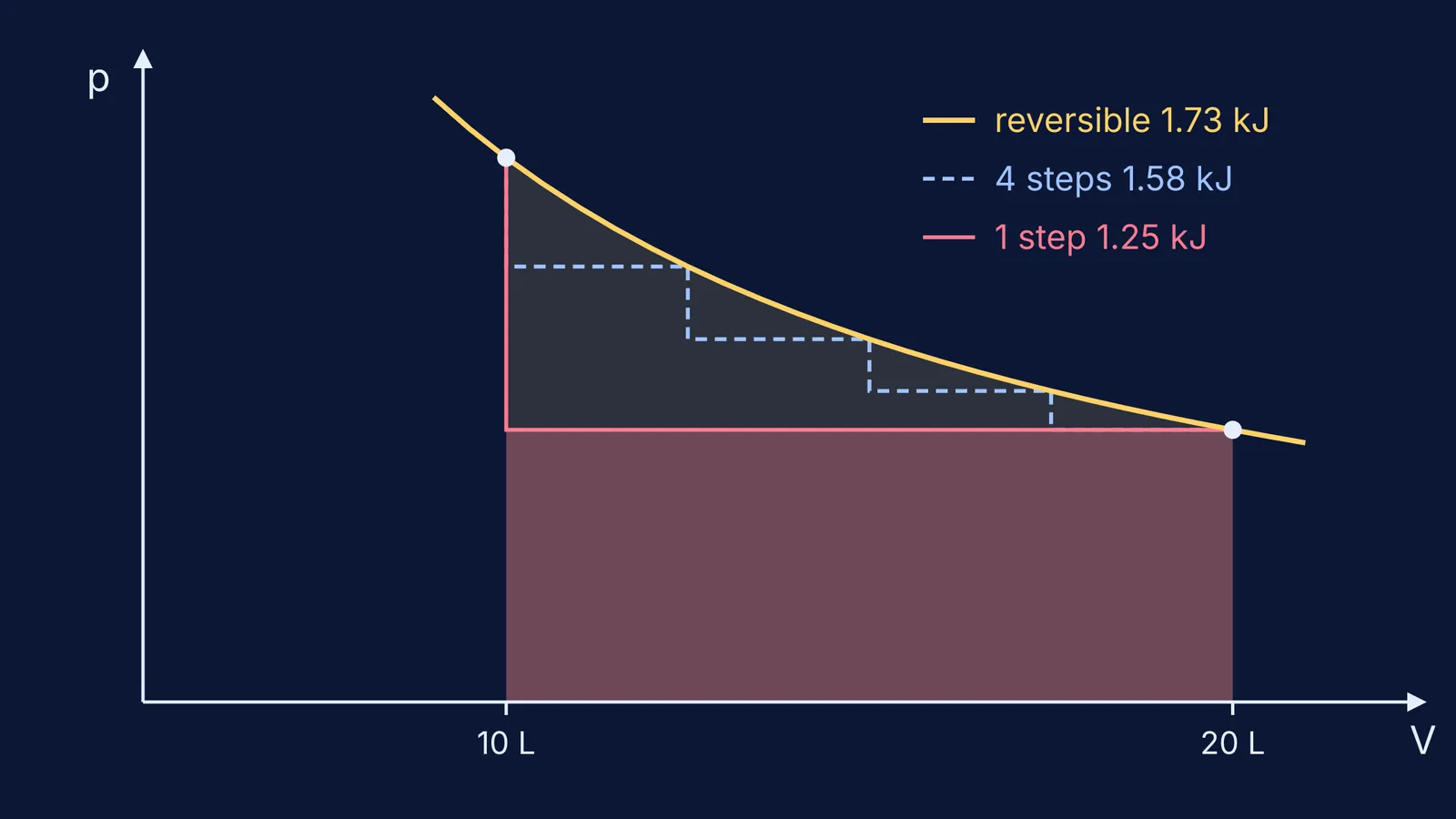
Work is the area under the p-V curve, and it depends on the path, not only on the end points (OpenStax University Physics Volume 2, section 3.2). The work a gas does on its surroundings is the outside pressure times each small change in volume, added up.
For a gas to expand at all, the outside pressure must be no more than the gas pressure. So the total work is at most the area under the gas's own curve. The two are equal only if the outside pressure matches the gas pressure all the way, which is exactly the reversible condition (LibreTexts, Ellgen, section 7.18/07%3A_State_Functions_and_The_First_Law/7.18%3A_Reversible_vs._Irreversible_Pressure-Volume_Work)). Any mismatch wastes some of that area.
Compression runs the other way: the outside pressure must be at least the gas pressure, so the reversible path needs the least work. As Ellgen puts it, "the isothermal reversible work done on the system is always less than the irreversible work for taking the system between the same two states."
Worked example: one gas, four ways to expand it
Take 1 mol of ideal gas at 300 K, expanding isothermally from 10 L to 20 L. Use R = 8.314 J/mol K, so nRT = 2494.2 J.
Reversible. W = nRT ln(V2/V1), the formula derived in OpenStax section 3.2. W = 2494.2 × ln 2 = 1729 J, about 1.73 kJ.
One sudden step. Drop the outside pressure straight to the final gas pressure, nRT/V2 = 124.7 kPa. W = 124.7 kPa × 0.010 m³ = 1247 J.
Two steps. Hold the outside pressure at the gas pressure for 15 L, then for 20 L. W = 2494.2 × (5/15 + 5/20) = 1455 J.
Four steps (12.5, 15, 17.5 and 20 L) give 1583 J, and ten one-litre steps give 1668 J.
More steps climb closer to 1729 J, reached only with infinitely many infinitesimal steps. Compressing back in one step means pushing at 249.4 kPa, costing 2494 J, against 1729 J for a reversible compression. For more practice, see our guide to work in irreversible expansion and the reversible isothermal work formula nRT ln.
How do you tell which one a question wants?
Words like "slowly", "quasi-statically" or "reversibly": use the gas pressure and integrate, for example nRT ln(V2/V1).
"Against a constant external pressure" or "suddenly": use the outside pressure times the change in volume.
"Into vacuum" or "free expansion": the outside pressure is zero, so the work is zero.
Sanity check: irreversible expansion work must come out below the reversible value. If not, recheck units (1 L = 0.001 m³).
If you keep picking the wrong formula, the Fermi Problem Library has worked problems with a step-by-step solver that explains the reasoning rather than printing an answer. To revisit the ideas underneath, such as equilibrium, state functions and path dependence, try the Fermi Concept Library.


